
The true carbon footprint of your home renovation isn’t in what you see, but in the tonnes of virgin material buried beneath it.
- Recycled aggregates are not a compromise; they meet the same stringent British engineering standards (BS EN) as quarried materials.
- Choosing a permeable, recycled sub-base actively combats local flood risk and can eliminate the need for UK planning permission.
Recommendation: Shift your focus from operational energy to the embodied carbon of materials; it’s the most significant and immediate environmental win in any construction project.
When planning a new patio or extension for your home, the focus naturally falls on the visible finishes: the sleek paving stones, the bi-fold doors, the final coat of paint. The considerable mass of the foundation and sub-base remains out of sight and out of mind. Yet, this hidden layer represents a massive environmental cost, a debt incurred through the extraction and transportation of tonnes of virgin stone and sand. The common assumption is that this is an unavoidable part of construction. Homeowners concerned with their carbon footprint might invest in solar panels or better insulation, focusing entirely on the home’s operational energy usage.
This approach, however, misses the biggest and most immediate factor: embodied carbon. The energy consumed to quarry, crush, and deliver virgin aggregate to your site is immense. The choice of material for your driveway base or foundation is not a minor detail; it is a critical engineering decision that fundamentally redefines your property’s environmental metabolism. It dictates not just its structural carbon load but also its interaction with local hydrology, affecting everything from flash flood risk to urban water table health. The discussion must move beyond a simple “recycled is cheaper” argument, which, while often true, overlooks the superior technical and environmental performance at a systems level.
This article re-frames the selection of aggregates as a primary engineering concern for any UK homeowner. We will dissect the performance, sourcing, and application of recycled materials, demonstrating why they are not merely an ‘eco-alternative’ but the logical, industrial standard for modern, resilient construction in England. We will analyse how this single choice impacts everything from structural integrity to the wider ecological balance of your neighbourhood.
The following sections provide a technical breakdown of how to specify, source, and implement recycled aggregates, moving from structural performance to the wider, systemic benefits for your property and the local environment.
Summary: The Industrial Case for Recycled Aggregates in UK Construction
- Is Crushed Concrete as Strong as Virgin Limestone for Foundations?
- How to Find a Recycled Aggregate Supplier Within 20 Miles?
- Which Sub-Base Prevents Flash Flooding on Your Driveway?
- The Driveway Mistake: How to Spot Contaminated Soil in Cheap Aggregate?
- How to Use Recycled Glass Sand for a Unique Eco-Friendly Render?
- Why “Net Zero” Operations Don’t Make Your Renovation Carbon Neutral?
- Manicured Lawn vs Wild Patch: Which Absorbs More Rainwater?
- Is Achieving “True” Net Zero Carbon Possible for an Existing UK Home?
Is Crushed Concrete as Strong as Virgin Limestone for Foundations?
A primary reservation concerning recycled aggregates is the question of structural integrity. The assumption that “recycled” implies “inferior” is a critical misunderstanding of the material science and rigorous standardisation within the UK construction industry. From an engineering perspective, performance is not determined by origin (quarried vs. recycled) but by compliance with specific, measurable criteria. For foundational use, the key is whether the material meets the grading, strength, and purity requirements set out in British Standards.
High-quality recycled aggregate, produced from crushed concrete and screened inert waste, is manufactured to the same specification as its virgin counterpart. The process ensures that the resulting material has the correct angularity for interlocking and compaction, providing a stable and load-bearing sub-base. In fact, properly processed recycled concrete can possess superior compaction properties due to the presence of unhydrated cement particles that can form new bonds. An independent analysis confirms that both recycled and virgin aggregates meet identical British Standards, such as BS EN 13242 for unbound sub-bases and BS EN 12620 for concrete.
Therefore, the question is not about strength, but about verification. The responsibility lies with the specifier to demand and confirm that the supplier adheres to the WRAP Quality Protocol. This protocol ensures that the material is no longer classified as waste and has been processed to a standard where it is fit for purpose, removing any doubt about its performance. A certified recycled aggregate is, by definition, as strong and reliable as virgin material for driveway bases and foundations.
Your Action Plan: Verifying Aggregate Quality Protocol
- Identify Points of Contact: List all potential local suppliers in your area and their contact details for certification requests.
- Collect Documentation: Formally request and inventory their current test certificates (BS EN 13242) and WRAP Quality Protocol compliance documents.
- Assess Coherence: Confront the supplier’s claims with their provided documentation. Does the delivered material visually match the certified product description?
- Scrutinise for Contaminants: Visually inspect a sample for prohibited materials like plasterboard, wood, or plastics, ensuring it aligns with certified low-contaminant standards.
- Create an Integration Plan: Finalise your choice of supplier based on documentation and inspection, and schedule delivery, ensuring End of Waste documentation is provided upon arrival.
How to Find a Recycled Aggregate Supplier Within 20 Miles?
Once the material integrity of recycled aggregate is established, the next logistical and environmental consideration is transport. The embodied carbon of an aggregate is heavily influenced by haulage distance. Sourcing locally is not just a matter of convenience; it is a primary strategy for reducing the overall carbon footprint of your project. The energy expended by heavy goods vehicles is significant, and minimising “material miles” delivers a quantifiable environmental saving. Industry analysis suggests that recycled aggregates can reduce CO₂ emissions by up to 40%, a figure largely driven by reduced transport from local recycling facilities versus remote quarries.
Finding a local supplier in England is more straightforward than many assume. The network of construction, demolition, and excavation waste recycling centres is extensive. A search for “recycled aggregate suppliers,” “crushed concrete,” or “Type 1 MOT recycled” appended with your town or county will typically yield multiple options. The key is to look for dedicated material recyclers or large skip hire companies that operate their own licensed waste transfer stations with crushing and screening equipment. These facilities are the direct source, minimising supply chain complexity and cost.
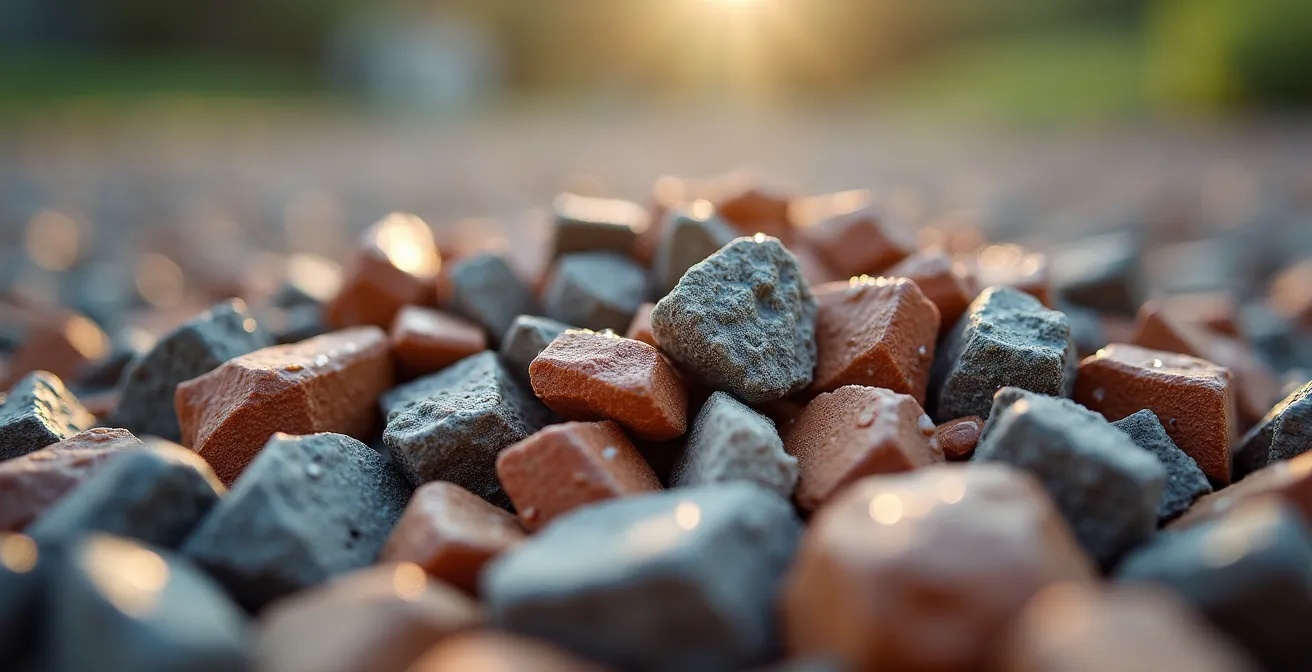
This close-up view of a high-quality recycled aggregate reveals its engineered composition. The varied texture of crushed concrete, brick, and stone provides the necessary angularity for excellent compaction and load-bearing capacity.
The success of this approach is demonstrated in real-world applications across the country. By prioritising proximity, you directly contribute to a more efficient, circular construction economy, turning local demolition waste into a high-value resource for your project.
Case Study: Pelham Bridge Recycled Concrete Project
In 2023, Minster Group successfully recycled crushed concrete from the Pelham Bridge demolition to improve the Billinghay and Walcott footpath in Lincolnshire. The material was repurposed locally, demonstrating significant savings on landfill fees and drastically reducing transport emissions by sourcing within a 20-mile radius. The project proved that reused aggregates deliver safe, long-lasting paved surfaces with performance comparable to new driveway installations, validating the local, circular model.
Which Sub-Base Prevents Flash Flooding on Your Driveway?
A driveway is not merely a parking surface; it is a major intervention in the local water cycle. Traditional impermeable driveways made with densely graded sub-bases like standard Type 1 MOT act as a seal, collecting rainwater and discharging it rapidly into public drainage systems. In a country like England, with increasing rainfall intensity, this contributes directly to the hydrological load on ageing sewer networks and increases the risk of localised flash flooding. The solution lies in designing the driveway as a permeable system, and the choice of sub-base is the critical factor.
To achieve permeability, the sub-base must be “open-graded,” meaning it contains a limited range of particle sizes with minimal “fines” (dust and small particles). This creates voids within the aggregate layer, allowing water to pass through it and slowly infiltrate the ground below. This approach is a core principle of Sustainable Drainage Systems (SuDS), a UK-mandated framework for managing surface water runoff. Recycled aggregates are perfectly suited for creating these permeable layers. Products like Recycled Type 3 or single-sized crushed concrete (e.g., 20/40mm) are specifically designed for this purpose.
The following table, based on UK standards, outlines the different aggregate types and their suitability for permeable applications. It highlights how choosing the correct sub-base not only manages water responsibly but can also have significant planning advantages.
| Size (mm) | Type | Permeability | BS EN Standard | Planning Permission Required (>5m²) |
|---|---|---|---|---|
| 4/20 | Recycled Type 3 | High (Open-graded) | BS EN 13242 | No – SuDS compliant |
| 20/40 | Crushed Concrete | Very High | BS EN 13242 | No – SuDS compliant |
| 0/32 | Type 1 MOT | Low (Dense-graded) | BS EN 13242 | Yes – Non-permeable |
This technical choice has direct legal and financial implications. As the Enviro Skip Hire Technical Team points out in their guide:
Using a specific permeable sub-base like Recycled Type 3 or a single-sized aggregate like 20mm recycled pipe bedding for a driveway over 5m² can mean avoiding the need for planning permission
– Enviro Skip Hire Technical Team, Recycled Aggregates for Driveways Guide
The Driveway Mistake: How to Spot Contaminated Soil in Cheap Aggregate?
While certified recycled aggregate offers performance on par with virgin materials, the primary risk in using it stems from sourcing uncertified, low-quality material. The most significant “driveway mistake” is opting for a cheap “crusher run” or unverified aggregate that may contain harmful contaminants. These not only compromise the structural integrity of the sub-base but can also introduce pollutants into your property’s soil and groundwater. From an engineering standpoint, ensuring material purity is as important as ensuring correct grading and compaction.
Contamination arises from poor sorting at the demolition or waste processing stage. Materials like soil, plasterboard (gypsum), wood, plastics, or even hazardous materials like asbestos from pre-2000s buildings can be mixed in. Gypsum, for instance, can react with other elements in the aggregate to cause swelling (known as sulphate attack), leading to heave and failure of the overlying surface. Excessive fines, typically from soil contamination, will clog the voids in the sub-base, destroying its permeability and turning a supposedly SuDS-compliant driveway into an impermeable slab.
Vigilant inspection upon delivery is a non-negotiable quality control step. An engineer or knowledgeable homeowner can spot the tell-tale signs of poor quality. Trusting a supplier’s certification is essential, but verifying the delivered product is prudent. The following points provide a simple visual inspection guide:
- Excessive Fines: The material appears dusty or has a high proportion of soil-like particles, indicating it hasn’t been properly screened.
- White, Powdery Chunks: This is a major red flag for plasterboard (gypsum) contamination.
- Organic or Man-made Debris: Visible fragments of wood, plastic, or rubbish are a clear sign of inadequately processed ‘crusher run’ waste.
- Fibrous Materials: Any soft, fibrous clumps should be treated with extreme caution as they could indicate potential asbestos contamination from older demolition sites.
- Inconsistent Colour and Size: A properly processed aggregate should be relatively uniform. A wide mix of materials suggests poor sorting and an unreliable product.
How to Use Recycled Glass Sand for a Unique Eco-Friendly Render?
The principle of using recycled materials extends far beyond foundational aggregates. The same circular economy logic applies to building finishes, offering innovative aesthetic and performance benefits. One of the most compelling examples is the use of recycled glass sand as a partial or full replacement for virgin sand in lime and cement-based renders. This application not only diverts glass from landfill but also creates a unique, high-performance building material.
Recycled glass, when crushed and graded to a specific sand-like consistency, acts as an excellent aggregate for renders and mortars. It is chemically inert, has zero water absorption, and provides excellent strength. When used in an external lime render, the fine glass particles catch the light, creating a subtle, shimmering finish that cannot be replicated with traditional sand. This makes it a favoured choice for heritage projects or contemporary designs seeking a distinct textural quality. The craftsperson’s skill in application is key to leveraging the material’s unique properties, as seen in traditional plastering techniques adapted for this modern, sustainable material.

The long-term viability of incorporating diverse recycled components into building materials is well-established in the UK. For decades, manufacturers have been innovating with waste streams to create products that meet and exceed modern performance standards while reducing environmental impact.
Case Study: Lignacite’s Heritage-Compatible Recycled Blocks
Lignacite, a UK block manufacturer, has been using recycled aggregates in its products since 1947. Their innovations include incorporating graded wood particles from timber off-cuts for carbon capture within the blocks themselves. Furthermore, their medium-density blocks utilise pulverised fuel ash (PFA), recovered from power stations, as a lightweight, inert aggregate. These blocks achieve excellent compressive strength, fire ratings, and sound insulation, demonstrating the long-term success of using recycled materials in high-performance, heritage-compatible applications across the UK.
Why “Net Zero” Operations Don’t Make Your Renovation Carbon Neutral?
In the drive for sustainability, terms like “Net Zero” are often used by suppliers as a mark of environmental responsibility. However, from an industrial and carbon accounting perspective, it is crucial to understand the distinction between operational emissions and embodied emissions. A supplier might achieve “Net Zero Operations” by powering their offices and processing plant with solar panels. This is a commendable step, but it does not make the final product—the aggregate delivered to your site—carbon neutral.
The critical, and often ignored, factor is Embodied Carbon. This refers to all the CO₂ emissions associated with the entire lifecycle of a material, from extraction and processing to transportation and installation. For aggregates, the most significant sources of embodied carbon are the diesel-powered crushers, screeners, and, most importantly, the heavy goods vehicles used for delivery. A supplier’s “net zero” office does not erase the carbon emitted by the truck hauling 20 tonnes of material from their yard to your home.
This is a fundamental concept in whole-life carbon assessment. As the London Energy Transformation Initiative (LETI), a leading UK body in this field, clarifies, the distinction is non-negotiable for accurate carbon accounting.
A supplier might use solar panels for ‘Net Zero Operations’, but the diesel used in the crusher and delivery trucks represents significant ‘Embodied Carbon’ that isn’t erased
– LETI (London Energy Transformation Initiative), Embodied Carbon Primer
This is precisely why choosing recycled aggregate from a local supplier is so effective. It directly tackles the largest portion of the material’s embodied carbon—transport. While the UK has made significant strides in recycling construction waste, the battle against embodied carbon is won by making smart, local choices, not by relying on misleading marketing terms.
Manicured Lawn vs Wild Patch: Which Absorbs More Rainwater?
The conversation about managing your property’s hydrological load cannot be confined to hard surfaces alone. The soft landscaping—your garden—plays an equally vital role. A common misconception is that any lawn is a permeable surface. However, a highly manicured, frequently mown lawn on compacted soil can behave almost like an impermeable surface. The soil structure becomes dense, reducing its infiltration rate and causing water to run off into drains, adding to the problem your permeable driveway is trying to solve.
In contrast, a “wild patch” or an area of wildflower meadow with diverse, deep-rooted plants creates a far superior drainage system. The roots create channels deep into the soil, keeping it open and uncompacted. The taller vegetation and layer of natural detritus slow down rainfall, giving it more time to soak in. According to studies by the Royal Horticultural Society (RHS), these less-managed areas can absorb many times more water than a compacted lawn, directly reducing pressure on public drainage during a downpour. This turns a section of your garden into a “water credit,” helping to offset the “water debt” created by any remaining hard surfaces like paths or patios.
A more engineered version of this concept, fully endorsed as a SuDS feature in the UK, is a rain garden. This is a shallow, planted depression strategically placed to receive runoff from roofs or driveways. It is designed to hold water for a short period (24-48 hours) while it slowly infiltrates the ground, watering the plants and recharging the local water table. It effectively turns a drainage problem into a biodiversity-rich garden feature, preventing water from ever reaching the street and the overloaded public system.
Key Takeaways
- Recycled aggregate is not a compromise; it meets the same rigorous BS EN standards for strength and performance as virgin material.
- The biggest environmental win comes from tackling embodied carbon, primarily by sourcing aggregates locally (within 20 miles) to minimise transport emissions.
- Using a permeable, open-graded recycled sub-base (like Type 3) is a SuDS-compliant solution that actively prevents local flooding and can remove the need for planning permission in the UK.
Is Achieving “True” Net Zero Carbon Possible for an Existing UK Home?
The goal of a “True” Net Zero Carbon home—one that balances all carbon emissions, including embodied carbon, over its lifetime—is an immense challenge for the UK’s existing housing stock. It requires a holistic assessment that goes far beyond operational energy like heating and electricity. It demands a meticulous accounting of the embodied carbon in every material used during renovation and maintenance, from the roof tiles down to the sub-base.
As we have established, the tonnes of aggregate required for foundations, driveways, and patios represent one of the largest single sources of embodied carbon in a typical renovation project. Therefore, while achieving absolute Net Zero may be complex, making a significant and immediate dent in your project’s carbon footprint is not. The single most impactful decision a homeowner can make is to switch from high-carbon virgin aggregates to locally sourced, recycled alternatives. This move simultaneously slashes embodied carbon from transport, reduces the demand for destructive quarrying, and promotes a circular economy.
Furthermore, by integrating this material choice with intelligent system design—such as using permeable sub-bases to manage hydrological load—you address another critical aspect of environmental impact. This isn’t about finding a single ‘silver bullet’ solution. It’s about making a series of informed, industrial-grade decisions where they matter most. The foundation is the logical and most effective place to start. Choosing recycled aggregate is the non-negotiable first step on the path to a genuinely lower-impact home.
The next logical step is to apply this industrial thinking to your own project. Begin by assessing the material requirements for your planned renovation and start the process of sourcing a certified, local supplier of recycled aggregates.