The 15% Passivhaus premium isn’t an extra cost; it’s an investment to eliminate the costly “performance gap” that plagues typical UK new-builds, where designed efficiency rarely matches reality.
- You are purchasing a contractually guaranteed outcome of minimal energy bills, not just an optimistic prediction on an EPC certificate.
- The engineered air quality from a mandatory MVHR system with F7-grade filters actively reduces indoor pollutants and common health risks.
Recommendation: The most critical decision is timing. Engage a certified Passivhaus consultant at RIBA Stage 0/1, before any architectural plans are drawn, to integrate the principles from the very start.
For any aspiring self-builder in the UK, the spreadsheet is a place of both dreams and dread. You have a vision for your perfect home, but the budget is a constant, unforgiving reality. When the concept of Passivhaus emerges, it brings a stark choice: invest an additional 10-15% upfront for the gold standard of energy efficiency, or stick with standard UK Building Regulations and allocate that cash elsewhere? The temptation to save is immense. After all, a new build is a new build, right?
The common arguments for Passivhaus are well-known: drastically lower energy bills and a smaller carbon footprint. While true, these points barely scratch the surface and fail to address the core concern of the savvy self-builder: “What am I *really* buying with that extra £30,000 or £40,000?” The answer is far more profound than just cheaper heating. You’re buying certainty.
The hidden flaw in most standard UK new-builds is the performance gap—the chasm between how a home is designed to perform (its EPC rating) and how it actually performs once built. This article moves beyond the platitudes of “eco-friendly living”. We will deconstruct the 15% premium to reveal what it truly secures: a home engineered for quantifiable health, absolute thermal comfort, and a contractual guarantee of performance that makes the unpredictability of standard construction a thing of the past.
This guide breaks down the tangible returns on that initial investment. We’ll explore the science behind the health benefits, the strategies for ensuring first-time success, and the critical design choices that separate a comfortable haven from a summer greenhouse. By understanding the ‘why’ behind the ‘what’, you can make an informed decision based on value, not just cost.
Summary: The Real Value of the Passivhaus Premium for UK Self-Builders
- Why Do Passivhaus Residents Report Fewer Asthma Attacks in Winter?
- How to Pass the Air Tightness Test on Your First Attempt?
- Passivhaus vs Building Regs: Which Guarantee Truly Low Bills?
- The Design Flaw That Turns Glass Houses into Greenhouses in August
- When Should You Involve an Energy Consultant in Your Self-Build Timeline?
- Do Net Zero Certified Homes Command a Premium in the UK Market?
- Do Smart Plugs Use More Energy Than They Save in Standby Mode?
- Is Achieving “True” Net Zero Carbon Possible for an Existing UK Home?
Why Do Passivhaus Residents Report Fewer Asthma Attacks in Winter?
The single greatest health benefit of a Passivhaus is not its warmth, but the quality of the air you breathe. This is a direct result of an engineered system: the Mechanical Ventilation with Heat Recovery (MVHR). Unlike a standard build that relies on draughts and trickle vents for “fresh” air, a Passivhaus is an airtight envelope where the air supply is precisely controlled. The MVHR system acts as the building’s lungs, continuously extracting stale, moist air and supplying fresh, filtered air.
The key lies in the level of filtration. A study confirms that the F7 filters required for Passivhaus certification adequately filter PM2.5 particles—the tiny, harmful pollutants from traffic and industry that can penetrate deep into the lungs and trigger respiratory issues like asthma. Standard G4 filters, common in lesser systems, simply cannot capture these particles effectively. This means a Passivhaus doesn’t just keep you warm; it actively removes invisible airborne threats, creating a healthier indoor environment, particularly for children and those with respiratory sensitivities.
However, the technology alone is not a silver bullet. It’s a system that must be correctly designed, installed, and maintained. A case study of Passivhaus social housing in Northern Ireland found that without proper resident education on how to live with and maintain the MVHR, indoor air quality could still be compromised. This highlights the Passivhaus philosophy: it’s not just about specifying superior components, but about ensuring the entire system performs as designed, which includes the human element.
How to Pass the Air Tightness Test on Your First Attempt?
The airtightness test, or blower door test, is the moment of truth for a Passivhaus project. It measures the building’s integrity by depressurising the house and measuring how much air leaks in through gaps and cracks. While UK Building Regulations are lenient, with a target of 5-8 m³/hr/m², Passivhaus demands a punishingly strict 0.6 air changes per hour (ach). This isn’t just about energy efficiency; it’s the fundamental enabler of the entire system’s performance, from thermal comfort to air quality.
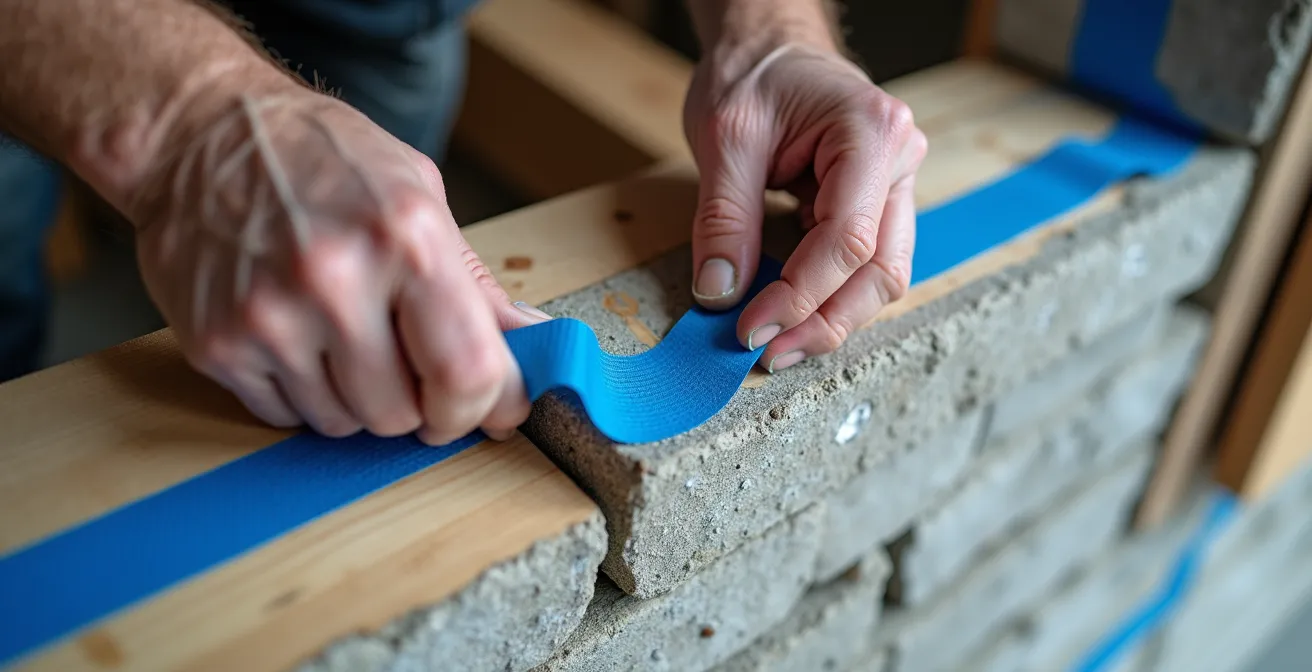
Passing this test first time requires a shift in mindset from typical construction. It’s a game of meticulous detail, where the “it’ll be covered by plasterboard” attitude has no place. The airtight layer—a continuous membrane or plastered surface—must be planned from the outset and protected fanatically throughout the build. Tradespeople must understand that every penetration for a pipe or wire is a potential point of failure.
Based on common UK self-build experiences, several key areas consistently cause failures:
- Junctions between different construction types, especially where blockwork meets timber frame elements.
- Unsealed penetrations through block-and-beam floors, often forgotten after services are installed.
- Complex traditional English brick detailing which requires specialist tapes and membranes to seal correctly.
- A lack of coordination between trades, leading to the airtight layer being damaged.
The most effective strategy is appointing an ‘Airtightness Champion’ on site, someone responsible for protecting this critical layer. Conducting intermediate tests during construction is also vital, allowing for easy corrections before finishes are applied and leaks become impossible to find.
Passivhaus vs Building Regs: Which Guarantee Truly Low Bills?
Here lies the core of the Passivhaus value proposition. Many self-builders have been disappointed to find that their brand-new, A-rated home still has surprisingly high energy bills. This is the “performance gap” in action. Shocking analysis reveals that standard new-builds in England often consume 50-100% more energy than their design EPC rating suggests. The EPC is a theoretical calculation, not a guarantee of real-world performance.
Passivhaus, on the other hand, is designed to eliminate this gap. It’s a performance-based standard, not a prescriptive one. The certification isn’t awarded based on a checklist of materials, but on achieving proven, measurable results in the finished building. The entire process is modelled from day one using the Passive House Planning Package (PHPP), a sophisticated piece of software that accurately predicts energy use. The final certified building’s performance is expected to be within 5% of this model.
This table illustrates the stark difference between the loose targets of UK regulations and the rigorous, contractually guaranteed standard of Passivhaus, as detailed in this performance comparison from the Passivhaus Trust.
| Criteria | UK Building Regs Part L | Passivhaus Standard | Real-world Performance |
|---|---|---|---|
| Air Permeability Target | 5-8 m³/hr/m² @ 50Pa | 0.6 ach @ 50Pa | 15x more stringent |
| Space Heating Demand | 75 kWh/m²/yr typical | ≤15 kWh/m²/yr | 80% reduction |
| Performance Gap | 50-100% higher than EPC | <5% variance from PHPP | Contractual guarantee |
| Annual Energy Bills (150m² home) | £1,434 average | £600-800 | £800+ savings/year |
That 15% upfront investment is effectively an insurance policy against the performance gap. You are paying for the engineering, quality control, and testing required to ensure your home performs exactly as predicted. It transforms your energy bill from a variable lottery into a predictable, minimal expense.
The Design Flaw That Turns Glass Houses into Greenhouses in August
A common misconception is that Passivhaus, with its focus on insulation and airtightness, is only suitable for cold climates. The opposite is true: the same principles of building physics that keep a house warm in winter are essential for keeping it cool in summer. A poorly designed, highly glazed modern home can quickly become an unbearable “greenhouse” during a UK heatwave. Passivhaus design directly tackles this risk from the outset.
As the Passivhaus Trust authoritatively states:
As UK summers grow hotter, passive design strategies are increasingly being tested. Recent summer heatwaves and a heating climate have made us more aware than ever that the risk of overheating demands attention.
– Passivhaus Trust, Passivhaus Trust Learning Hub 2024
The key is smart design, not just adding air conditioning. The PHPP software models the building’s performance on an hour-by-hour basis throughout the year. It allows the designer to test strategies to mitigate solar gain, such as:
- Optimised Glazing: Sizing and positioning windows to maximise winter sun while minimising high-angle summer sun.
- External Shading: Incorporating features like overhangs, brise-soleils, or external blinds, which are far more effective than internal blinds at stopping heat before it enters the building.
- Cross Ventilation: Designing window placements to allow for effective and secure night-time purging of built-up heat.
This proactive approach to summer comfort is so robust that PHPP modelling has been deemed a valid method for demonstrating compliance with Part O of the Building Regulations in England, which specifically addresses overheating. This is another example of Passivhaus engineering providing a superior, more reliable solution to a growing problem.
When Should You Involve an Energy Consultant in Your Self-Build Timeline?
This is perhaps the most critical, and most frequently misunderstood, aspect of a successful Passivhaus build. You cannot simply design a house and then “make it Passivhaus” by adding more insulation. The Passivhaus standard is a design philosophy that must be integrated from the very first sketch. Involving a certified Passivhaus consultant or designer too late in the process is the most common and costly mistake a self-builder can make.
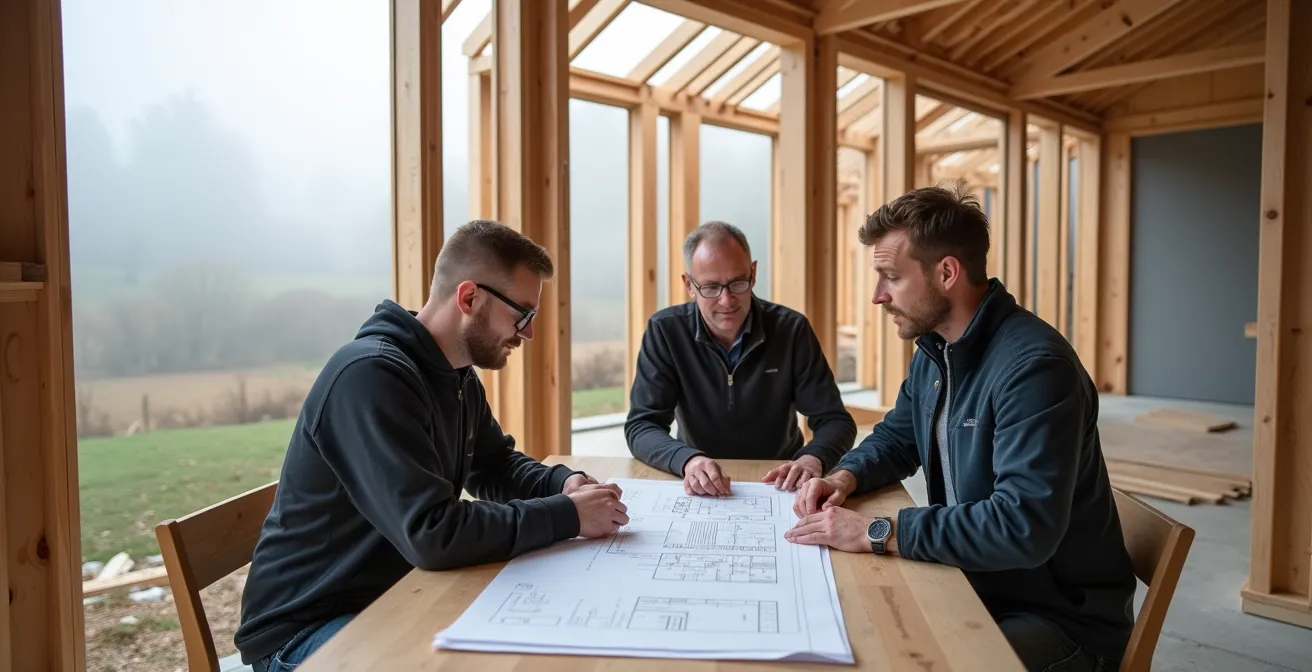
The ideal time to engage a consultant is at RIBA Stage 0 (Strategic Definition), before you have even appointed an architect. At this stage, the consultant can assess the site’s potential, advise on the building’s optimal form and orientation, and help set a realistic brief. Their input at this early stage has the maximum impact for the minimum cost. Trying to “fix” a design for Passivhaus at a later stage often leads to compromised aesthetics, awkward details, and spiralling costs.
The consultant’s role evolves throughout the project, perfectly aligning with the RIBA Plan of Work. This structured approach ensures the Passivhaus principles guide every decision.
Your Action Plan: Integrating Passivhaus into the RIBA Work Stages
- RIBA Stage 0-1 (Strategic Definition & Preparation): The consultant conducts an initial feasibility assessment, analysing the site for solar orientation and form factor potential before any lines are drawn.
- RIBA Stage 2 (Concept Design): The first PHPP model is created. This is a crucial step to test different massing, form factor, and orientation options to find the most efficient and cost-effective design direction.
- RIBA Stage 3 (Spatial Coordination): The PHPP model is refined with detailed window specifications, sizing, and optimised shading strategies to balance heat loss, solar gain, and daylighting.
- RIBA Stage 4 (Technical Design): All Passivhaus-certified components (windows, doors, MVHR unit) are specified. The consultant coordinates the detailed drawings for the airtightness and thermal-bridge-free layers.
- RIBA Stage 5-6 (Construction & Handover): The consultant provides on-site quality assurance, oversees airtightness testing, and prepares the final documentation for certification.
Do Net Zero Certified Homes Command a Premium in the UK Market?
While the health and comfort benefits are compelling, the financial case for the 15% upfront cost must also stand up to scrutiny. The evidence is increasingly clear: the market is waking up to the value of genuine energy efficiency, and Passivhaus-certified homes are commanding a significant premium. This isn’t just about lower running costs; it’s about future-proofing an asset.
Data consistently shows that the investment pays off at resale. For instance, recent analysis points to a 5-15% increase in market value for Passivhaus-certified homes compared to their standard-build equivalents. As energy prices remain volatile and awareness of build quality grows, this “green premium” is only expected to strengthen. An asset that is cheaper to run, more comfortable to live in, and healthier for its occupants is fundamentally more valuable.
This trend is driven by a tangible shift in homebuyer priorities. The EPC rating, once a footnote on a property listing, is becoming a key decision-making factor. According to research from NatWest, in 2021, only 29% of homebuyers saw an EPC rating as ‘very important’. By 2023, that figure had jumped to 40%. Buyers are becoming more educated about the real-world implications of a poor EPC rating, and they are willing to pay more for the certainty of a high-performance home.
Building a Passivhaus is therefore not just an investment in your own quality of life; it’s a savvy financial decision that creates a more desirable, resilient, and valuable asset in a rapidly evolving property market.
Do Smart Plugs Use More Energy Than They Save in Standby Mode?
In a typical UK home with high heating costs, the tiny amount of energy consumed by smart devices on standby—known as “vampire load”—is a rounding error. However, in an ultra-low-energy Passivhaus, the entire energy landscape is turned on its head. When your heating bill is almost negligible, these small, constant loads, known as unregulated energy, become a significant portion of your total energy consumption.
This is a perfect illustration of the precision of the Passivhaus approach. The standard meticulously calculates “regulated” energy (heating, hot water, ventilation), but achieving true low running costs means also managing the unregulated loads (appliances, lighting, electronics). For example, in a Passivhaus with heating bills of just £150/year, a 10W constant smart-home standby load costs ~£30/year at current UK electricity prices—suddenly accounting for a substantial 20% of the heating cost itself.
This table breaks down the energy profile of a typical Passivhaus, showing how the focus shifts from heating to appliances and other plug-in loads.
| Energy Type | What’s Included | Typical Annual Cost (Passivhaus) | % of Total Bill |
|---|---|---|---|
| Regulated Energy | Heating, hot water, ventilation | £150-200 | 30-40% |
| Unregulated Energy | Appliances, lighting, electronics | £300-400 | 60-70% |
| Smart Home Standby (10W) | Always-on smart devices | £30 | 5-10% |
So, do smart plugs use more energy than they save? In a Passivhaus, it’s a legitimate question. If a smart plug consuming 1W of standby power is used to turn off a TV that only drew 0.5W on standby anyway, you have a net energy loss. This level of granular detail is the reality of living in a truly high-performance home and demonstrates a philosophy that considers every single watt of energy.
Key Takeaways
- The Passivhaus premium buys a performance guarantee that eliminates the “performance gap” common in typical UK new-builds, ensuring your energy bills are as low as predicted.
- The mandatory MVHR system with F7-grade filters provides quantifiable health benefits by continuously removing harmful airborne pollutants like PM2.5 from your indoor air.
- To succeed, you must engage a certified Passivhaus consultant at the very start of your project (RIBA Stage 0/1), as the principles must be integrated into the core design, not added on later.
Is Achieving “True” Net Zero Carbon Possible for an Existing UK Home?
While much of the focus is on new builds, the principles of Passivhaus offer a robust and proven pathway for transforming the UK’s existing housing stock. The challenge is immense, but achieving near-net-zero performance in a retrofit is possible through a rigorous, fabric-first approach known as the EnerPHit standard.
Case Study: The EnerPHit Standard for UK Retrofits
EnerPHit is the official Passivhaus standard for refurbishment projects. Unlike the common UK approach of simply installing solar panels or a heat pump on a poorly insulated building (often called ‘greenwashing’), EnerPHit prioritises reducing energy demand first. It focuses on applying the core Passivhaus principles—high levels of insulation, thermal-bridge-free detailing, an airtight envelope, and an MVHR system—to the complexities of an existing structure. It’s a holistic, scientifically-modelled approach that guarantees a drastic reduction in energy consumption before any renewable technology is even considered.
Achieving “true” net zero carbon is a complex question involving embodied carbon and operational carbon, but EnerPHit provides the most effective route to minimising operational energy demand to a point where it can realistically be met by on-site renewables. It’s the only way to ensure an existing home is genuinely low-energy, comfortable, and healthy for the long term.
This fabric-first philosophy even challenges long-held industry conventions. For example, it was often thought that MVHR systems were only effective in new, highly airtight homes. However, as the field has advanced, this is being questioned. The Passivhaus Trust’s technical panel suggests that MVHR is, in fact, desirable in nearly all domestic situations, new-build or retrofit, for the significant air quality benefits it provides. This is a testament to a philosophy that is constantly evolving based on evidence and performance data.
To ensure your self-build delivers on its promises of comfort, health, and low energy, the crucial first step is to model its performance accurately. A certified Passivhaus designer can help you turn your architectural vision into a guaranteed reality, making that initial investment the smartest one you’ll make for your new home.