Your smart thermostat isn’t truly “smart” if you’re just using it as a fancy remote control; its real power lies in predictive automation.
- True intelligence comes from integrating universal protocols like Matter, allowing all your devices to form a cohesive ecosystem.
- Predictive automation uses data inputs like your phone’s location (geofencing) and solar forecasts to act preemptively, not just reactively.
Recommendation: Shift your mindset from making manual adjustments to configuring an autonomous energy ecosystem that manages and optimises your home’s consumption for you.
You’ve kitted out your home with the latest smart gadgets. You’ve got the smart thermostat, the voice assistant, and a collection of smart plugs. Yet, you find yourself constantly tweaking schedules, manually overriding settings, and wondering if this “smart” home is living up to its promise. The common wisdom is to use these devices for remote control or to set basic schedules, but that’s barely scratching the surface. It’s like owning a performance car and only ever driving it in first gear.
The real revolution isn’t about controlling your heating from the sofa; it’s about making your heating control you—or rather, your energy needs. The leap from a reactive, remote-controlled house to a proactive, predictive one is where genuine energy intelligence is born. But what if the key wasn’t just in the thermostat itself, but in creating a fully integrated, autonomous energy ecosystem? A system where your home doesn’t just learn your patterns, but anticipates future conditions, optimises for cost and carbon, and makes decisions without your intervention.
This guide moves beyond the basics. We’ll deconstruct the layers of a truly intelligent system, starting with the universal language that lets your devices talk. We’ll then explore how your home can learn where you are and when free energy is available, how to build this system securely and cost-effectively, and ultimately, how to turn your optimised home into an asset that can even earn you money. It’s time to unlock the real “intelligence” in your smart home.
To navigate this journey from simple control to true automation, this article breaks down the essential components and strategies. The following sections will guide you through each layer of building your predictive energy ecosystem.
Summary: How to Build a Predictive AI Heating System
- Will the Matter Protocol Finally Make All Your Smart Devices Talk?
- How to Configure Geofencing So Your Heating Turns Off When You Leave?
- Cloud vs Local: Which Smart Home System Works When the Internet Is Down?
- Smart Plugs or Smart Appliances: Which Is the Cheaper Route to Automation?
- How to Automate Your Washing Machine to Start When the Sun Shines?
- Do Smart Plugs Use More Energy Than They Save in Standby Mode?
- How to Secure Your IoT Cameras Against Common Default Password Hacks?
- How to Earn Money by Turning Off Your Appliances During Demand Service Events?
Will the Matter Protocol Finally Make All Your Smart Devices Talk?
The biggest bottleneck for a truly predictive home has always been the walled-garden approach of manufacturers. Your Nest thermostat didn’t want to talk to your Hive sensors, and your Apple HomeKit setup ignored your Amazon Alexa routines. This created a fragmented system, not an ecosystem. Matter is the open-source connectivity standard designed to demolish these walls. Backed by major players like Apple, Google, and Amazon, it acts as a universal translator, allowing devices to communicate directly with each other over your local network, regardless of the brand.
For your heating system, this is a game-changer. It means a third-party window sensor can tell your Tado thermostat to turn off the radiator in a specific room when the window is opened, without needing a complex cloud-based integration. The support for the protocol is growing exponentially; the Connectivity Standards Alliance confirms that 200+ manufacturers now support Matter, making it a safe bet for future-proofing your setup. For UK homeowners, this means devices like the Tado X and the 4th Generation Nest Thermostat are already fully Matter-compliant, eliminating vendor lock-in for your long-term smart home investment.
The protocol’s evolution is specifically targeting energy management. While early versions laid the groundwork for thermostats, upcoming releases are set to integrate heat pumps, solar systems, and home batteries. This creates the foundational layer for a holistic energy ecosystem.
The table below from Wikipedia illustrates the rapid, energy-focused evolution of the Matter standard.
| Version | Release Date | Heating-Related Features |
|---|---|---|
| Matter 1.0 | October 2022 | Thermostats and HVAC controllers |
| Matter 1.3 | May 2024 | Improved energy management features |
| Matter 1.4 | November 2024 | Heat pumps, water heaters, batteries, solar systems |
How to Configure Geofencing So Your Heating Turns Off When You Leave?
Geofencing is one of the first and most powerful layers of predictive intelligence you can implement. Instead of relying on a fixed schedule that can’t account for spontaneous trips out or coming home early, geofencing uses your smartphone’s location as a trigger. It creates a virtual boundary—a “fence”—around your home. When your phone crosses this boundary, it automatically signals your thermostat to switch to an “away” mode, turning down the heating. When you re-enter the zone, it switches back on, ensuring the house is warm by the time you walk through the door.
This is true automation: the system acts based on your real-world behaviour, not a pre-programmed assumption. The key to an effective setup is precision. Setting the radius too small means the heating won’t have time to warm up before you arrive; too large, and you’ll be wasting energy heating an empty house for longer than necessary. For most UK urban and suburban areas, a radius of 150-500 meters provides a good balance. This simple automation eliminates the mental load of remembering to turn the heating down and directly tackles one of the biggest sources of energy waste: heating an empty home.
Your 5-Point Geofencing Setup Plan: From Configuration to Confirmation
- Device Compatibility: Check that your smart thermostat’s app (e.g., Hive, Tado, Nest) officially supports geofencing with your specific smartphone model.
- Permissions & Services: Enable location services for the thermostat app in your phone’s system settings and ensure the geofencing feature is activated within the app itself.
- Home Location Precision: Pin your home’s location precisely on the map interface within the app. An inaccurate pin is a common source of failure.
- Radius Configuration: Configure your geofencing radius. Start with a default like 200 metres and adjust based on your local travel time to find the sweet spot between comfort and savings.
- System Test: Actively test the system. Leave the geofenced area for at least 15 minutes and verify through the app that the heating switched to ‘away’ or ‘eco’ mode, and then confirm it turns back on as you approach home.
Cloud vs Local: Which Smart Home System Works When the Internet Is Down?
A common frustration for early smart home adopters is the dreaded “server is unavailable” message. Many smart devices are entirely cloud-dependent, meaning every command—even turning on a light from a switch in the same room—is sent to a server on the other side of the world and back again. When your broadband goes down, your “smart” home becomes very dumb, very quickly. This is a critical vulnerability, especially for an essential system like heating.
This is where the architectural choice between cloud-based and local control becomes paramount. Local control systems process commands directly within your home network. This is the philosophy behind protocols like Matter, which are specifically engineered to operate locally for core functions. A Matter-certified thermostat will continue to execute its automations, communicate with local sensors, and respond to your commands via your home Wi-Fi, even if your internet connection is completely dead. This local-first approach ensures a level of resilience that cloud-only systems simply cannot match.
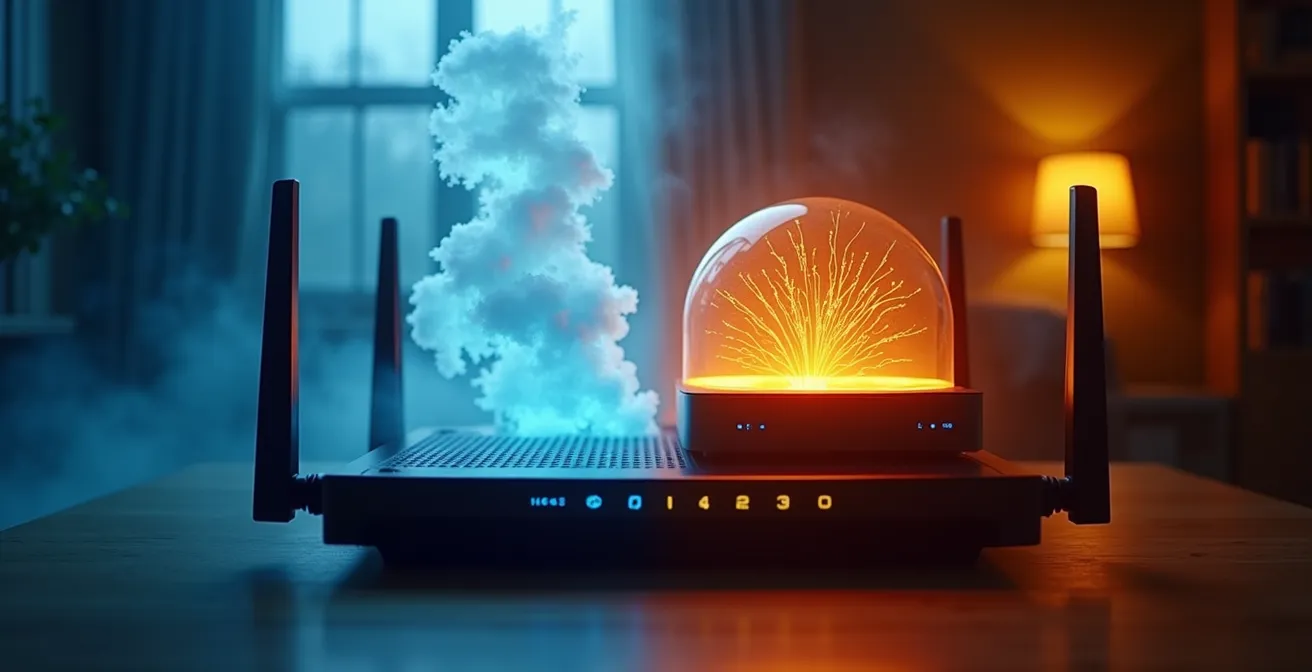
As the image illustrates, cloud systems offer convenience for remote access, but local control provides the robust, fail-safe foundation essential for a truly autonomous home. For a system predicting and managing your energy, this reliability isn’t a luxury; it’s a core requirement. You need to know your heating automations will run, your security routines will trigger, and your home will function, regardless of your internet provider’s uptime. This is a fundamental principle of building a resilient and truly intelligent home ecosystem.
Smart Plugs or Smart Appliances: Which Is the Cheaper Route to Automation?
Once you have a central “brain” for your heating, the next step is to extend that intelligence to other devices. The big question is whether to invest in expensive, natively smart appliances or to use affordable smart plugs to automate your existing “dumb” ones. From a cost-optimisation perspective, smart plugs are almost always the superior entry point for granular control. A new smart washing machine might cost £500+, whereas a smart plug with energy monitoring can be had for £15-£25.
This approach allows you to experiment and build out your ecosystem incrementally. You can make your old electric heater “smart” by plugging it into a smart plug and creating an automation rule: “If the living room temperature drops below 19°C and it’s between 6 PM and 9 PM, turn on the heater.” This gives you room-specific heating control without the cost of a full smart TRV system. The real power comes from plugs with energy monitoring, which report real-time and historical power consumption back to your central hub. This data is the lifeblood of a predictive system, allowing it to learn which devices are energy hogs and make smarter decisions about when to run them.
While a fully integrated smart boiler or heat pump is the ultimate goal for efficiency, smart plugs and smart thermostatic radiator valves (TRVs) offer the most flexible and cost-effective path to building a granular, room-by-room, and appliance-by-appliance automated system. The following table gives a rough cost comparison for different smart heating solutions in the UK.
| Solution | Initial Cost | Installation | Flexibility |
|---|---|---|---|
| Smart Thermostat (Hive) | £195-470 | Professional recommended | Works with existing boiler |
| Smart TRVs | £40-80 per radiator | DIY possible | Room-by-room control |
| New Smart Boiler | £2,500-4,000 | Professional required | Locked to manufacturer |
How to Automate Your Washing Machine to Start When the Sun Shines?
This is where your smart home graduates from simple convenience to true energy arbitrage. Running high-consumption appliances like washing machines, dishwashers, and tumble dryers during peak hours is expensive and carbon-intensive. If you have solar panels, the most logical time to run them is during the day when you are generating free, clean electricity. However, most people are at work. An AI-powered energy management system solves this dilemma by acting as your home’s energy broker.
Here’s how it works in practice: you load the washing machine in the morning but don’t start it. You use your smart home app to schedule it to run “sometime today.” The system then takes over. It monitors the weather forecast and the real-time output from your solar panels. Once it detects a sustained period of high solar generation, it sends a signal to the smart plug connected to your washing machine to begin the cycle. This ensures you’re using your own generated power (maximising self-consumption) instead of exporting it to the grid for a pittance and then buying expensive electricity back in the evening.
Case Study: AI-Powered Solar Integration for UK Homes
Modern AI energy systems go even further. If sunny conditions are predicted for the afternoon, the system may preheat the home’s water tank using free solar power, reducing the need for the boiler to fire up during the peak-price evening period. The AI constantly balances energy usage with generation, activating high-load appliances only when sufficient clean energy is available from solar panels. For homes with a solar battery, the AI can even make a predictive choice: use the solar energy now for the washing machine, or store it in the battery to power the home through the evening ‘peak’. This level of coordination turns your home into a dynamic, self-optimising energy grid.
This isn’t a futuristic concept; it’s a practical application of predictive AI available today. By linking appliance automation to energy generation data, you shift consumption from the most expensive to the cheapest (or free) times of day, without any manual intervention. This is the core of predictive energy optimisation.
Do Smart Plugs Use More Energy Than They Save in Standby Mode?
It’s a valid question for any optimisation-minded geek: does the parasitic power draw of the smart home devices themselves negate the savings they generate? It’s true that smart plugs and thermostats consume a small amount of energy to maintain their Wi-Fi connection and internal electronics, typically around 0.5 to 1.5 watts in standby. Over a year, a single plug might use 4-13 kWh of electricity. With UK electricity rates, this translates to a few pounds per year. The crucial point, however, is the scale of the savings they unlock.
These devices aren’t designed to save energy by their mere presence; they save energy by controlling the much larger, more power-hungry appliances they’re connected to. A television left on standby can consume 5-10 watts. An old games console or set-top box can be even higher. A smart plug can completely cut power to these “vampire” loads. The savings from eliminating the standby consumption of just one or two such devices will typically outweigh the plug’s own running cost. When you apply this to a high-draw appliance like an electric heater, the savings are magnified enormously. According to the Energy Saving Trust, a well-configured smart thermostat alone can save a typical UK household up to £150 per year on energy bills.
The standby usage of the control device is a rounding error compared to the savings from intelligent automation. The table below provides context on typical UK household energy usage, showing the scale of the bills that smart automation aims to reduce.
| Household Type | Annual Gas Usage | Cost (2025 rates) |
|---|---|---|
| Low Usage | 7,500 kWh/yr | £524 |
| Average | 11,500 kWh/yr | £804 |
| High Usage | 17,000 kWh/yr | ~£1,188 |
Key Takeaways
- A true smart home is an autonomous ecosystem, not a collection of remote-controlled gadgets.
- Predictive intelligence relies on integrating multiple data sources: location, weather, solar generation, and grid demand.
- Local control via protocols like Matter provides the resilience and speed that cloud-dependent systems lack.
How to Secure Your IoT Cameras Against Common Default Password Hacks?
Building an intelligent, interconnected home means you are essentially building a private network of sensors and controllers. Protecting this network is not an afterthought; it’s a foundational requirement. Internet of Things (IoT) devices, particularly cameras and even thermostats, are prime targets for hackers. The most common attack vector is shockingly simple: default usernames and passwords. Many users never change the “admin/admin” credentials the device shipped with, leaving a wide-open door onto their home network.
Securing your digital fortress requires a multi-layered approach. The first, non-negotiable step is to change every default password on every new device you install. But true security goes deeper. A best practice is to create a separate, isolated network for your IoT devices. Most modern UK routers from providers like BT or Sky allow you to create a “guest” network or a VLAN (Virtual Local Area Network). By placing all your smart plugs, cameras, and thermostats on this segregated network, you ensure that even if one device is compromised, the attacker cannot access your primary network where your laptops, phones, and sensitive personal data reside.
The UK’s National Cyber Security Centre (NCSC) provides clear guidance on this, emphasising the principle of network segregation as a core tenet of smart home security. As they state, this containment strategy is crucial.
IoT devices like cameras and thermostats should be segregated from your main network to prevent a breach in one device from compromising your entire home network
– UK National Cyber Security Centre, Smart Home Security Guidelines 2024
Enabling two-factor authentication (2FA) wherever possible adds another critical layer of defence, ensuring that even if a password is stolen, access is not granted without a second verification step from your phone. Regular firmware updates are also vital, as they often contain patches for newly discovered security vulnerabilities.
How to Earn Money by Turning Off Your Appliances During Demand Service Events?
This is the final, most advanced stage of home energy optimisation: turning your home from a passive energy consumer into an active, profitable grid asset. National Grid and energy suppliers like Octopus, British Gas, and OVO are increasingly running Demand Side Response (DSR) schemes. The concept is simple: during periods of extremely high national demand (e.g., a cold winter evening), the grid is under immense strain. To avoid firing up expensive and polluting power plants, suppliers will pay customers to reduce their consumption for a short period, typically an hour or two.
This is where your autonomous ecosystem shines. When a DSR event is announced, your energy system receives a notification. It can then automatically take action: turning down your thermostat by a degree or two, delaying the start of the dishwasher cycle, and temporarily pausing the charging of your electric vehicle. You experience a negligible, often unnoticeable, change in comfort, but by collectively reducing demand, you help stabilize the grid and get paid for the energy you *didn’t* use. It’s a win-win-win: you earn money, the supplier avoids costly peak generation, and the overall carbon intensity of the grid is lowered. Some studies show AI-powered systems could cut energy use by up to 30%, and participating in DSR schemes allows you to monetise a portion of that reduction.
Participating is straightforward. You typically register for a scheme like ‘Saving Sessions’ through your supplier’s app. Your smart meter reports your reduced consumption during the event, and you receive a credit on your bill or a direct payout. With an AI-driven system, this entire process can be automated. You set your comfort parameters—for example, “never drop the temperature by more than 2°C during an event”—and the system handles the rest, turning your optimised home into an active, income-generating participant in the national energy market.
Now that you have the complete framework for building a predictive system, the next logical step is to perform an audit of your current devices and identify the first, most impactful automation you can implement to begin your journey towards a truly intelligent home.