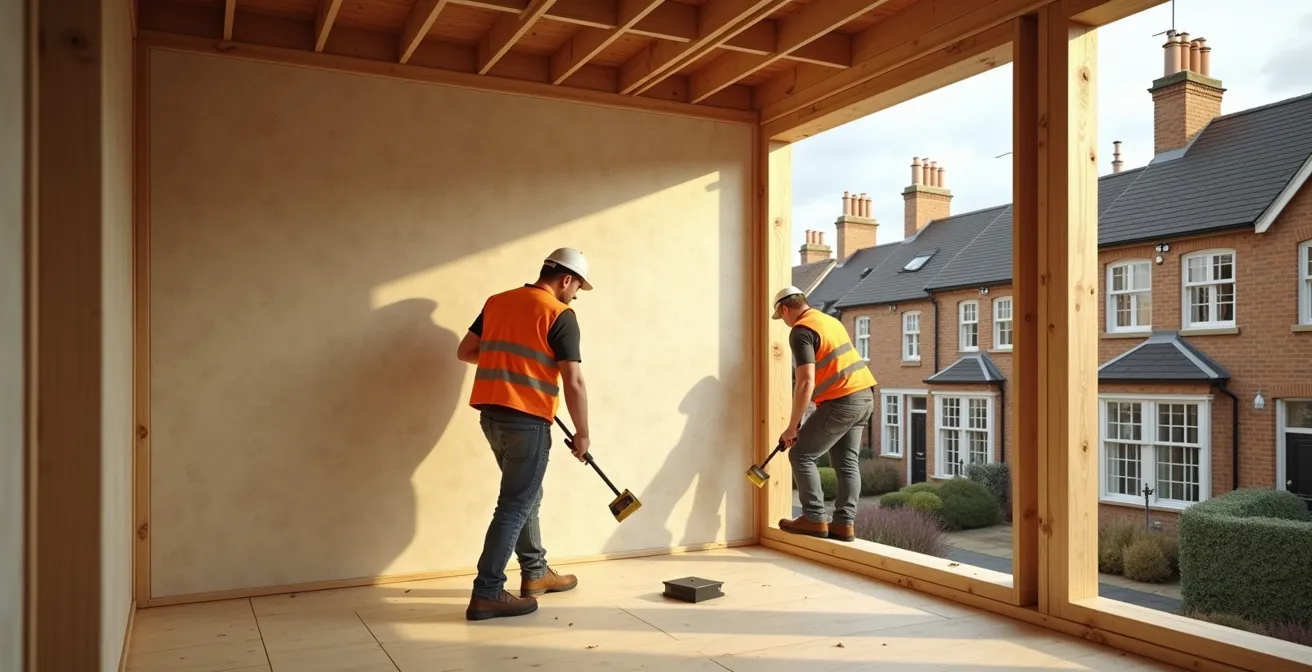
Mycelium insulation is no longer a lab-grown curiosity; it’s a commercially viable, carbon-negative material ready to challenge conventional insulators in the UK market.
- It actively sequesters carbon, unlike the high embodied carbon of brick or PIR foam.
- Its performance in moisture management and vapour permeability makes it superior for retrofitting the UK’s older, solid-wall building stock.
Recommendation: The key to adoption is not waiting for universal approval, but proactively building a robust technical file (BBA status, EPDs, warranties) to satisfy lenders and building control now.
For architects and self-builders in the UK, the search for the next generation of construction materials is a constant balance between pioneering sustainability and pragmatic reality. We are moving beyond an era of simply minimising harm to one of active environmental restoration, where our buildings can function as carbon sinks. Materials grown in a lab, not mined from the earth, are at the forefront of this revolution. Mycelium, the root network of fungi, is the leading candidate, promising to be a high-performance, carbon-negative insulation.
The common discourse often stops at its futuristic appeal and biodegradable properties. But for a project to get off the ground, these are not enough. The real questions are practical: can it meet UK Building Regulations? Can it be handled efficiently on a muddy building site? And crucially, will a mortgage lender even consider it? The conversation must evolve from “what is it?” to “is it viable?”.
This article moves past the hype. We will not just list the benefits of mycelium; we will dissect its readiness for the UK’s unique construction landscape. Instead of simply stating it’s a good insulator, we will analyse its performance data against established materials. We will treat mycelium not as a novelty, but as a serious contender, and provide the evidence-based framework needed to specify it with confidence. This is the due diligence report for the future of British building.
For a visual immersion into the world of bio-fabrication, the following video from Biohm showcases the innovative processes behind creating materials like mycelium panels. It provides a compelling look at the future of sustainable manufacturing that complements the technical details in this guide.
To fully explore the readiness of this material, we will systematically address the most pressing questions that architects and builders face when considering any new technology. The following sections break down the evidence, from carbon accounting and on-site practicalities to the critical challenges of regulation and finance.
Summary: A Deep Dive into Mycelium’s UK Viability
- How Much Carbon Does Hempcrete Lock Away Compared to Brick?
- How to Cut Wood Fibre Boards Without Blunting Your Tools Instantly?
- Do Bio-Sourced Materials Rot Faster Than Conventional Insulation?
- Are Rats More Attracted to Sheep’s Wool Insulation Than Fiberglass?
- How to Get Mortgage Lenders to Accept Straw Bale Construction?
- Polystyrene vs Wood Fibre: Which Insulation Lets Your Walls Breathe?
- How to Read an EPD to Choose the Lowest Carbon Insulation?
- Should You Demolish and Rebuild or Retrofit to Save the Most Carbon?
How Much Carbon Does Hempcrete Lock Away Compared to Brick?
The conversation around sustainable building materials is increasingly dominated by one metric: embodied carbon. While materials like hempcrete represent a significant step forward from traditional fired brick by sequestering carbon, mycelium-based composites are pushing the boundaries even further. They are not just low-carbon; they are actively carbon-negative. This means that over their production lifecycle, they store more CO2 than is emitted.
The performance is quantifiable. Detailed life-cycle assessments provide the hard data needed for specification. For example, research by ACS Sustainable Chemistry shows mycelium panels achieve a carbon sequestration of -39.5 kg CO2eq per cubic metre. This figure transforms insulation from a passive building component into an active tool for decarbonisation. A building insulated with mycelium becomes a carbon sink from day one.
This isn’t just theoretical. UK-based pioneers are already demonstrating this potential at scale. Biomaterials company Biohm, for instance, operates a production facility for mycelium insulation that is itself carbon-negative. The company claims its production process sequesters at least 16 tonnes of carbon per month. By manufacturing locally in the UK, the significant emissions associated with transporting conventional insulation materials from mainland Europe are eliminated, further strengthening the carbon-negative case when assessed against UK standards like BREEAM.
Ultimately, while hempcrete is a commendable choice, mycelium offers a superior carbon balance sheet, providing architects with a powerful narrative and a quantifiable contribution towards net-zero targets.
How to Cut Wood Fibre Boards Without Blunting Your Tools Instantly?
A material’s theoretical benefits are irrelevant if it’s impractical to work with on site. A common complaint with some dense bio-based materials, like certain wood fibre boards, is their abrasive nature, which can quickly dull standard cutting tools. This raises a valid question for mycelium panels: are they equally challenging, requiring specialised equipment and slowing down construction timelines?
The answer, fortunately, is no. Mycelium panels exhibit a workability akin to medium-density fibreboard (MDF) or cork. They are dense yet not abrasive, allowing for clean, precise cuts without the rapid tool wear associated with mineral-heavy composites. This ease of handling is a critical factor for adoption by UK construction teams accustomed to established workflows.
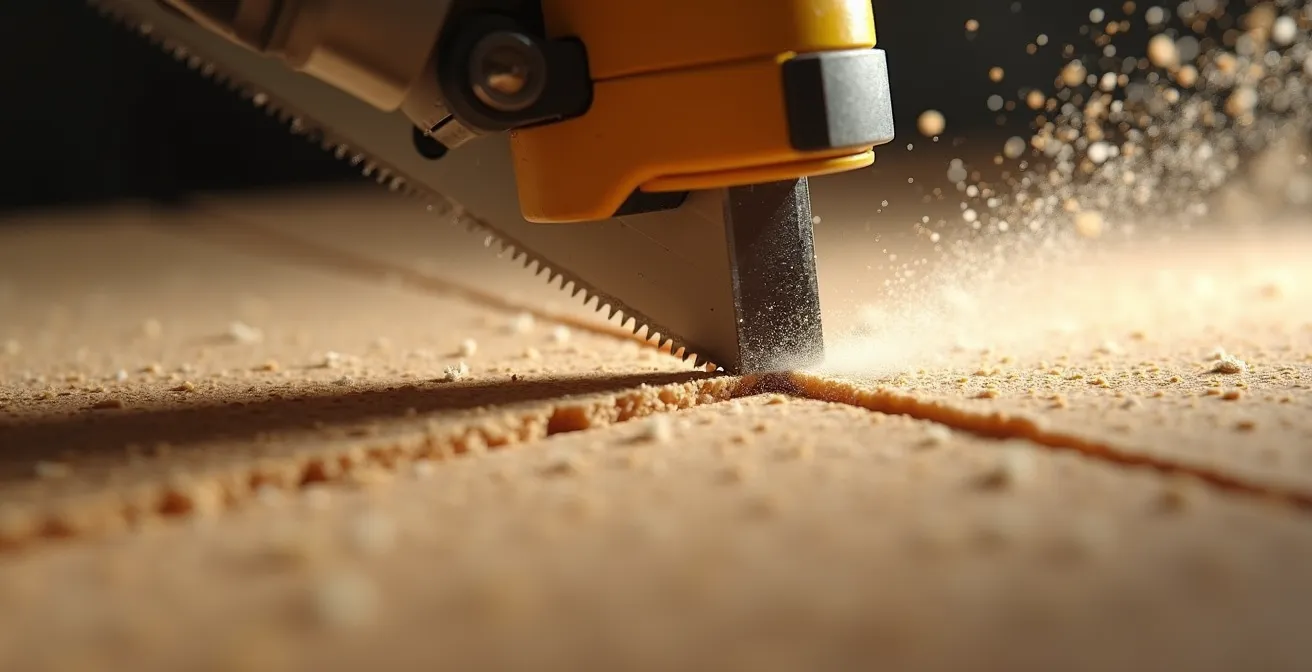
As the image reveals, the material’s fibrous structure cuts cleanly, producing minimal chipping or breakout. This translates to less waste and a higher quality finish. To ensure a smooth and safe installation process on a UK site, follow these key steps:
- Tool Selection: Use standard wood saws. A fine-tooth panel saw for manual cuts or a circular saw with a standard Tungsten Carbide Tipped (TCT) blade provides excellent results. No specialised diamond blades are needed.
- Health & Safety: As with MDF or any wood product, wear FFP2 dust masks during cutting. This manages the inhalation of organic dust particles and complies with UK Health and Safety Executive (HSE) guidelines.
- Fixing: Secure the panels using standard timber frame screws. Fixing at 400mm centres is typically sufficient to meet the airtightness requirements of UK Building Regulations Part L.
- Jointing: To maintain the wall’s overall performance, seal all joints between panels with a high-quality, vapour-permeable tape. This ensures a continuous airtight layer while allowing the structure to breathe.
- Weather Protection: If the panels are to be left externally exposed for any period during construction, particularly in the UK’s damp climate, applying a temporary protective bio-based coating is a wise precaution.
This straightforward process means that any competent carpenter or builder can install mycelium insulation without a steep learning curve or investment in new equipment, removing a significant barrier to its mainstream adoption.
Do Bio-Sourced Materials Rot Faster Than Conventional Insulation?
The primary concern for any organic material within a building fabric is its relationship with moisture. The word “rot” is an ever-present fear, especially in the damp UK climate. Conventional, non-breathable insulations like polystyrene create a seemingly “safe” waterproof barrier. However, this often leads to a more insidious problem: trapped moisture, interstitial condensation, and subsequent mould growth and structural decay within the wall assembly.
Bio-sourced materials like mycelium operate on a fundamentally different principle: hygroscopic buffering and vapour permeability. Instead of blocking moisture, they actively manage it. Mycelium’s porous, open-cell structure allows it to absorb and release water vapour from the air, helping to regulate indoor humidity and prevent condensation build-up. It doesn’t rot because it doesn’t trap water; it breathes. The data confirms its superior performance; UKGBC data shows mycelium insulation uses an impressive 90% less water absorption than polystyrene when subjected to testing, meaning it is far less susceptible to becoming saturated.
This performance is essential for the longevity and health of a building. The UK Green Building Council highlights this critical advantage in their assessment:
Mykor promotes higher standards of air quality compared with synthetic materials which emit toxins as they degrade. Their materials prevent the accumulation of dampness, they are breathable, vapour-permeable, and free of volatile compounds.
– UK Green Building Council, UKGBC Mycelium Insulation Resource Page
In essence, how long does mycelium insulation last? Because it manages moisture rather than fighting it, its durability is intrinsically linked to the health of the entire building system. In a well-designed, breathable wall assembly, it will last the lifetime of the building without degrading or losing performance, a stark contrast to synthetic foams which can degrade and release harmful chemicals over time.
For architects specifying materials for heritage retrofits or new builds aiming for healthy indoor environments, mycelium’s ability to prevent damp is not a weakness to be mitigated, but a primary performance benefit to be leveraged.
Are Rats More Attracted to Sheep’s Wool Insulation Than Fiberglass?
The choice of insulation material can have unintended consequences, including its appeal to common pests. Natural materials like sheep’s wool, while excellent insulators, can sometimes be attractive to rodents or insects for nesting if not properly treated or detailed. This leads to a reasonable question: does mycelium, as an organic material, present a similar risk compared to inert options like fibreglass?
The evidence suggests mycelium offers a robust defence against pests, deriving its resilience from its physical structure and composition. Unlike loose-fill wool, mycelium insulation is produced as a dense, rigid panel. This compressed form provides no easy voids for nesting. Furthermore, during its manufacturing, the mycelium is blended with other agricultural byproducts and often treated with natural, non-toxic fire retardants like boron salts.
This boron treatment serves a dual purpose: it significantly enhances fire resistance while also acting as a powerful biocide and insecticide. It creates an environment that is inhospitable to rodents, insects like silverfish, and mould growth. Early UK installations of the material confirm this resilience. For example, case studies of projects by the UK company Biohm have shown no pest infiltration issues to date, with the dense, borate-treated panels proving to be an effective and non-toxic barrier that satisfies building control requirements.
Therefore, while the initial thought of using a “mushroom-based” product might evoke images of decay and infestation, the reality of the processed material is the opposite. It is a dense, inert, and unpalatable composite that provides a far less inviting home for pests than many other natural insulation options, and certainly a safer, non-toxic alternative to fibreglass.
By engineering a material that is both unappealing to pests and inherently fire-resistant, mycelium composites solve two critical risk factors in a single, elegant, and bio-based solution.
How to Get Mortgage Lenders to Accept Straw Bale Construction?
The challenge of securing a mortgage for a home built with non-standard materials is a familiar story for pioneers. The UK lending market is conservative, relying heavily on established certification and insurance-backed guarantees. The path forged by straw bale construction offers a crucial lesson: acceptance is not granted, it is earned through rigorous documentation and de-risking the proposition for the lender.
For mycelium insulation to enter the mainstream, it must follow the same path. An architect or self-builder cannot simply present it as a “good idea.” They must present a comprehensive technical file that answers every potential question from the lender’s surveyor and underwriter before they are even asked. This file effectively translates the material’s innovative properties into the conservative language of risk management and compliance.
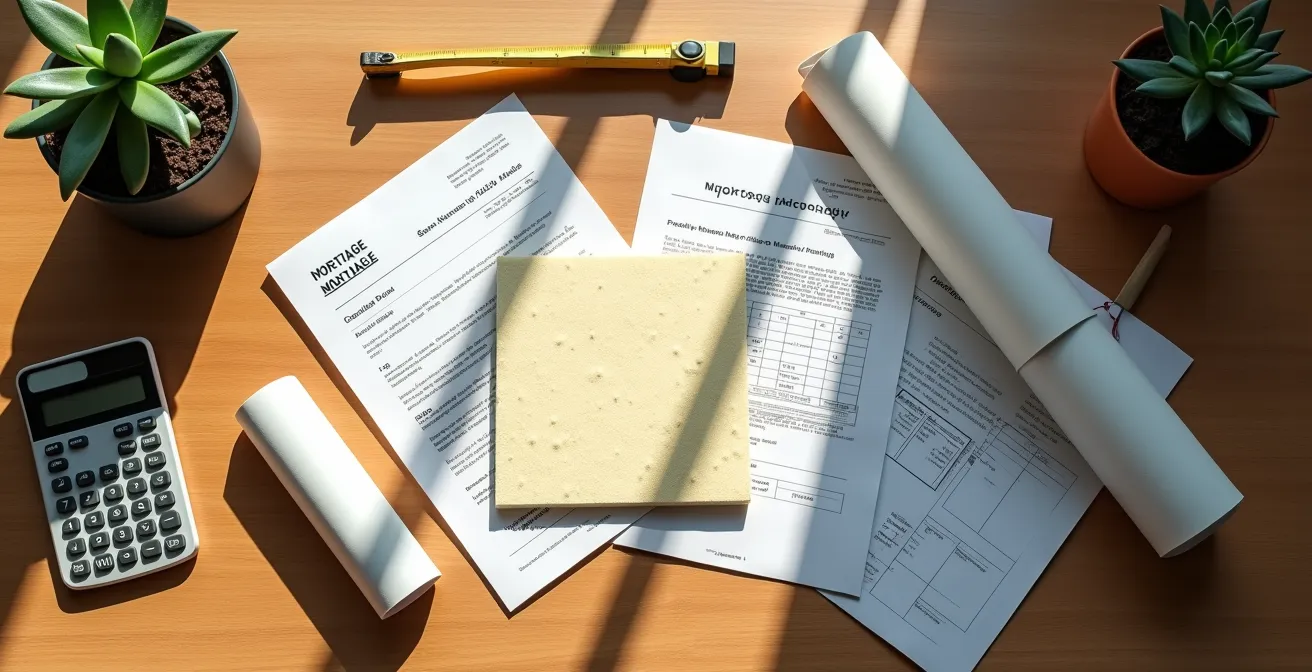
Building this file is the single most important step in achieving “mortgageability.” While full BBA (British Board of Agrément) certification is the ultimate goal for any new material, a robust file can bridge the gap. Proactive engagement with progressive lenders, such as the Ecology Building Society, who have a track record of financing innovative green projects, is also key.
Your technical file for a mycelium-based project in the UK should be meticulously assembled and include the following:
- Third-Party Validation: Include documentation on pending or achieved BBA certification, or equivalent validation from recognised UK bodies like BRE or TRADA.
- Structural Compliance: Provide a structural engineer’s report that explicitly confirms the proposed use complies with UK Building Regulations Part A (Structure).
- Fire Safety Data: Submit certified fire safety test data showing compliance with BS 476 or, preferably, the more current European standard EN 13501-1.
- Installation Warranty: Secure a professional installation warranty from a specialist installer or a RICS-registered contractor to guarantee the quality of workmanship.
- Future Homes Standard Alignment: Document a whole-life carbon assessment demonstrating how the project aligns with or exceeds the requirements of the Future Homes Standard 2025.
- Precedent Case Studies: Present examples of where similar bio-based materials have been successfully approved by lenders like Ecology Building Society or Triodos Bank.
By proactively addressing every point of potential concern, you shift the conversation from one of risk to one of demonstrable, certified performance, making a ‘yes’ from the lender the only logical outcome.
Polystyrene vs Wood Fibre: Which Insulation Lets Your Walls Breathe?
The concept of a wall that can “breathe” is critical, particularly for the UK’s vast stock of older, solid-wall buildings. “Breathability” refers to vapour permeability—the ability of a material to allow water vapour to pass through it. This prevents moisture from becoming trapped within the wall structure, which can lead to damp, mould, and decay. Petrochemical-based insulations like Polystyrene (EPS) or Celotex (PIR) are vapour-closed. They act like a plastic bag around the building, trapping moisture inside.
Natural materials like wood fibre are excellent alternatives, offering high vapour permeability. However, mycelium panels match or even exceed this performance, positioning them as a premier choice for breathable construction. Research shows that mycelium insulation provides around 40% better moisture regulation than PIR foam, actively helping to buffer humidity. The technical measure for this is the vapour resistance factor, or ‘μ value’—the lower the value, the more breathable the material.
The following table, based on data from sources like the UKGBC, compares mycelium to common UK insulation materials, clearly demonstrating its superiority for breathable applications.
| Material | Vapour Resistance (μ value) | Breathability Rating | Suitability for UK Heritage Buildings |
|---|---|---|---|
| Mycelium Panels | 3-5 | Excellent | Ideal for solid walls |
| Wood Fibre | 3-5 | Excellent | Good compatibility |
| Sheep’s Wool | 1-2 | Outstanding | Traditional choice |
| Celotex PIR | 50-200 | Poor | Risk of damp |
| Polystyrene | 20-100 | Poor | Not recommended |
For any retrofit of a Victorian terrace or a pre-1919 solid brick or stone building, specifying a material with a high vapour resistance like polystyrene is a recipe for disaster. Mycelium’s excellent vapour permeability (μ value of 3-5), combined with its insulating properties, makes it an ideal, technically superior solution for preserving the health and longevity of Britain’s architectural heritage.
How to Read an EPD to Choose the Lowest Carbon Insulation?
In the age of greenwashing, an Environmental Product Declaration (EPD) is the construction industry’s most crucial tool for objective truth. It is a standardised, third-party verified document that details a product’s environmental impact from cradle to grave. For an architect or specifier, knowing how to read an EPD is no longer an optional skill; it’s a core competency for making responsible decisions.
When comparing mycelium to a conventional product like Kingspan’s K103 phenolic foam, the EPD tells a compelling story. A cradle-to-gate analysis reveals the stark contrast: mycelium’s production process is a carbon sink, while PIR/phenolic foam production is highly energy-intensive. A study highlighted by ACS Publications calculated mycelium’s embodied carbon to be -39.5 kg CO2eq per cubic metre, whereas traditional foams have a significant positive carbon footprint. But a true comparison for a UK project requires looking beyond the factory gate (Modules A1-A3).
The real insights come from analysing the modules relevant to a UK specification: transport to site (A4), installation waste (A5), and end-of-life disposal (C3/C4). Here, locally-produced mycelium has a massive advantage over foams often imported from Europe. Furthermore, its compostability at end-of-life (meeting PAS 100 standards) contrasts sharply with the landfill or incineration pathways for synthetic foams, which have major negative impacts. This compostability can even contribute to ‘beyond system boundary’ benefits (Module D) where the composted material improves soil health, sequestering further carbon.
Your EPD Audit Checklist: Mycelium vs. Foam
- Module A1-A3 (Production): Verify the location. Is the mycelium UK-manufactured, avoiding import emissions common with European PIR factories?
- Module A4 (Transport): Calculate the transport carbon from the specific UK facility (e.g., Biohm) versus a factory in Belgium or Ireland.
- Module A5 (Installation): Compare installation waste. Mycelium panels can be cut precisely, generating minimal offcuts which are fully biodegradable.
- Module C3/C4 (Disposal): Assess the end-of-life routes. Is it mycelium’s certified compostability versus PIR’s inevitable journey to landfill or incineration?
- Module D (Benefits Beyond): Account for the carbon sequestration benefits of mycelium that occur after the building’s life, a factor entirely absent in synthetics.
Ultimately, reading an EPD is about understanding the full story. For mycelium in the UK, that story is one of local production, minimal waste, carbon sequestration, and a truly circular end-of-life—a narrative that conventional insulators simply cannot match.
Key Takeaways
- Carbon Negative Reality: Mycelium isn’t just ‘green’; it is a verified carbon sink, with UK production sequestering significant CO2.
- Performance without Compromise: It excels in vapour permeability and moisture management, making it ideal for the UK’s challenging climate and older building stock.
- Market-Ready Practicality: The material is practical for on-site use and the pathway to mortgage approval is clear, requiring proactive documentation rather than new science.
Should You Demolish and Rebuild or Retrofit to Save the Most Carbon?
The most sustainable building is often the one that already exists. The immense amount of carbon released during demolition and new construction means that retrofitting is almost always the lower-carbon option. The question then becomes: what is the most effective way to retrofit? This is where high-performance, lightweight, and carbon-sequestering insulation like mycelium becomes a game-changing tool for UK projects.
Consider a typical Victorian terrace in Manchester. A demolish-and-rebuild approach would generate enormous upfront carbon emissions. In contrast, a deep retrofit using mycelium for internal wall insulation offers a radically different outcome. Calculations show this approach could save approximately 3.5 tonnes of CO2 equivalent compared to a rebuild, all while preserving the building’s architectural heritage and avoiding lengthy and complex planning procedures. The carbon saved by retaining the existing structure is locked in, and the new insulation adds a further, measurable carbon-negative dividend.
A critical factor in retrofitting older buildings is the additional weight of new materials on existing structures. Here, mycelium offers another distinct advantage. As a lightweight composite, mycelium panels are approximately 75% lighter than hempcrete, another popular bio-based insulator. This dramatically reduces the structural load imposed on aging foundations and timber frames, simplifying engineering requirements and making it a far more versatile solution for sensitive heritage projects.
For UK architects and builders aiming for maximum carbon savings, the answer is clear. A strategy of retention and retrofit, powered by lightweight, carbon-negative materials like mycelium, represents the most efficient, responsible, and intelligent path forward. It’s time to equip your next retrofit project with materials that not only insulate but actively heal the planet.