For most English homeowners on metered water, retrofitting a greywater system specifically for toilet flushing is rarely a sound financial decision.
- The high initial installation cost, coupled with significant engineering complexity and operational risks, leads to an extremely long return on investment.
- The water saved by toilet flushing alone is often insufficient to justify the system’s expense compared to its total potential output.
Recommendation: Prioritise a full audit of low-cost, high-impact water-saving devices like shower flow restrictors and tap aerators before considering a large-scale greywater project. The financial calculus is demonstrably superior.
For the English homeowner with a water meter, the rising cost of mains water transforms every flush, shower, and wash into a tangible expense. The concept of a greywater recycling system, which captures used water from baths, showers, and sinks to be reused for non-potable applications like toilet flushing, appears as an elegant and environmentally conscious solution. It promises to slash water consumption and, by extension, utility bills. Many homeowners assume this is a straightforward investment in sustainability and long-term savings.
However, this assumption often overlooks the harsh engineering realities and the cold financial calculus involved. The standard advice focuses on the potential water savings, but rarely delves into the systemic inefficiencies, operational drag, and significant capital outlay required for a safe and compliant system. The conversation frequently ignores the vast disparity in return on investment between a complex greywater installation and simpler, targeted water-saving interventions.
The core of the issue is not whether greywater systems save water—they do. The critical question is whether they represent a financially prudent investment for their most commonly cited purpose: flushing toilets. This analysis moves beyond the eco-friendly marketing to provide a calculating, engineering-led assessment. We will dissect the hidden complexities and costs that define these systems and demonstrate why, for many, the pursuit of greywater for toilet flushing is a financial trap.
This article provides a detailed breakdown of the factors you must consider. We will analyse the engineering challenges, compare system costs, highlight critical safety considerations, and ultimately present a clear, data-driven comparison with more effective water-saving strategies. By understanding the complete financial picture, you can make a truly informed decision.
Summary: A Financial Breakdown of Greywater Retrofitting in the UK
- Why Must Kitchen Sink Water Be Treated as Black Water, Not Grey?
- How to Build a Safe Laundry-to-Landscape System for Summer Watering?
- Direct Feed vs Reed Beds: Which Greywater System Suits a Suburban Garden?
- The Storage Mistake: Why You Should Never Keep Greywater for More Than 24 Hours?
- Which Laundry Detergents Are Safe for Greywater Irrigation?
- How to Install Flow Restrictors That Teenagers Won’t Notice?
- How to Siphon Bath Water into the Garden Without Swallowing Soap?
- How to Calculate the Water Storage You Need for a 3-Week UK Drought?
Why Must Kitchen Sink Water Be Treated as Black Water, Not Grey?
The first miscalculation in many home greywater plans is the assumption that all non-toilet wastewater is created equal. From an engineering and public health standpoint, water from a kitchen sink is fundamentally different and far more problematic than water from a bath or shower. It is heavily contaminated with FOGs (Fats, Oils, and Grease), food particles, and potent cleaning chemicals. These organic solids decompose rapidly, creating foul odours and providing a rich breeding ground for harmful bacteria. Consequently, UK water regulations treat it not as simple greywater, but as ‘blackwater’.
Attempting to integrate kitchen sink effluent into a standard greywater system designed for toilet flushing is a critical design flaw. The FOGs will congeal and clog pipes, filters, and pumps, leading to system failure and costly maintenance. The high bacterial load requires a level of treatment far beyond simple filtration, pushing the system’s complexity and cost into the realm of a miniature sewage treatment plant. Any such installation must comply with stringent UK standards, including the Water Supply (Water Fittings) Regulations 1999 and potentially BS 8525 for greywater systems.
For a retrofitted domestic system, the most pragmatic and cost-effective approach is to exclude kitchen water entirely. This simplifies the design, lowers the installation and maintenance costs, and reduces the health risks. While this exclusion reduces the total volume of water available for recycling, it eliminates the single greatest point of failure and contamination. The potential 30% reduction in water use cited for comprehensive greywater systems must be recalibrated downwards once kitchen water is correctly removed from the equation, further impacting the financial viability calculation.
This initial engineering constraint immediately challenges the perceived simplicity of greywater recycling and introduces the first of many hidden costs that undermine its financial return.
How to Build a Safe Laundry-to-Landscape System for Summer Watering?
While using greywater for toilet flushing is fraught with financial and technical hurdles, a far simpler and more viable application is immediate garden irrigation. A ‘Laundry-to-Landscape’ (L2L) system is a low-cost, low-tech method that diverts water from a washing machine’s rinse cycle directly to the garden for subsurface irrigation. This approach avoids the major pitfalls of toilet-flushing systems: it requires no storage, minimal filtration, and has a significantly lower installation cost.
The core principle is immediate use. The water is diverted via a three-way valve, flowing through a simple pipe network to mulch basins distributed around trees and larger shrubs. This method is particularly effective in the UK during summer hosepipe bans, providing essential water to established plants. Because the water is discharged below a layer of mulch, it minimises human contact and evaporation, delivering moisture directly to the root zone. A well-designed system can effectively irrigate key parts of a garden using water that would otherwise go down the drain.
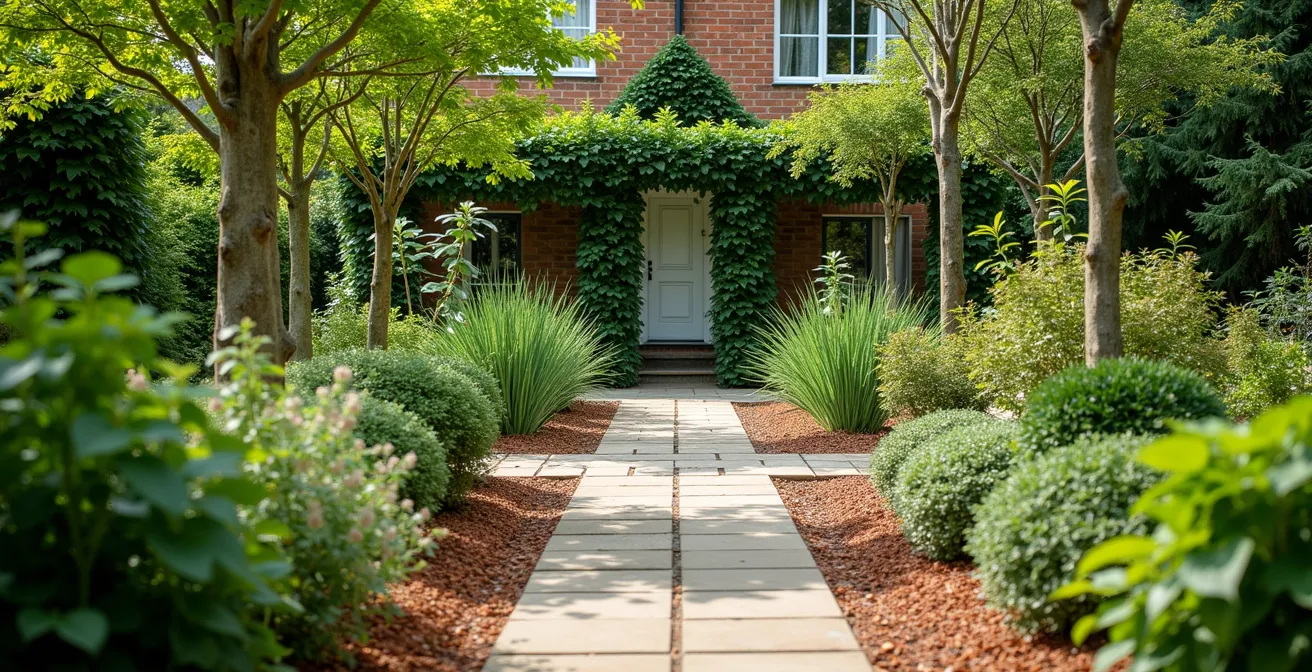
As the illustration of a typical English garden suggests, the infrastructure for such a system can be almost invisible. The key to safety and effectiveness lies in the design. The system should rely on gravity where possible and distribute water to multiple outlets to prevent oversaturation of any single area. It is crucial to only use this water on established, non-edible plants, as the water is untreated and may contain lint and chemicals not suitable for vegetable patches. The simplicity of an L2L system makes it a practical first step into greywater reuse, offering tangible benefits without the significant financial outlay of a full-scale toilet flushing system.
This shifts the cost-benefit calculus dramatically, positioning greywater not as a complex utility replacement but as a simple, seasonal irrigation aid.
Direct Feed vs Reed Beds: Which Greywater System Suits a Suburban Garden?
When evaluating a retrofitted system for toilet flushing, the choice of technology directly dictates the cost and spatial footprint. For a typical suburban home in England, two main options are considered: a direct feed system or a natural reed bed filter. A calculating analysis of their costs reveals the significant financial commitment required. A direct feed system is the more common compact solution. It filters greywater from baths and showers and pumps it directly to toilet cisterns. It is relatively small but requires regular filter cleaning and maintenance.
A reed bed system offers a higher level of natural filtration. Water passes slowly through a constructed wetland environment where plant roots and microorganisms break down impurities. While highly effective, this is a non-starter for most suburban properties due to its significant space requirement (typically 20-30 square metres) and much higher installation cost. For the vast majority of homeowners, the only feasible option is a direct feed system. However, even this “cheaper” option represents a major investment, especially when compared to its actual water savings.
The following table, based on recent UK market data, breaks down the comparative costs. It clearly shows that even a DIY approach requires a significant outlay, and professional installation quickly runs into thousands of pounds.
| System Type | Installation Cost (GBP) | Space Required | Maintenance | Best For |
|---|---|---|---|---|
| Direct Feed | £1,000-£2,000 | Minimal | Low | Suburban homes |
| Reed Beds | £5,000+ | 20-30 m² | Moderate | Large properties |
| DIY Basic | £500-£1,000 | Minimal | High | Budget-conscious |
This financial breakdown is critical. While a DIY installation can save between £500 to £1,500, the total cost for a reliable, professionally installed direct feed system quickly approaches that of a rainwater harvesting system, which provides cleaner water with fewer health risks. This cost must be weighed against the savings from reduced toilet flushing, a figure we will see is often disappointingly small.
The upfront capital expenditure for a system dedicated only to toilet flushing immediately puts its financial viability under severe pressure.
The Storage Mistake: Why You Should Never Keep Greywater for More Than 24 Hours?
The single most critical point of failure in a domestic greywater-to-toilet system is storage. Greywater is a highly unstable, nutrient-rich liquid. It contains skin cells, soap, hair, and bacteria. If stored for more than 24 hours, particularly in warmer temperatures, anaerobic bacteria begin to dominate. This process of putrefaction breaks down the organic matter, releasing noxious hydrogen sulfide gas (the smell of rotten eggs) and turning the water black and septic.
This 24-hour rule is a non-negotiable engineering constraint. Any system designed to flush toilets must ensure that the collected water is used within this timeframe or automatically diverted to the sewer. This creates a fundamental systemic inefficiency: the supply of greywater (from morning and evening showers) is often mismatched with the demand (intermittent toilet flushes throughout the day). A household may produce a large volume of greywater in a short period, far more than the toilet cisterns can hold, while at other times there may be no greywater available. This requires a complex system with sensors, pumps, and diverter valves, adding to the cost and potential points of failure.
Furthermore, the chemical and biological nature of greywater poses a direct threat to the plumbing itself. Experts in the field strongly advise against this application due to the long-term operational problems it creates. As one expert from Greywater Action, a leading educational organisation, states in their public forum:
I strongly recommend you use your rainwater to flush toilets, NOT the greywater. It is much easier and lower cost to create a well functional rainwater system to flush toilets. Even with filters and disinfection past greywater-to-toilet systems have caused increased corrosion of internal toilet tank parts.
– Greywater Action Expert, Greywater Action Q&A Forum
This expert advice is a damning indictment of the concept’s viability. The combination of bacterial risk, corrosive effects, and the complexity required to manage the 24-hour limit makes rainwater a far superior and safer choice for toilet flushing.
Which Laundry Detergents Are Safe for Greywater Irrigation?
The concept of “operational drag” is a critical factor in the long-term financial calculation of any water recycling system. It refers to the hidden, ongoing costs and behavioural changes required to operate the system safely and effectively. For greywater systems, particularly those used for garden irrigation, the choice of cleaning products is paramount. Standard laundry detergents and soaps are not designed with plant health in mind.
Many common household products contain substances that are harmful to soil and plants. These include:
- Sodium (Salts): High concentrations of sodium are toxic to plants and can build up in the soil over time, destroying its structure and preventing water absorption.
- Phosphates: While a plant nutrient, excess phosphates from detergents can cause blockages in pipes and are a significant pollutant if they enter natural waterways.
- Boron: Often found in “natural” detergents as a whitener, boron is toxic to many common garden plants even in small concentrations.
- Chlorine Bleach: Highly toxic to both plants and beneficial soil microorganisms.
To use a greywater system for irrigation, a homeowner must commit to using only low-sodium, phosphate-free, and biodegradable detergents. Brands like Ecover or Bio-D are often recommended. This introduces an ongoing additional expense, as these eco-friendly brands are typically more expensive than standard detergents. This extra cost, which can amount to an estimated £50-£100 per year, must be factored into any calculation of the system’s return on investment. This operational requirement adds a layer of complexity and cost that is often overlooked in the initial assessment.
This ongoing financial and practical burden further erodes the already questionable economic case for complex greywater systems compared to simpler, passive water-saving measures.
How to Install Flow Restrictors That Teenagers Won’t Notice?
The central thesis of this analysis is that for a homeowner focused on financial return, a greywater system for toilet flushing is a poor investment. The evidence for this lies in comparing its cost and payback period with simpler, more effective technologies. The most potent of these are flow restrictors. A shower flow restrictor, or an aerator for a tap, is a small, inexpensive device that limits the volume of water passing through it without a significant drop in perceived pressure. They often work by mixing air with the water stream, giving the feeling of a full flow while using up to 50% less water.
Their installation is simple, often requiring no more than unscrewing the shower hose or tap end, inserting the small disc, and reattaching it. For a household with teenagers known for taking long showers, this is a powerful, passive water-saving tool. Crucially, when a good quality aerating restrictor is used, the change in flow is often barely noticeable, avoiding complaints while delivering significant savings on both water and the energy used to heat it.
The financial calculus is stark. A greywater system costs thousands and has a payback period measured in decades. A flow restrictor costs a few pounds and pays for itself in months. The following table compares the return on investment for the most common water-saving methods in the UK.
| Method | Initial Cost | Water Savings | Payback Period |
|---|---|---|---|
| Flow Restrictor | £10-20 | 30% shower water | 2-3 months |
| Greywater System | £6,000+ | 30-35% total | 15+ years |
| Rainwater Harvesting | £2,000-4,000 | 40-50% non-potable | 8-12 years |
This data on comparative payback periods makes the financial case undeniable. Before contemplating a major engineering project like a greywater system, a homeowner should first exploit all low-cost, high-return leverage points. Installing flow restrictors on all showers and taps is the single most cost-effective action a metered household can take.
From a purely financial standpoint, investing in flow restrictors and other low-cost devices first is the only logical course of action.
How to Siphon Bath Water into the Garden Without Swallowing Soap?
For the homeowner seeking a truly low-cost method of reusing water for the garden, even a Laundry-to-Landscape system can seem overly engineered. The most basic method of greywater reuse is the simple act of siphoning water from the bath directly to a water butt or collection buckets for immediate use on ornamental plants. This “hillbilly” method, as it’s sometimes called, requires no permanent plumbing and has a near-zero installation cost. It is an effective, if labour-intensive, way to salvage 50-80 litres of water per bath during a dry spell.
However, safety is paramount. The old method of starting a siphon by mouth is unhygienic and dangerous, risking a mouthful of soapy, bacteria-laden water. A proper, hand-operated siphon pump is an essential and inexpensive piece of equipment. The principle is simple: place the intake end of the hose in the bathtub and the outlet end in a collection container positioned at a lower level than the tub. Pumping the handle creates the initial suction, and gravity does the rest. It’s crucial to filter the water through a fine mesh (like an old pair of tights) over the collection bucket to remove hair and other debris that could clog a watering can.
Your Action Plan: Safe Bath Water Siphoning
- Acquire Equipment: Purchase a dedicated siphon pump with a one-way valve and a sufficient length of hose. Never use your mouth to start the siphon.
- Position for Gravity: Place your collection container (e.g., a large bucket or water butt) on the ground outside, ensuring it is significantly lower than the bottom of the bathtub.
- Filter at Source: Secure a mesh filter over the outlet end of the hose to capture hair, lint, and debris before the water enters your container.
- Initiate and Monitor Flow: Submerge the siphon’s intake end in the bath, operate the pump to start the flow, and monitor the process to prevent overflow.
- Use Immediately: Transfer the collected water to the garden for irrigating ornamental plants within 24 hours. Do not store it or use it on edible crops.
While not an automated solution, this method provides real water savings during critical periods like a hosepipe ban, with virtually no financial investment, reinforcing the argument that complexity is not always the answer.
Key Takeaways
- The financial viability of retrofitting a greywater system for toilet flushing in the UK is extremely poor due to high costs (£2,000-£6,000+) and long payback periods (15+ years).
- Significant engineering and health risks, such as bacterial growth in stored water and the need to exclude contaminated kitchen water, add hidden costs and complexity.
- Simpler, low-cost alternatives like shower flow restrictors (£10-£20) offer a vastly superior return on investment, with payback periods of just 2-3 months.
How to Calculate the Water Storage You Need for a 3-Week UK Drought?
A final argument sometimes made for complex water recycling systems is resilience during a drought. The idea of having an independent water source during a prolonged dry spell and hosepipe ban is appealing. However, a pragmatic calculation demonstrates the limitations of a greywater system in this scenario. Let’s model the water needs for a typical garden during a three-week (21-day) drought in the UK.
Assuming a modest garden requires 50 litres of water every other day to keep key plants alive, the total need over 21 days would be approximately 11 watering sessions, totalling 550 litres. Now, consider the greywater system. As established, greywater cannot be stored for more than 24 hours. This means the system provides no “storage” in the traditional sense. You can only use the water your household generates on any given day. If an average family of four generates 200 litres of bath and shower water per day, that is the maximum available for irrigation.
This is useful, but it is not drought-proofing storage. A true storage solution for drought resilience is a rainwater harvesting system. A standard 200-litre water butt can be filled from a single heavy downpour. A more advanced underground tank of 2,000-4,000 litres, fed by all the roof’s downpipes, can comfortably store enough clean, non-corrosive water to see a garden through a multi-week drought. This stored rainwater can also be used for toilet flushing far more safely than greywater. The cost-benefit calculus again favours rainwater harvesting for any homeowner concerned with drought resilience, as it provides actual storage, whereas a greywater system only provides immediate supply.
Therefore, the logical first step for any homeowner on metered water is not to invest in a complex, high-maintenance greywater system with a poor financial return. The prudent course of action is to perform a thorough audit of your home’s water usage and invest in the low-cost, high-return solutions first. Calculate the rapid savings from installing flow restrictors and aerators, and if drought resilience is a goal, direct your larger investment towards a more effective and safer rainwater harvesting system.