
The National Grid’s Demand Flexibility Service isn’t just about saving a few quid on your bill—it’s a gateway to actively ‘gaming’ the energy market from your living room and getting paid for it.
- You can join a “Virtual Power Plant” and earn rewards even if your main energy supplier doesn’t offer a scheme.
- Automation with cheap smart plugs, not necessarily expensive smart appliances, is the secret to effortless and profitable participation.
- Combining smart tariffs with automated charging for your EV or home battery transforms you from a simple consumer into a savvy energy trader.
Recommendation: Start with one smart plug on a heavy-use appliance (like a tumble dryer or immersion heater) and join an independent DSR app to experience your first paid ‘turn-down’ event.
That familiar text message buzzes on your phone: “National Grid DFS Event tonight, 5pm-6pm. Earn rewards by reducing your electricity use!” You dutifully switch off the washing machine, delay the dishwasher, and maybe even brave a cold dinner. You get a few pounds credited to your bill and feel pretty good about it. But what if I told you that’s just the tip of the iceberg? What if that simple act of “turning things off” is the entry level to a much more exciting and profitable game? The truth is, the energy revolution isn’t just about saving energy; it’s about shifting it. And for those willing to look a little deeper, it’s about getting paid to do so.
Most advice stops at the basics: sign up with your supplier, turn off big appliances. But the real pros, the amateur energy traders emerging in living rooms across Britain, are going further. They’re not just participating; they’re strategizing. They’re building a home “automation stack,” hunting for negative prices, and turning their homes into mini power stations that actively help balance the grid. Forget passively saving a few quid. This is about actively earning by becoming a crucial player in the UK’s green energy transition. It’s time to stop just being a consumer and start being a ‘flexibility asset’.
This guide is your entry into that world. We’re going to move beyond the simple “switch it off” advice and explore the tactics of true grid-gaming. We’ll delve into why the grid actually wants you to use more power sometimes, how to join the most lucrative schemes, and how to automate the whole process so you can profit without even thinking about it. Get ready to level up your energy game.
This article provides a comprehensive roadmap for transforming your household into an active participant in the UK’s energy market. Below is a summary of the key strategies we will explore to help you maximize your earnings.
Summary: How to Earn Money by Turning Off Your Appliances During Demand Service Events?
- Why Does the Grid Pay You to Use Electricity on Windy Nights?
- How to Join a Virtual Power Plant if Your Supplier Doesn’t Offer It?
- Smart Plugs or Smart Appliances: Which Is the Cheaper Route to Automation?
- The Smart Meter Data Fear: Is Big Brother Really Watching Your Kettle?
- How to Charge Your Car for Free During Plunge Pricing Events?
- Is It Cheaper to Boil Water in a Kettle or on a Gas Hob?
- How to Automate Your Washing Machine to Start When the Sun Shines?
- How to Reach 70% Solar Self-Consumption Without Lifestyle Sacrifices?
Why Does the Grid Pay You to Use Electricity on Windy Nights?
It sounds completely backwards, doesn’t it? For years, we’ve been told to use less electricity. Now, the grid sometimes pays you to use more. This isn’t a glitch; it’s the new reality of an energy system powered by renewables. On a blustery night, the UK’s enormous offshore wind farms are spinning at full tilt, flooding the grid with cheap, green electricity. The problem is, national demand at 3 am is usually rock bottom. This creates a supply and demand imbalance where there’s too much power and nowhere for it to go. This can lead to a phenomenon called “negative pricing”, where energy producers literally have to pay to offload their excess electricity to prevent grid instability.
This is where you, the savvy energy gamer, come in. By shifting your consumption to these periods of high supply and low demand, you are providing a valuable service. You’re acting as a sponge, soaking up that excess green energy. This is the core of Demand Side Response (DSR). Instead of the grid firing up expensive, often fossil-fuel-powered, “peaker” plants to meet high demand, it pays consumers to either reduce demand during peaks (the classic DFS event) or increase demand during troughs. The scale of this is already huge; 1.6 million households and businesses saved over 3,300MWh during the 2022/23 service alone.
This paragraph introduces the core concept of grid imbalance. To truly appreciate the scale and beauty of this new energy source, the image below captures the source of these negative pricing events: our offshore wind infrastructure working through the night.

As you can see, these are colossal power-generating machines. When a whole fleet of them is operating, the amount of energy is staggering. By aligning your home’s energy use with their output—charging your car, heating your water, running your appliances—you’re not just getting cheap power; you’re directly supporting the integration of renewable energy into our national infrastructure. You’re part of the solution, and you get rewarded for it. This is the fundamental principle of the new energy game.
How to Join a Virtual Power Plant if Your Supplier Doesn’t Offer It?
So, you’re sold on the idea of grid-gaming, but your energy supplier’s app is basic, or worse, they’re not even participating in the National Grid’s Demand Flexibility Service (DFS). Do you have to switch suppliers and go through all that hassle? Absolutely not! This is a common misconception. You can, and should, look into joining an independent Virtual Power Plant (VPP) aggregator. Think of these as independent clubs for energy gamers. They pool the flexibility of thousands of individual households like yours and offer it up to the National Grid as a single, powerful block.
These third-party providers often offer more flexibility, better rewards, and more engaging user experiences than the supplier-led schemes. Companies like Equiwatt, Hugo, and Power Rewards connect directly to your smart meter data (with your permission, of course) and manage your participation in DFS events. The key difference is how they pay you. While most big suppliers will only offer a credit on your bill, many independents pay you in cold, hard cash via PayPal or direct bank transfer, or offer high-value vouchers. This makes the rewards feel much more tangible—you’re not just reducing a bill; you’re actively earning money.
Choosing the right provider depends on your preferences for payment and how you want to interact with the service. The following table, based on an analysis of UK providers, breaks down some of the key differences between joining a supplier-led scheme and an independent VPP.
| Provider Type | Payment Method | Hardware Requirements | Average Reward/Event |
|---|---|---|---|
| Supplier-led (e.g., British Gas PeakSave) | Bill credit only | Smart meter only | £3-5 per household |
| Independent (e.g., Equiwatt) | PayPal, vouchers | Smart meter + app | £5-8 per household |
| Independent (e.g., Hugo Energy) | Direct bank transfer | Smart plugs supported | £4-7 per household |
As the data on National Grid’s partners shows, the independent route can be more lucrative and offers more choice. It decouples your participation in DFS from your choice of energy supplier, giving you the freedom to hunt for the best underlying energy tariff while still playing the DSR game with the best VPP provider for your needs. This is the first major step from being a passive participant to a strategic player.
Smart Plugs or Smart Appliances: Which Is the Cheaper Route to Automation?
The secret to winning at grid-gaming isn’t frantically running around your house unplugging things. It’s automation. You want your high-consumption devices to automatically respond to grid signals without you lifting a finger. The big question is: do you need to splash out on a brand new, £800 “smart” washing machine, or can you achieve the same result with a £15 smart plug? For the aspiring energy trader, the answer is almost always the smart plug. It’s the cheaper, more flexible, and more strategic entry point into home automation for DSR.
A smart plug with energy monitoring, like a Tapo P110 or Kasa KP115, is your new best friend. You plug it into the wall, plug your “dumb” appliance into it, and suddenly your old washing machine, tumble dryer, or immersion heater is part of your automation stack. Through apps, or more advanced platforms like IFTTT (If This Then That), you can set rules to automatically turn these devices off during peak-price DSR events. More importantly, you can set them to turn *on* during negative price events. This modular approach allows you to bring your most energy-hungry devices into the game for a fraction of the cost of replacing them.
Of course, smart appliances with native DSR integration are cool, but they represent a significant upfront investment and lock you into a single appliance. The smart plug strategy is about building a flexible, low-cost “team” of controllable devices. The only major limitation is that some appliances with electronic start buttons can’t be restarted remotely after a power cut-off, so always test your appliance first. This cost-benefit analysis is crucial for any trader.
The upfront cost versus long-term benefit is a key calculation. The table below, informed by current UK market pricing and DSR compatibility, outlines the financial trade-offs.
| Solution | Upfront Cost (UK) | DSR Compatibility | Energy Monitoring | Limitations |
|---|---|---|---|---|
| Tapo P110 Smart Plug | £12-15 | Yes – via apps/IFTTT | Yes – detailed | Cannot restart appliances requiring manual button press |
| Samsung Smart Washer | £600-800 (£200 premium) | Yes – native | Yes – built-in | Limited to single appliance |
| Kasa KP115 Smart Plug | £18-22 | Yes – via IFTTT | Yes – with history | 13A maximum load |
The analysis clearly shows that for a small initial outlay, smart plugs provide the core functionality needed for DSR participation: remote control and energy monitoring. Building an army of smart-plug-enabled devices is a far more capital-efficient strategy than buying a single, expensive “general” in the form of a smart appliance. It’s about deploying your capital where it has the most impact.
The Smart Meter Data Fear: Is Big Brother Really Watching Your Kettle?
Let’s address the elephant in the room: smart meters and data privacy. The moment you start talking about sharing energy data to get paid, a certain level of Orwellian dread can creep in. Is my supplier tracking my every tea break? Does the government know when I’m not home? These are valid concerns, but the reality of smart meter data in the UK is far more mundane and, crucially, user-controlled than most people think. You are the one in the driver’s seat.
Firstly, the data itself is anonymised and aggregated. The National Grid doesn’t see “Jane Doe at 22 Acacia Avenue just boiled her kettle.” It sees a statistical blip in demand across a postcode. Secondly, and most importantly, you have granular control over how frequently your data is shared. The default setting for most smart meters is a monthly reading, the same as the old system. To participate in DSR, you’ll need to opt-in to sharing either daily or, more likely, half-hourly readings. This is a conscious choice you make, and you can change it at any time via your supplier’s online portal or app. You are giving specific permission for your data to be used for a specific purpose: to help you earn money and balance the grid.
Think of it less like “Big Brother is watching” and more like “You’re providing a paid-for data service.” You are monetising your energy consumption patterns. The system is designed with privacy regulations at its core, and in England, you even have the right to refuse a smart meter installation, even as a tenant. The control is yours.
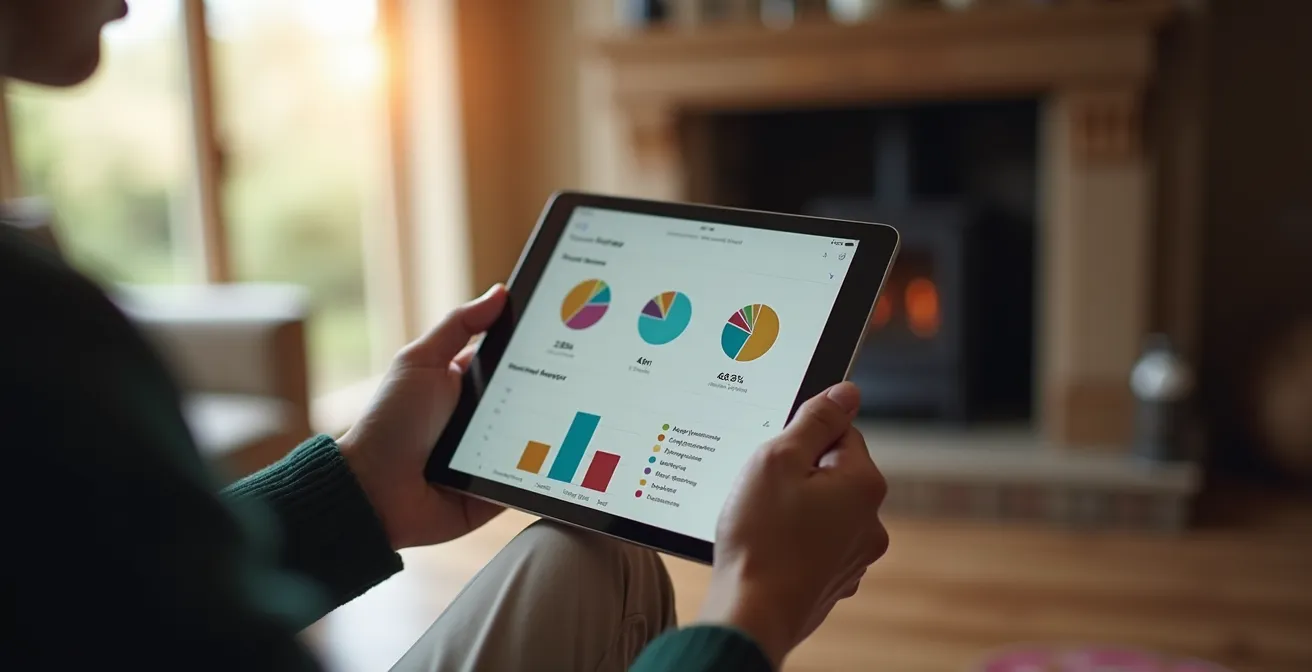
The image above perfectly captures the modern reality: it’s about you, in your own home, interacting with an interface and making informed choices. The fear of surveillance is often a barrier, but understanding that you hold the keys and can opt-in or out at any time is empowering. It transforms the narrative from one of passive monitoring to one of active, controlled participation. Your data is a valuable asset, and it’s only right that you should be in control of how it’s used and be compensated for it.
How to Charge Your Car for Free During Plunge Pricing Events?
For the serious home energy trader, the Electric Vehicle (EV) is the ultimate flexibility asset. It’s essentially a massive battery on wheels. While most people see it as a huge energy consumer, you should see it as your most powerful tool for grid-gaming. With the right setup, you can not only get your transport fuel for next to nothing but actually get paid to take electricity from the grid. This is the major leagues, and it’s surprisingly easy to get started.
The key is combining three elements: a smart EV charger, a dynamic energy tariff, and the provider’s app. Tariffs like Octopus Agile or OVO Charge Anytime pass on wholesale energy prices to you every half-hour. When the wind is howling at 3 am and the grid is flooded with excess power, prices can “plunge” below zero. Yes, they will pay you to charge your car. Your smart charger, connected to the tariff’s app, will see these price signals and automatically start charging your car’s massive battery, drinking up all that free (or better than free) green electricity. You wake up with a full battery and a fuller wallet.
This isn’t just theory; it’s happening right now across the UK. EV owners are the super-users of the Demand Flexibility Service, automatically soaking up energy during “turn-up” events when there’s an excess of renewables. The savings and earnings can be substantial, often running into hundreds of pounds a year, effectively slashing transport costs. It’s the single biggest weapon in your DSR arsenal.
Your Action Plan: Setting Up Automated EV Charging for Plunge Pricing
- Install a smart charger compliant with UK’s 2021 regulations (e.g., a Myenergi Zappi or Ohme Home Pro).
- Switch to a dynamic tariff that offers plunge pricing exposure, such as Octopus Agile or OVO’s Charge Anytime.
- Connect your charger to the tariff provider’s app to enable automatic scheduling and smart charging.
- Set your minimum charge requirements within the app (e.g., ensure the battery is always at least 30% full for emergencies).
- Enable grid signals reception to allow your charger to automatically participate in “turn-up” events when excess renewable energy is available.
By following this plan, you transform your EV from a simple mode of transport into an active, automated, and profitable part of the national energy infrastructure. You’re not just driving on sunshine; you’re driving on smarts.
Is It Cheaper to Boil Water in a Kettle or on a Gas Hob?
After talking about big-ticket items like EVs and home batteries, this question might seem trivial. But it’s by mastering the micro-decisions that you truly adopt the mindset of an energy trader. The kettle vs. hob debate is a classic of British energy-saving lore, but in the new world of dynamic pricing, the answer has become more nuanced and interesting. The short answer is: the electric kettle is almost always cheaper, faster, and more efficient. And it’s a perfect example of how to think about your energy use.
An electric kettle is a beautifully efficient device. Almost all the electricity it draws goes directly into heating the water via its submerged element. A gas hob, by contrast, is very inefficient. A huge amount of heat is lost to the surrounding air, heating your kitchen instead of your water. But the real difference for a grid-gamer is the energy source. Gas prices are relatively stable throughout the day. Electricity prices, as we’ve seen, are a rollercoaster. That means the cost of boiling your kettle can vary dramatically, from a few pence during a peak event to literally being paid to do it during a negative price plunge.
This paragraph introduces the micro-level thinking required. The efficiency of the electric kettle is a key factor, beautifully visualized by the macro process of heating.

This level of detail matters. While you’re not going to get rich from boiling your kettle at the right time, embracing this mindset is crucial. Every appliance that uses electricity is now a potential asset in your DSR strategy. Understanding the efficiency and controllability of each one is part of the game. The humble electric kettle, a champion of efficiency, is a reminder that even small loads, when timed correctly, contribute to a smarter, more flexible energy system. The cumulative effect of millions of such decisions is enormous; it’s estimated that demand side response could save the British electricity system between £3-8 billion annually by 2050.
How to Automate Your Washing Machine to Start When the Sun Shines?
For households with solar panels, the game gets even more interesting. Your primary goal shifts from just using cheap grid electricity to using your own, self-generated, free solar electricity first. This is called increasing “self-consumption.” The enemy is exporting your precious solar power to the grid for a pittance (typically 5-15p/kWh) only to buy it back later for much more (30p/kWh or higher). The solution? Automate your “daytime” appliances, like the washing machine or dishwasher, to run only when the sun is shining brightly.
This is where your automation skills come into play. While you could just look outside and guess, the real pros use data. By combining a simple smart plug (like our friend the Tapo P110) with a home automation platform like Home Assistant, you can create powerful rules. Home Assistant can talk to your solar panel inverter’s API and see exactly how much power you’re generating and how much you’re exporting. You can then create a simple rule: “IF solar export is greater than 1.5kW for 5 minutes, THEN turn on the washing machine smart plug.”
You can even get more sophisticated and add a secondary check against the grid’s carbon intensity. Many apps and APIs (like the National Grid ESO’s own) provide real-time data on how green the grid is. Your rule could become: “Turn on the washing machine IF I am exporting more than 1.5kW OR if the grid’s carbon intensity is super low.” This ensures you’re always running your appliances at the cheapest and greenest possible time. This level of automation is what separates the dabblers from the masters of self-consumption.
This isn’t a niche fantasy; it’s the future direction of our entire energy system. As National Grid ESO themselves project, the potential is massive.
DSR potential of 6-12 GW is predicted by 2040 from residential, commercial, and industrial sectors in our net zero scenarios.
– National Grid ESO, Future Energy Scenarios 2024
Your automated washing machine is a small but important part of that multi-gigawatt future. It’s a tangible step towards a home that intelligently manages its own energy flows, saving you money and supporting the grid simultaneously.
Key Takeaways
- The goal isn’t just saving money, but actively earning it by providing ‘flexibility’ to the National Grid.
- You don’t need your supplier; independent Virtual Power Plants (VPPs) can offer better rewards and cash payments.
- Automation is king: use cheap smart plugs and dynamic tariffs to automatically shift your energy use to the cheapest and greenest times.
How to Reach 70% Solar Self-Consumption Without Lifestyle Sacrifices?
We’ve talked about solar, and we’ve talked about DSR. The holy grail of home energy trading is putting them all together: solar panels, a home battery, and a smart tariff. This is the trifecta that allows you to achieve incredibly high levels of self-sufficiency—and profitability—without changing your daily habits. It’s how you reach the mythical 70% self-consumption target and truly become the master of your home’s energy destiny.
Here’s how the complete system works. During the day, your solar panels power your home. Any excess energy, instead of being exported for a low price, is used to charge your home battery. As evening falls and your solar generation drops off, your home seamlessly begins drawing power from the battery, using that stored solar energy for free. Already, you’ve avoided buying expensive peak-time electricity. But the game doesn’t stop there. Your smart tariff knows that overnight, between midnight and 5 am, grid electricity will be dirt cheap. If your battery is low and it’s not a sunny day tomorrow, it will automatically top itself up with this ultra-cheap grid power, ready for the morning rush. This simple “price arbitrage” alone can save a fortune.
Now, add DSR events on top. Your system is constantly watching the grid. When a high-price “turn-down” event is called, your home can choose to run entirely from the battery, exporting nothing and importing nothing, earning you rewards. Even better, in some setups, you can actively export your stored battery power to the grid during these events, earning a premium. This combination transforms your home from a passive consumer into a dynamic, responsive, and profitable node on the grid. And the best part? It’s all automated. You don’t have to do anything; your system is constantly optimising in the background.
UK Household Achieving 70% Self-Consumption Through Grid Gaming
A typical UK household with a 4kW solar system and a 10kWh battery (e.g., a GivEnergy system) can achieve over 70% self-consumption. By combining solar storage for daytime use, automated overnight charging on cheap rates, and active participation in DSR events, one such household in the Midlands reported earning over £400 annually directly from grid services, on top of the bill savings from reducing their grid dependence by 65%. This demonstrates the powerful synergy of combining generation, storage, and flexibility trading.
This is the pinnacle of the home energy game. It’s a setup that maximizes your use of renewable energy, insulates you from price spikes, and earns you a consistent income stream for supporting the grid. The number of people catching on is growing fast, with reports from Smart Energy GB showing that through demand flexibility services, participation is rapidly increasing year on year.
Start your journey into grid-gaming today. Your first step could be as simple as buying a single smart plug and seeing just how much your tumble dryer really costs to run. The energy revolution is here, and it’s waiting for more players.
Frequently Asked Questions about Demand Side Response
What are my data sharing options?
In the UK, you have full control. You can choose between monthly readings (the default, which is not sufficient for DSR), daily readings, or half-hourly readings. You need to opt-in to half-hourly sharing to participate fully in demand flexibility services. You can change these settings at any time through your energy supplier’s online account portal.
Can I refuse a smart meter installation in a rented property?
Yes. In England, tenants have the right to refuse the installation of a smart meter. Your landlord cannot force you to have one installed without your consent. Ofgem’s regulations confirm that the decision rests with the bill-payer, which is typically the tenant.