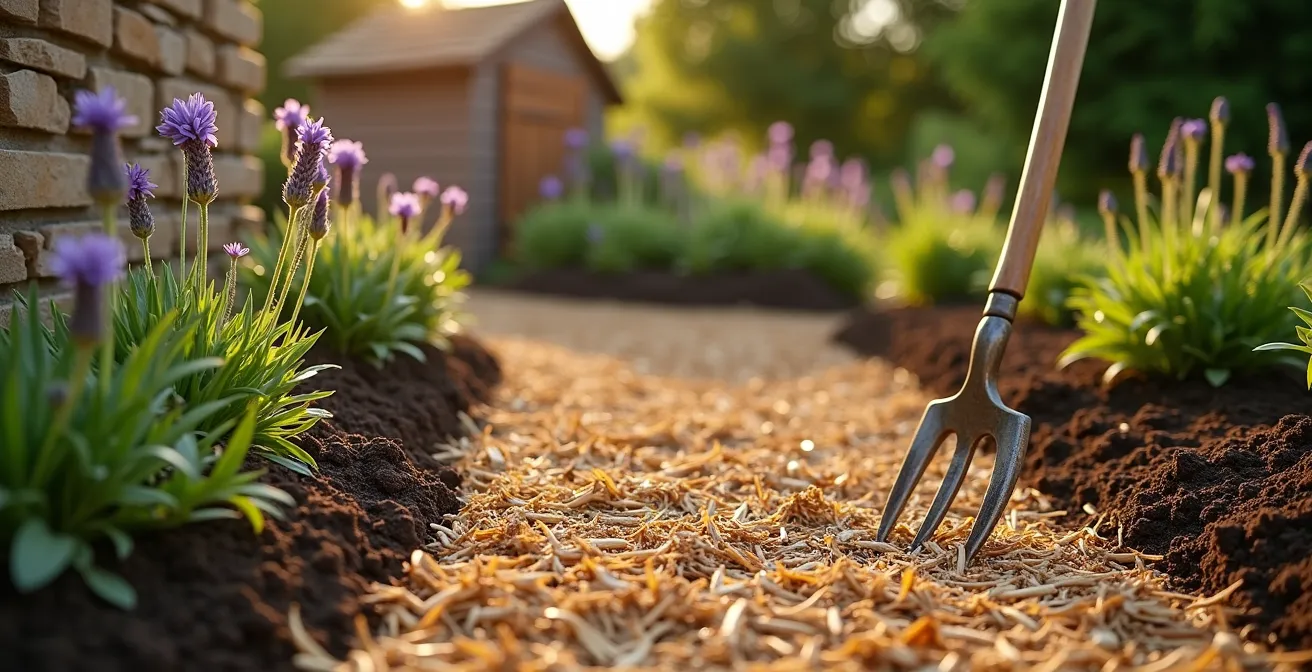
Contrary to common advice focused on ‘improving’ soil, the key to a resilient UK garden lies in ‘protecting’ its living ecosystem from climate extremes.
- Tilling and digging actively destroy soil structure and release vital carbon, weakening your garden’s foundation.
- A thick organic mulch acts as ‘soil armour’, regulating temperature, locking in moisture, and fuelling the biological engine beneath.
Recommendation: Adopt a ‘no-dig’ philosophy and apply a 7-10cm layer of the right organic mulch this season to build a self-sustaining, water-wise garden.
For gardeners across the UK, the weather is becoming a formidable challenge. The pattern of increasingly dry, hot summers followed by mild, waterlogged winters puts immense stress on our plants and, more importantly, on the very soil they depend on. Many common gardening practices are reactive: we water more during droughts, we add drainage to boggy patches, we fight a constant battle against the elements. We are told to endlessly “improve” our soil with additives, as if it were an inert substance.
But what if this approach is fundamentally flawed? What if the secret to a thriving, resilient garden isn’t about constantly adding things, but about protecting what’s already there? As a soil scientist, I argue that the single most effective action you can take is to treat your soil not as a medium to be fixed, but as a living, breathing ecosystem that needs protection. This is where mulching transcends being a mere chore and becomes a strategic act of defence. It is the process of applying ‘soil armour’.
This protective layer does far more than just suppress weeds. It creates a shield that regulates temperature and moisture, fosters a vibrant underground ‘biotic engine’ of fungi and bacteria, and builds a robust soil structure that can withstand both deluge and drought. This article will deconstruct the science behind mulching, moving beyond the platitudes to give you a foundational understanding of how to build true resilience from the ground up. We will explore why you should stop digging, how to choose and apply the right materials, and how to adapt to the new era of peat-free gardening, turning your plot into a stable, low-maintenance haven.
For those who prefer a visual introduction to the core principles of protecting soil structure, this video provides a step-by-step guide to starting a ‘no-dig’ garden bed, a foundational technique for building soil resilience.
To navigate the core principles of building this soil resilience, this guide is structured to answer the most pressing questions UK gardeners face. Explore the sections below to understand the science and the practical steps for creating your own climate-proof garden.
Contents: Mastering Soil Armour for a Resilient Garden
- Why Does Digging Your Soil Actually Reduce Its Fertility?
- How to Apply Straw Mulch to Suppress Slugs and Retain Water?
- Mushroom Compost or Manure: Which Is Better for Clay Soil Improvement?
- The Woodchip Myth: Does Fresh Woodchip Really Steal Nitrogen from Plants?
- Loose Load vs Bags: When Is It Cheaper to Buy a Cubic Tonne of Mulch?
- Why Does Peat-Free Compost Look Wet on Top but Dry underneath?
- How to Lock Moisture into Soil So You Only Need to Water Once a Week?
- Why Are Your Plants Dying in Peat-Free Compost and How to Fix It?
Why Does Digging Your Soil Actually Reduce Its Fertility?
The traditional image of a gardener, spade in hand, turning over the soil each spring is deeply ingrained. Yet, from a soil science perspective, this annual ritual is one of the most destructive acts for long-term fertility. Soil is not an inert growing medium; it is a complex, living ecosystem powered by a vast ‘biotic engine’ of bacteria, fungi, worms, and other organisms. The most critical component of this engine is the intricate web of mycorrhizal fungi, whose thread-like hyphae form symbiotic relationships with plant roots, extending their reach for water and nutrients.
When you dig or till, you physically shred this delicate fungal network, destroying the very infrastructure that feeds your plants. Furthermore, digging exposes the deeper soil layers to the air. This causes a rapid oxidation of soil organic matter—the ‘carbon sponge’ that holds your soil together. The result is a massive release of carbon dioxide into the atmosphere and a loss of the precious ‘glue’ that forms stable soil aggregates. Undisturbed soils are far richer in this vital component; indeed, research from 2024 analysing 15,790 UK soil cores shows that soil carbon stocks were highest in undisturbed woodlands and lowest in tilled croplands.
This isn’t just theory. As the UK’s leading proponent of no-dig gardening, Charles Dowding, states:
No dig requires less compost than if you dig, for the same amount of harvest. We see this on my trial beds, from which I have recorded harvests every year since 2007.
– Charles Dowding, Charles Dowding’s No Dig website
His long-term trials consistently show the no-dig bed out-producing the dug bed, demonstrating that by leaving the soil structure intact, we allow the biotic engine to do its work more efficiently. By abandoning the spade in favour of layering mulch on the surface, you are not being lazy; you are practicing intelligent, evidence-based soil stewardship.
How to Apply Straw Mulch to Suppress Slugs and Retain Water?
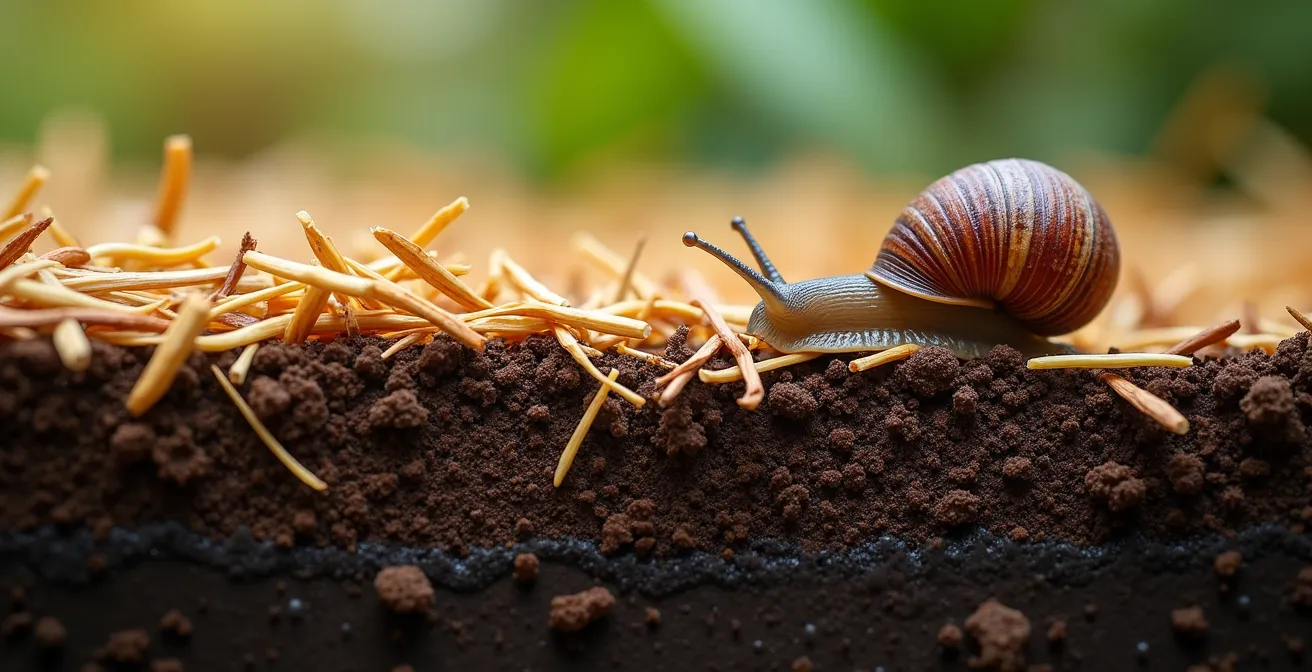
Straw is a fantastic mulching material, particularly for vegetable beds, but its effectiveness hinges on understanding its dual nature. Its primary benefits are slug suppression and water retention, which seem contradictory but work in perfect harmony when applied correctly. The key is creating a layer that is dry and abrasive on top, but moist and protective underneath. Slugs and snails, which thrive in damp conditions, are deterred by the dry, scratchy surface of a thick straw mulch, making it a physical barrier that is far more effective than leaving bare, damp soil around your plants.
Simultaneously, this dry upper layer acts as an insulating shield against the sun and wind, dramatically reducing evaporation from the soil surface. This process of hydrothermal regulation is remarkably effective. In fact, recent 2024 research demonstrates that organic mulching can reduce evaporation by 28-58.8% and enhance soil moisture by up to 22%. The straw itself doesn’t hold much water, but it prevents the water in your soil from escaping.
To achieve this effect, the technique is crucial. You must apply the straw to soil that is already moist, for instance after a good spring rain. The mulch then locks that existing moisture in. The visual below illustrates this principle: a dry, protective upper layer with precious moisture trapped in the soil beneath.
For best results, apply a layer at least 5cm (2in) thick, but do not pile it directly against the stems of your plants, as this can trap too much moisture and encourage rot. A good strategy is to first apply a thin layer of compost for nutrition, and then top it with a thick layer of straw for protection and water retention. This creates a powerful ‘soil sandwich’ that feeds and protects your garden.
Mushroom Compost or Manure: Which Is Better for Clay Soil Improvement?
For gardeners battling heavy clay soil, common in many parts of the UK, incorporating organic matter is non-negotiable. Clay’s fine particles compact easily, leading to poor drainage in winter and a brick-hard surface in summer. Both spent mushroom compost and well-rotted farmyard manure are excellent for improving this, but they have distinct properties that make them suitable for different situations. The choice is not about which is ‘better’ overall, but which is better for your specific soil’s chemistry and your gardening goals.
Spent mushroom compost is a superb structural improver. Its mix of straw, manure, and chalk creates a coarse, fibrous material that physically opens up heavy clay, creating air pockets for roots and improving drainage. However, the chalk used in the growing process gives it an alkaline pH. This makes it ideal for gardens in the western and northern parts of the UK, where soils are naturally more acidic, as it will help to gently raise the pH towards neutral. Conversely, it should be used with caution on the naturally alkaline, chalky soils of Southern England.
Farmyard manure, on the other hand, is typically neutral to slightly acidic and acts more as a rich, fast-acting fertiliser. While it does improve structure, its primary benefit is providing a quick boost of nitrogen and other nutrients, making it perfect for hungry crops like courgettes and brassicas. The main caveat with manure is the potential risk of persistent herbicide contamination, so sourcing it from a trusted, organic-certified supplier is crucial. Scientific studies confirm the profound impact of these amendments; after three years of organic mulching, compost treatment decreased bulk density (a measure of compaction) from 1.22 to 0.89 Mg m−3 and dramatically increased the water infiltration rate in UK garden soil.
The following table, based on guidance from UK horticultural experts, summarises the key differences to help you make an informed choice.
| Property | Mushroom Compost | Farmyard Manure |
|---|---|---|
| pH Level | Alkaline (due to chalk casing) | Neutral to slightly acidic |
| Best for UK Regions | Western/Northern UK (acidic soils) | Southern England (chalk downs) |
| Primary Benefit | Superior structural improver for clay | Fast nutrient boost for vegetables |
| Contamination Risk | Lower risk | Risk of persistent herbicides |
| Decomposition Speed | Slow, long-lasting | Faster breakdown |
The Woodchip Myth: Does Fresh Woodchip Really Steal Nitrogen from Plants?
One of the most persistent myths in gardening is that using fresh woodchip as a mulch will “steal” nitrogen from the soil, starving your plants. This idea has prevented countless UK gardeners from using one of the most sustainable and beneficial mulches available. The science is more nuanced: the decomposition of carbon-rich materials like wood does require nitrogen. However, this process, known as nitrogen immobilisation, only occurs at the very thin interface where the woodchip directly touches the soil. It does not ‘suck’ nitrogen from the entire root zone of an established plant.
For a surface mulch on perennial beds, paths, or around shrubs and trees, the effect is negligible and far outweighed by the benefits. As the woodchip slowly breaks down from the bottom up, it creates a phenomenal habitat for the soil’s ‘biotic engine’. It fosters a fungal-dominant soil environment, which is ideal for perennial plants, and slowly releases its own nutrients over many years. As David Hurrion of Gardeners’ World notes, the benefits extend above ground, too:
Organic mulches also contain nutrients, acting as slow-release plant food. What’s more, while they’re breaking down they attract beetles, worms and other soil invertebrates, which provides food for birds.
– David Hurrion, Gardeners’ World
This transforms your mulch layer from a simple covering into a vibrant ecosystem. It becomes a critical habitat for ground beetles (which eat slugs), a foraging ground for blackbirds, and a haven for hedgehogs, directly contributing to garden biodiversity.

The key is using the right kind of woodchip and applying it correctly. Avoid sterile, bagged bark chippings from garden centres. Instead, seek out fresh arborist woodchip, which contains a mix of wood, bark, and leaves, offering a richer blend of nutrients and textures. Many local tree surgeons in the UK offer “chip drop” schemes, providing a cheap or even free source of this superior material. When using it around annual vegetables, it’s wise to let it age for 6-12 months or to add a nitrogen-rich layer like grass clippings underneath to be safe, but for most garden applications, the nitrogen myth can be confidently busted.
Loose Load vs Bags: When Is It Cheaper to Buy a Cubic Tonne of Mulch?
Once you commit to a serious mulching strategy, the question of logistics and cost becomes paramount. Buying mulch in small 40L plastic bags from a garden centre is convenient for potting or a single container, but it’s an incredibly expensive and inefficient way to cover a garden bed. To apply the recommended 7.5-10cm (3-4 inch) layer of ‘soil armour’, you need to think in terms of cubic metres, not litres. For UK gardeners, the main choice is between a loose bulk load tipped onto a driveway, or delivery in large ‘dumpy’ or tonne bags.
The most cost-effective option is almost always a loose bulk load. You are paying for the product, not for the bagging and extensive handling. This is ideal for those with large gardens and easy access, like a driveway where a tipper truck can drop the load. However, it’s not practical for everyone. If you live in a terraced house with no front garden, or need to move the mulch to an allotment, a loose pile is a logistical nightmare. This is where tonne bags become the superior choice.
While the cost per tonne is higher, a dumpy bag can often be craned over a wall or fence and placed exactly where you need it, saving immense physical labour. It also keeps the material contained, preventing it from washing away in the rain or making a mess. Another emerging option is a community bulk buy, where neighbours group together to order a large loose load and split the cost and the material. As according to the RHS, having mulch delivered in bulk often provides far better value than multiple trips to the garden centre. Deciding which method is ‘cheaper’ involves factoring in not just the ticket price, but also access, labour, and convenience.
This comparison table breaks down the typical options available to UK gardeners.
| Delivery Method | Typical Cost | Coverage | Best For |
|---|---|---|---|
| Loose bulk load | £30-50/tonne | 10-15 sq metres | Large gardens, driveways |
| Dumpy/Tonne bags | £60-80/bag | 8-10 sq metres | Terraced houses, allotments |
| 40L plastic bags | £5-8 each | 0.4 sq metres | Small spaces, containers |
| Community bulk buy | £40-60/tonne split | Varies | Neighbours sharing costs |
Why Does Peat-Free Compost Look Wet on Top but Dry underneath?
As UK gardening moves into the mandatory peat-free era, many gardeners are encountering a frustrating and deceptive problem: the compost in their pots looks dark and moist on the surface, but just an inch below, it’s bone dry, and their plants are wilting. This isn’t a sign of a bad product; it’s a fundamental difference in the physics of the materials used to replace peat. Understanding this is the first step to success with peat-free composts.
Peat has a uniform, sponge-like structure that wicks water evenly. Modern peat-free composts, however, are typically made from a blend of materials with very different properties, most commonly coir (coconut fibre) and wood fibre. Each behaves differently with water. As one analysis explains, this combination creates the issue:
Wood fibre, a common component, can be hydrophobic when it dries, while coir has high surface tension. This combination creates the deceptive crust.
– Scientific explanation, Analysis of UK peat-free compost components
When the surface layer of wood fibre dries out, it can become hydrophobic, meaning it actively repels water. Subsequent light watering may only wet this top crust, while the water fails to penetrate to the root zone below. The coir component can hold a lot of water, but it’s also prone to drying out completely and can be difficult to re-wet. This creates a worst-of-both-worlds scenario: a damp top that fools the eye, and a dry core that starves the plant.
The only reliable way to manage this is to abandon visual checks and adopt a more tactile approach. The ‘finger test’ is no longer just a good habit; it’s an essential skill for peat-free gardening. You must physically check the moisture levels at depth to know when to water. For containers, another good method is to simply lift the pot. A lightweight pot is a dry pot, regardless of how the surface looks.
Key Takeaways
- Mulching is a defensive act of ‘soil armouring’, not just a method for weed suppression or aesthetic improvement.
- Ceasing to dig or till is the first step to protecting the soil’s ‘biotic engine’ and preserving its carbon-rich structure.
- The right choice of mulch (straw, woodchip, compost) depends on specific goals, such as slug control, structural improvement of clay, or creating wildlife habitats.
How to Lock Moisture into Soil So You Only Need to Water Once a Week?
The promise of watering only once a week, even during a dry UK summer, is not a fantasy. It is the achievable result of a systematic approach to soil management that combines building soil structure, intelligent watering, and effective surface protection. It’s about creating a ‘Soil Moisture Sandwich’—a three-layer system that maximises water absorption and minimises evaporative loss. This approach, validated by modern soil science, allows your garden to become a resilient, self-regulating reservoir.
The foundation of this system is high organic matter content *within* the soil. Amending your soil initially with compost improves its structure, creating a sponge that can hold vast quantities of water. The second layer of the ‘sandwich’ is your watering technique. Instead of light, frequent sprinkling which encourages shallow roots, you must water deeply and infrequently. A thorough soaking once a week encourages plant roots to grow deeper in search of moisture, making them far more resilient to surface drying.
The crucial top layer is a thick application of coarse surface mulch, your ‘soil armour’. A 7.5-10cm layer of woodchip or straw acts as a physical barrier, insulating the soil from the sun and wind and drastically cutting down on evaporation. UK soil moisture mapping studies using advanced sensors confirm that this combination of incorporating organic matter, deep watering, and applying a thick surface mulch is the most effective way to maintain consistent soil moisture levels across varied conditions.
By implementing these three elements together—a water-retentive base, deep-rooted plants, and a protective top layer—you transition from a cycle of constant watering to a state of stable hydration. Your garden’s reliance on the hosepipe plummets, and its ability to withstand dry spells increases dramatically.
Your 5-Point Audit for a Water-Resilient Garden
- Foundation Audit: Assess your soil’s base. Is it compacted? Does it drain poorly? Plan to incorporate a 5cm layer of compost into the top few inches (for initial setup only, then no-dig).
- Watering Technique Review: Check your current watering habits. Are you watering little and often? Switch to a deep, thorough soak once a week to encourage deep root growth.
- Soil Armour Assessment: Measure your current mulch layer. Is it less than 7.5cm? Plan to apply a top layer of coarse mulch (woodchip/straw) to a depth of 7.5-10cm.
- Plant Selection Check: Inventory your key plants. Are they thirsty varieties? Identify one or two to replace with UK-proven drought-tolerant species like Verbena bonariensis or Eryngium.
- Timing and Maintenance Plan: Check the calendar. Is your soil moist now (ideal in spring, April-May)? Schedule an annual ‘top-up’ of your mulch layer to maintain its protective depth.
Why Are Your Plants Dying in Peat-Free Compost and How to Fix It?
Many keen gardeners who have embraced the ecological imperative to go peat-free are finding their plants struggling. The issue often isn’t the quality of the compost, but a failure to adapt gardening techniques. With the mandatory peat ban coming into effect for amateur gardeners in England from 2024, mastering these new skills is no longer optional. The two primary reasons plants fail in peat-free mixes are related to nutrition and water management.
Firstly, peat-free composts based on wood fibre and coir contain very few intrinsic nutrients. Peat itself is also nutrient-poor, but its stable structure holds onto added fertilisers for a long time. The coarser structure of many peat-free mixes means that nutrients, especially from liquid feeds, can wash through more quickly. Plants can therefore run out of food much earlier than you might expect. The solution is to start feeding earlier and more regularly. As soon as you see active growth, begin applying a liquid feed (such as an organic seaweed extract) weekly. For containers, incorporating a controlled-release fertiliser at the time of planting is a highly effective strategy.
Secondly, as discussed, the water-holding properties are different. In addition to the ‘wet top, dry core’ issue, the overall structure can slump over time, reducing air pockets for the roots. To combat this, you can improve the structure by mixing your shop-bought peat-free compost with homemade compost or a loam-based mix on a 50:50 basis. This adds more body and better water- and nutrient-holding capacity. Adapting to peat-free is a learning curve, but by adjusting your feeding and watering regimes, you can achieve results that are just as good, if not better, than with peat-based products.
- Start liquid feeding earlier in the season, as soon as growth is established.
- Incorporate a controlled-release fertiliser into all container plantings.
- Water little and often, ensuring the entire root ball is wetted, not just the surface.
- Improve structure by mixing peat-free compost with your own homemade compost.
To truly build a garden that can withstand the UK’s changing climate, the next step is to move beyond troubleshooting individual problems and implement a consistent, holistic mulching strategy. Start today by auditing your soil’s needs and choosing the right ‘soil armour’ for the seasons ahead.