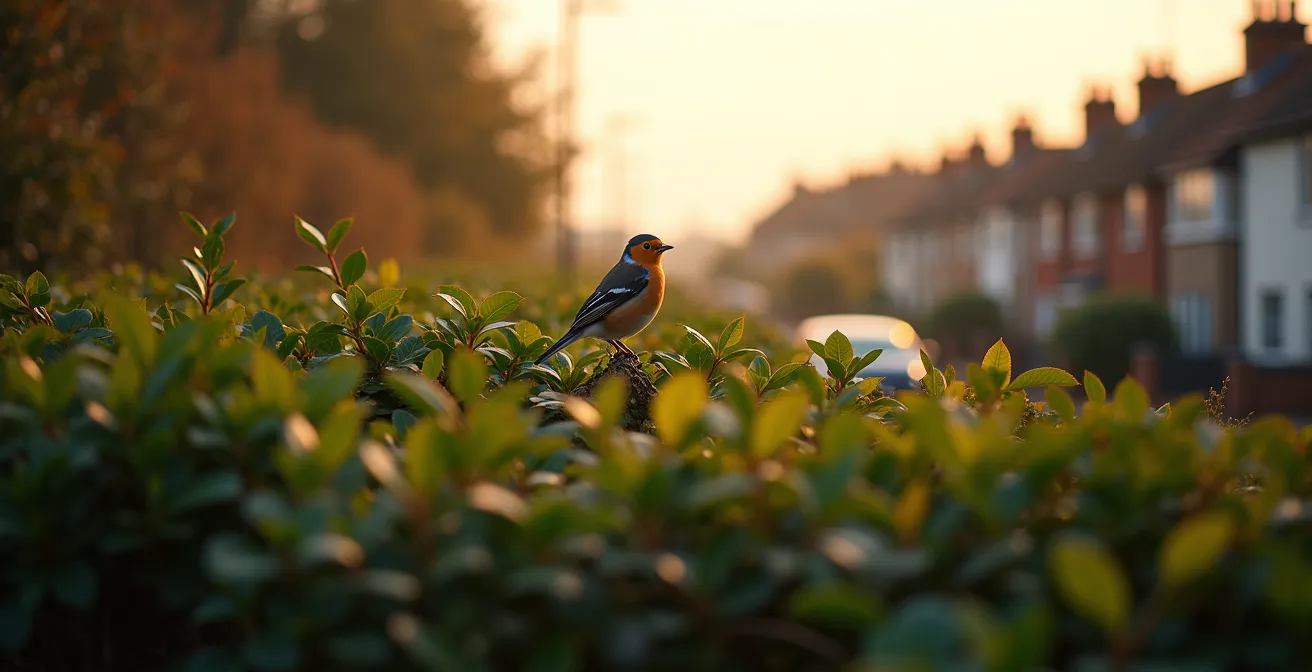
Choosing a native hedge over a fence is the single most impactful decision for transforming your garden from a sterile plot into a living piece of the English countryside.
- It offers a dynamic, multi-sensory barrier that actively deters predators and reduces noise, unlike a passive fence.
- Over 15 years, a native hedge is up to 85% cheaper and adds value to your property, while a fence requires costly replacement.
Recommendation: Prioritise a mixed planting of native, thorny, and marcescent species for year-round privacy, security, and wildlife support.
There’s a familiar sight in the English suburbs and countryside: the erection of a new wooden fence. The neat stack of treated pine panels and the rhythmic thump of the post driver promise a swift solution to privacy. It’s seen as the default, the clean and simple way to mark one’s territory. We’ve been conditioned to believe that a good fence makes a good neighbour, and that its uniform, impenetrable line is the pinnacle of garden security and seclusion. This thinking suggests it’s the low-maintenance, straightforward choice for a modern home.
But what if this pursuit of instant privacy is a missed opportunity? What if the ‘perfect’ boundary is, in fact, a silent, sterile barrier, rejecting the very landscape it sits within? The truth is, a fence is a dead structure. It offers no food, no shelter, and no life. It begins to decay the moment it’s installed, demanding paint, repairs, and eventual, costly replacement. It stands in stark contrast to the alternative, an approach deeply woven into the fabric of our nation’s heritage: the native hedgerow.
This guide challenges the supremacy of the fence. The real key to lasting privacy and a truly beautiful boundary lies not in erecting a sterile barrier, but in cultivating a living sanctuary. A native hedge isn’t just a line of plants; it’s a dynamic, four-dimensional ecosystem. It is a living tapestry that changes with the seasons, offers an ecological dividend in the form of wildlife and birdsong, and becomes a lasting landscape legacy that grows in value and beauty over time.
This article will guide you through the profound and practical advantages of this choice. We will explore how a hedge offers superior protection for wildlife, why it’s a shrewder financial investment, and how it can be managed to ensure perfect neighbourly relations while re-stitching your garden back into the glorious, breathing countryside of England.
Summary: The Enduring Value of a Living English Boundary
- Why Do UK Songbirds Abandon Gardens With Wooden Fences?
- How to Plant a Mixed Native Hedge in Winter for Guaranteed Growth?
- Hedge Trimming vs Fence Painting: Which Takes More Time Over a Decade?
- The High Hedge Law Mistake That Could Land You in Court
- Which Native Species Mix Provides the Best Winter Screening?
- Trees or Hedges: Which Corridors Are Vital for Bats and Birds?
- How to Use Planting to Block Traffic Noise and Create a Quiet Zone?
- How to Convince Your Neighbours to Create a Hedgehog Highway Street?
Why Do UK Songbirds Abandon Gardens With Wooden Fences?
The gentle chirping of a robin or the cheerful melody of a blue tit is the quintessential soundtrack to an English garden. Yet, in gardens bordered by tall, stark fences, this music often fades. The reason is brutally simple: a wooden fence is a predator’s playground. It offers no refuge for small birds. Cats, in particular, can patrol the top of a fence panel like a sentry, surveying the garden below for unsuspecting prey. With an estimated 9 million cats killing an average of 30 birds each per year in the UK, providing safe spaces is not a luxury, but a necessity for garden bird survival.
A fence offers zero escape cover. When a sparrowhawk dives, a small bird’s only hope is to plunge into dense, thorny vegetation in a split second. A fence panel is an unforgiving wall. A native hedge, by contrast, is a fortress of life. The dense, interwoven branches of species like hawthorn and blackthorn create an impenetrable thicket that larger predators cannot breach. It’s not just a barrier; it’s a three-dimensional sanctuary.
This living structure provides more than just safety. It’s a larder, a nursery, and a home. Birds like the whitethroat and yellowhammer will nest deep within its protective embrace. They feast on the insects, berries, and seeds it provides throughout the year. The fence is a sterile barrier, but the hedge is a bustling high street for wildlife, a critical piece of the living tapestry that supports a healthy garden ecosystem. Choosing a hedge is a direct invitation for songbirds to stay.
By replacing a dead wall with a living one, you are not just marking a boundary; you are actively casting a vote for a garden filled with life and song.
How to Plant a Mixed Native Hedge in Winter for Guaranteed Growth?
Planting a hedge is an act of faith and an investment in the future. The best time to lay the foundation for this landscape legacy is during the plant’s dormancy, between November and March. This is when you can use bare-root “whips”—young, field-grown plants that are cost-effective and establish with remarkable vigour. Success is not a matter of chance, but of following a few time-honoured steps that work in harmony with nature’s cycles.
The process is more straightforward than many believe and deeply rewarding. It begins with choosing the right species for your soil and location, and ends with a line of promising young plants ready to burst into life in the spring. Following a structured approach ensures you are creating a dense, healthy barrier that will thrive for generations.
Here is a proven method for planting a mixed native hedge for guaranteed growth:
- Select Location-Appropriate Species: A mix is always best for wildlife. A classic English hedge blend of hawthorn, blackthorn, field maple, and holly provides a fantastic habitat and varied seasonal interest.
- Prepare the Ground: Clear a strip at least a metre wide of all weeds and grass. Dig a trench around 30cm deep and wide, forking over the base to break up any compaction.
- Boost the Roots: Before planting, apply mycorrhizal fungi directly to the roots. Products like Rootgrow help the plants form a secondary root system, dramatically improving nutrient and water uptake.
- Space for Density: For a thick, stock-proof hedge, plant your whips in two staggered rows. Aim for 4-5 plants per metre, with about 30cm between the two rows. This ensures the hedge knits together quickly and densely.
- Plant and Firm: Place the plants in the trench so the soil mark on the stem is level with the ground. Backfill with soil, gently shaking the plant to ensure soil fills around the roots. Firm in well with your heel.
- Water and Mulch: Water the newly planted hedge thoroughly. Applying a thick layer of bark mulch or well-rotted compost will suppress weeds and conserve moisture during the crucial first year.
Once established, your native hedge will be remarkably drought-tolerant and self-sufficient, a testament to the resilience of plants perfectly suited to the British climate.
Hedge Trimming vs Fence Painting: Which Takes More Time Over a Decade?
One of the most persistent myths favouring fences is that they are “low maintenance.” This perception is largely based on the initial few years. In reality, a wooden fence is a depreciating asset with a built-in cycle of costly and time-consuming upkeep. It demands regular treatment against rot and, in the UK climate, its eventual full replacement is an inevitability. The gentle annual trim of a mature hedge pales in comparison to the repetitive cycle of sanding, treating, and painting fence panels, or the significant cost of replacing them.
The contrast between the two is starkly illustrated below. On one side, a thriving, mature hawthorn hedge, a picture of health and vitality. On the other, a typical wooden fence after a few British winters: weathered, weakening, and showing the first signs of decay. The hedge grows in value and ecological richness; the fence simply deteriorates.
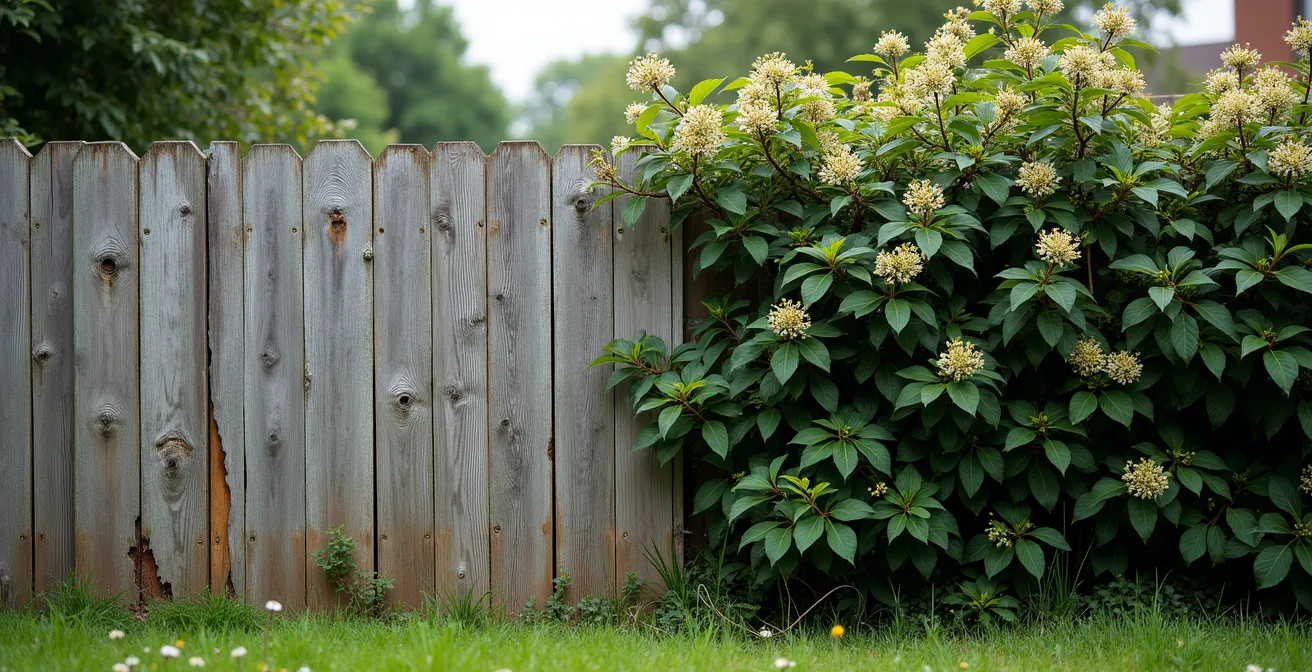
This visual difference is mirrored in the long-term costs. A fence requires a large upfront investment and then periodic, significant financial outlays. A hedge, started from bare-root whips, has a very low initial cost and requires only a small amount of time for an annual trim once established. An analysis by the Woodland Trust shows the dramatic financial difference over a 15-year period for a typical garden boundary.
The following data reveals that choosing a hedge isn’t just an ecological choice, but a profoundly sensible financial one, delivering a huge saving that can be considered a direct financial dividend.
| Cost Factor | Wooden Fence | Native Hedge |
|---|---|---|
| Initial Installation | £1,500-2,000 | £200-400 (bare root plants) |
| Maintenance Years 1-5 | £300 (painting every 3 years) | £0 (establishing) |
| Maintenance Years 6-10 | £600 (2x painting) | £150 (annual trim 3hrs @ £15/hr) |
| Maintenance Years 11-15 | £2,000 (full replacement) | £225 (annual trim) |
| Total 15-Year Cost | £4,400-4,900 | £575-775 |
| Property Value Impact | Neutral/Negative if deteriorating | Positive (kerb appeal) |
Ultimately, a native hedge is an appreciating asset that enhances your property’s appeal and biodiversity. A fence is a depreciating liability with a finite lifespan and a recurring cost.
The High Hedge Law Mistake That Could Land You in Court
The phrase “high hedge dispute” can send a shiver down the spine of any homeowner. The fear of protracted disagreements with neighbours over light and views is a powerful deterrent and often pushes people towards the perceived safety of a standard 2-metre fence. However, this fear is almost exclusively associated with one specific type of plant: the fast-growing conifer, particularly Leylandii. Native mixed hedges, being slower growing and easier to manage, very rarely cause such issues. The key is not to avoid hedges, but to practice good boundary stewardship from the outset.
Poor planning is the root of almost all hedge-related disputes. Planting an inappropriate species too close to a boundary without any discussion is a recipe for trouble. If a complaint is made to the local council under the High Hedges part of the Anti-social Behaviour Act 2003, it can be a stressful and expensive process, with application fees often ranging from £400-£700 according to the Woodland Trust. The good news is that this is entirely avoidable with a little foresight and communication.
Adopting a ‘good neighbour’ approach transforms the process from a potential conflict into a collaborative enhancement of both properties. A well-maintained native hedge is an asset to everyone. The following checklist provides a clear, actionable framework for ensuring your living boundary is a source of pride, not problems.
Your Good Neighbour’s Hedgerow Plan
- Discuss Plans First: Before a spade hits the ground, have a friendly chat with your neighbours about your intentions. Show them the species mix and agree on the position. Getting an informal agreement in writing or an email is a wise precaution.
- Choose Sensible Species: Explicitly avoid fast-growing conifers like Leylandii for boundary lines. Opt for a classic, manageable native mix which is far less likely to cause issues with height or spread.
- Respect the Boundary Line: Plant the hedge at least 1 metre back from the legal boundary line. This allows the hedge to grow to a reasonable width without overhanging and causing an issue for your neighbour.
- Agree on Maintenance: Discuss a maintenance schedule. A single annual trim after the bird nesting season (i.e., from September onwards) is usually sufficient for a native hedge. Agree on who will trim which side.
- Maintain a Social Height: Keep the hedge to a height that you can both comfortably live with. A height of around 1.8-2 metres is standard and prevents any potential ‘loss of light’ claims under the High Hedge legislation.
By following these simple, considerate steps, you can enjoy all the benefits of a beautiful native hedge with complete peace of mind, fostering goodwill rather than resentment.
Which Native Species Mix Provides the Best Winter Screening?
A common argument for fences is their promise of “instant, year-round privacy.” Many assume that a deciduous hedge will leave them exposed throughout the winter months. This is a misunderstanding of the sophisticated way a well-designed mixed hedge works. By combining different types of plants, you can create a dense, visually interesting screen that provides excellent privacy 365 days a year, something far more beautiful than a monolithic wall of wood or conifer.
The secret lies in a multi-layered strategy using three key types of plants. Firstly, evergreens like Holly (Ilex aquifolium) or Yew (Taxus baccata) provide the structural backbone of green throughout the winter. Secondly, and most cleverly, are the marcescent species. These are deciduous trees like Beech (Fagus sylvatica) and Hornbeam (Carpinus betulus) that retain their dead leaves—a beautiful, coppery-bronze—on their branches all winter, only shedding them when the new green leaves emerge in spring. This provides a wonderfully textured, light-filtering screen when most other trees are bare.
Finally, the inclusion of dense, twiggy, thorny species like Hawthorn (Crataegus monogyna) and Blackthorn (Prunus spinosa) creates a thick matrix of branches that is difficult to see through even without leaves. This combination is not only effective but also provides a dynamic, changing view that marks the passing of the seasons. For an ultimate, police-approved boundary, a specific mix can be employed that combines privacy with formidable security.
- 40% Thorny Base: Hawthorn and Blackthorn form a fast-growing, dense, and spiky core.
- 30% Evergreen Structure: Holly provides year-round green and an additional thorny deterrent.
- 20% Marcescent Screen: Beech or Hornbeam hold their leaves to provide a solid winter privacy screen.
- 10% Winter Colour: Dogwood (Cornus sanguinea) can be added for its stunning red stems that glow in the low winter sun.
This intelligent mix creates a boundary that is not only secure and private but also a beautiful, evolving feature of the garden, offering far more interest and ecological value than a static fence.
Trees or Hedges: Which Corridors Are Vital for Bats and Birds?
When we look at a hedge, we see a boundary. When a bat or a dormouse looks at a hedge, it sees a motorway, a restaurant, and a safe house all in one. Hedges are the vital arteries of the British countryside, linear corridors that allow wildlife to move safely between fragmented habitats. A garden fence, in this context, is not just a barrier; it is a dead end. It abruptly severs these ancient pathways, isolating wildlife and making gardens ecological islands.
The importance of these corridors cannot be overstated. As The Wildlife Trusts eloquently state, they form a complete ecosystem in miniature. It’s a truth that brings the whole concept of a ‘living boundary’ into sharp focus.
Bank vole, harvest mouse and hedgehog all nest and feed in hedgerows alongside birds including blue tit, yellowhammer and whitethroat, while bats use them as ‘commuter routes’ for foraging and roosting.
– The Wildlife Trusts, Hedgerow habitat guide
For bats, such as the common pipistrelle, hedgerows are particularly critical. They navigate and hunt by echolocation, following linear features in the landscape. A dark, featureless garden bordered by fences is a confusing and dangerous void. A garden bordered by a hedge is a clear, food-rich flight path, connecting their roosts to foraging grounds.

By planting a native hedge where a fence might have stood, a homeowner is doing more than just marking their property. They are making a conscious decision to plug their garden back into this wider living tapestry. You are restoring a vital piece of local infrastructure for countless species. A single hedge can connect a garden to a nearby copse, a park, or another hedge down the road, creating a safe passage for everything from hedgehogs to butterflies.
Choosing a hedge is an act of profound generosity to the natural world, ensuring your private space contributes to the health of the entire local ecosystem.
How to Use Planting to Block Traffic Noise and Create a Quiet Zone?
The drone of distant traffic is an unwelcome intrusion into the peace of a garden. Many believe a solid fence is the best solution for soundproofing, but the physics of sound tells a different story. A hard, flat surface like a wooden fence does not absorb sound; it reflects it. This can sometimes create strange echoes or even bounce noise towards the house. A dense, living hedge works in a completely different and more effective way. It absorbs and diffuses sound waves.
The complex structure of a hedge—with its thousands of leaves, twigs, and branches of varying sizes and angles—breaks up sound waves, reducing their energy. The soft surfaces of the leaves absorb sound rather than reflecting it. A thick, well-maintained hedge can achieve a noise reduction of 5-10 decibels. While this may not sound like much on paper, it is perceived by the human ear as roughly halving the noise level, transforming a noticeable drone into manageable background sound.
For homeowners on particularly busy roads, this effect can be amplified using a professional landscaping technique that mirrors the methods used by National Highways England on motorways. This involves creating an earth mound, or ‘berm’, along the boundary line.
- First, a landscaped earth mound, 1 to 1.5 metres high, is built along the boundary.
- The dense hedge is then planted on top of this berm, effectively raising the height of the sound barrier.
- A mix of species with year-round foliage, such as Holly, Yew, and retained-leaf Beech, is planted in a triple-row pattern for maximum density.
- Maintaining a hedge width of at least 1.5 metres is crucial for optimal sound diffusion.
This approach creates a formidable, natural sound wall that significantly enhances the tranquility of your garden, delivering an ‘ecological dividend’ of peace and quiet that a simple fence can never match.
Key takeaways
- Hedges provide active, three-dimensional protection for wildlife from predators, a function that passive, sterile fences cannot fulfil.
- A native hedge is a significant long-term financial asset, costing up to 85% less than a wooden fence over a 15-year period due to low installation costs and minimal maintenance.
- Intelligent species selection, incorporating a mix of thorny, evergreen, and marcescent plants, is the key to creating a boundary that offers dense, year-round privacy and security.
How to Convince Your Neighbours to Create a Hedgehog Highway Street?
The final, and perhaps most profound, advantage of a living boundary over a sterile fence is its ability to connect, not just divide. Our gardens are not isolated plots; they are a patchwork quilt of potential habitats. But impermeable fences have turned this quilt into a collection of disconnected squares, with devastating consequences. The tragic decline of the hedgehog, one of Britain’s most beloved mammals, is a direct result of this fragmentation. The State of Britain’s Hedgehogs 2022 report reveals a staggering 30-75% decline in rural areas since 2000, largely because they cannot roam the large territories they need to find food and mates.
A fence is a full stop. A gravel board at the bottom of a fence panel is an insurmountable wall for a hedgehog. The solution is beautifully simple: a 13cm by 13cm hole. But this small gap represents a monumental shift in thinking—from pure privacy to compassionate connection. By convincing neighbours to join in, you can create a “Hedgehog Highway,” transforming an entire street into a super-habitat.
Broaching the subject with neighbours can feel daunting, but framing it as a positive, proactive community project is often met with enthusiasm. The Hedgehog Street campaign, a partnership between the People’s Trust for Endangered Species (PTES) and The British Hedgehog Preservation Society (BHPS), provides excellent resources. Sharing key statistics about the decline, organising a “Hedgehog Highway Weekend,” and leading by example by creating a hole in your own fence first are powerful ways to build momentum. This small act of community stewardship extends the principle of the living boundary beyond your own garden and into the neighbourhood.
Ultimately, choosing a hedge and championing a hedgehog highway are two sides of the same coin. They represent a choice to create a garden that works with the grain of the English landscape, fostering a legacy of life, connection, and beauty that no wooden fence could ever hope to match. Assess your garden’s potential to become part of this living network and begin your journey towards a truly meaningful boundary today.