
For large families in England, switching to a water meter is less of a financial gamble and more of a strategic household audit.
- A meter transforms your water bill from an uncontrollable fixed charge into a manageable expense, exposing hidden costs like silent leaks.
- Legislation provides a risk-free trial period (up to 24 months), allowing you to revert to your old rate if your bills increase.
- Modern, passive water-saving technology can drastically cut consumption without relying on changing your family’s habits.
Recommendation: Treat the switch as a no-obligation financial experiment. Use the trial period to gather data, fix inefficiencies, and make a decision based on hard numbers, not fear.
That brown envelope from your water company has arrived. It suggests, or perhaps insists, that you consider switching to a water meter. For a large family, this can trigger immediate financial anxiety. Visions of teenagers taking hour-long showers and the constant hum of the washing machine translate into a fear of skyrocketing bills. The old system, based on your home’s “rateable value,” is predictable, even if it feels expensive. The meter, however, represents the unknown.
The common advice is often a simplistic rule of thumb: if you have more bedrooms than people, a meter is likely cheaper. This fails to capture the reality of modern family life. What it misses is the fundamental shift in perspective a meter provides. It’s not just a billing device; it’s a powerful diagnostic tool for your home’s water efficiency. The decision to switch isn’t about hoping your family uses less water; it’s about gaining the control and information needed to ensure you pay a fair price.
This article moves beyond the generic advice. We will dismantle the fear by focusing on the mathematical realities, the legal safety nets specific to England, and the practical technology that empowers you to manage costs. We will explore the surprising scenarios where you can save money even if a meter can’t be fitted, how to become a “leak detective” with a smart meter, and why your postcode is as important as your consumption habits. This is your guide to turning an uncertain decision into a calculated, and likely profitable, household strategy.
To navigate this decision effectively, we will break down the key questions and strategic considerations. The following sections provide a clear roadmap, from understanding the financial nuances to leveraging the legal protections available to you.
Summary: Deciphering the Water Meter Decision for Your Family
- Why You Might Pay Less if a Meter Cannot Be Installed?
- How to Use Your Smart Meter to Detect a Silent Toilet Leak?
- North vs South: Where Does Switching to a Meter Save the Most?
- The Switching Error: Can You Go Back to Fixed Rates if Bills Soar?
- How to Install Flow Restrictors That Teenagers Won’t Notice?
- Where Exactly Does the Water Company’s Responsibility End on Your Street?
- Why Must Kitchen Sink Water Be Treated as Black Water, Not Grey?
- Who Pays for the Leak: You or the Water Company if Pipes Burst Underground?
Why You Might Pay Less if a Meter Cannot Be Installed?
In a surprising twist of regulation, one of the most beneficial outcomes can occur when your water company cannot fit a meter at your property. This might happen due to complex pipework, shared supplies, or the cost and disruption being prohibitive. When this occurs, you cannot be left on the outdated Rateable Value (RV) system if you’ve requested a meter. Instead, you are typically moved to an “Assessed Charge.”
This charge is a fixed annual fee based not on your property’s historical value, but on the water company’s estimate of what an average family in a similar-sized property would use. For many large families in older, high RV homes, this can lead to significant and immediate savings. You get the benefit of a bill based on typical usage without the stress of monitoring actual consumption. For instance, some schemes show a potential £40.88 reduction on wastewater charges alone for properties without a meter.
The difference between assessed charges and rateable value bills varies by region, but it almost always presents a financial advantage for those in high RV properties, as this comparative table based on Ofwat data suggests.
| Water Company | 4-Bed Assessed Charge (Annual) | Average Rateable Value Bill | Potential Saving |
|---|---|---|---|
| Thames Water | £420-480 | £471 | Up to £51 |
| Southern Water | £450-500 | £548 | Up to £98 |
| Northumbrian Water | £380-420 | £422 | Up to £42 |
Therefore, requesting a meter is a no-lose situation. In the best-case scenario, a meter is fitted and you take control of your bills. In another excellent scenario, it can’t be fitted, and you are moved to a potentially cheaper fixed assessed charge. This removes a significant element of risk from the decision.
How to Use Your Smart Meter to Detect a Silent Toilet Leak?
One of the most powerful features of a water meter, especially a smart meter with an online portal, is its ability to turn you into a household “leak detective.” The most common and costly culprit is the silent toilet leak, where water constantly trickles from the cistern into the pan. It’s often invisible and inaudible, yet it can waste hundreds of litres a day. In fact, research shows a continuously leaking toilet cistern can add approximately £94 per year to a metered bill in England.
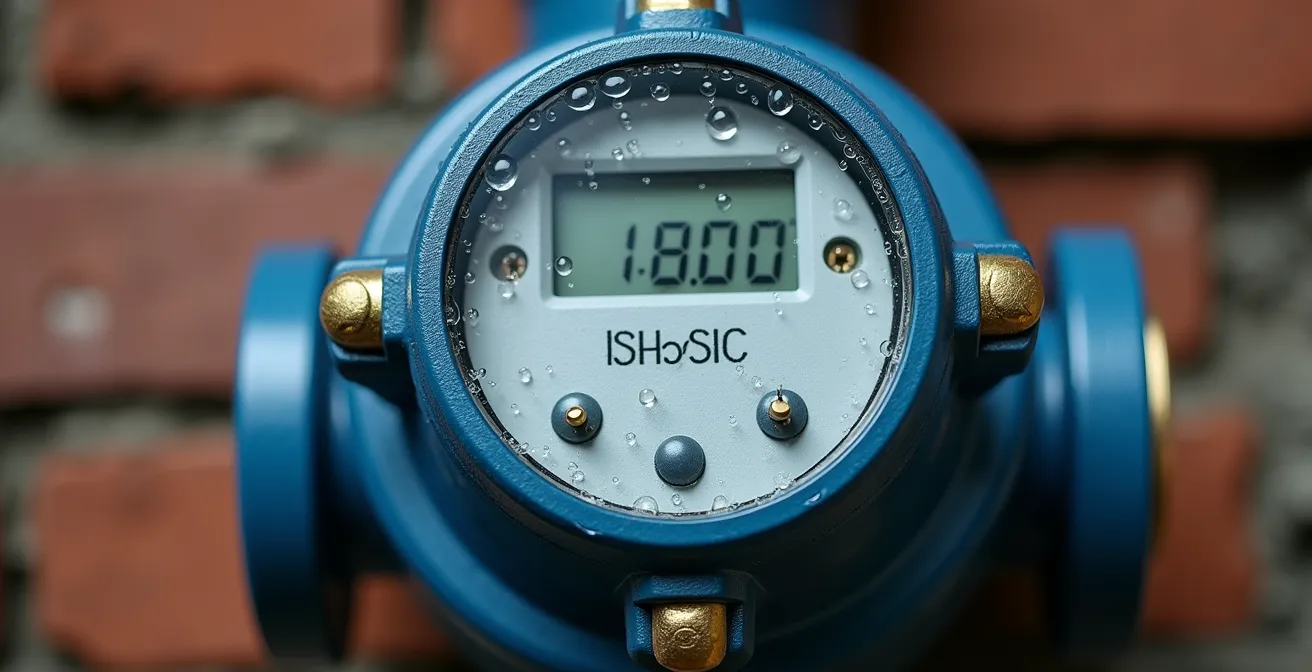
Your meter provides the definitive evidence. A traditional meter will have a small dial or bubble that spins even when all taps are off, but a smart meter makes diagnosis even easier. By performing a simple overnight flow test, you can identify a problem without needing a plumber. This test relies on a period when no legitimate water use should occur.
Follow this simple procedure to check for hidden leaks:
- Log into your water company’s app or online portal around 11 PM to view your smart meter’s hourly data, or take a manual reading if you have an older meter.
- Ensure no one in the house uses any water overnight (no flushing toilets, running taps, or using the dishwasher/washing machine).
- Check the readings again between 2 AM and 4 AM. Most smart meter portals show a graph of hourly or even half-hourly consumption.
- Any consistent, non-zero flow during this period is a strong indicator of a leak. A continuous flow of even a few litres per hour confirms there is an issue that needs fixing.
This simple diagnostic capability transforms the meter from a billing tool into a home maintenance asset, empowering you to stop paying for water you aren’t even using.
North vs South: Where Does Switching to a Meter Save the Most?
A crucial factor often overlooked in the water meter debate is geography. The financial benefit of switching is not uniform across England; it is heavily influenced by regional variations in unmetered charges. Unmetered bills are based on the historic “rateable value” of a property, a system that creates significant disparities. Generally, properties in the South of England have higher rateable values and, consequently, higher unmetered water bills than identical properties in the North.
This means the potential savings from switching to a meter are often far greater for families living in the South. Data consistently shows this regional divide. For example, analysis confirms the gap between highest and lowest bills shows a £126 annual difference across England for 2024-25. A family in a high-cost area has much more to gain by moving to a bill based on consumption rather than an inflated property value from decades ago.
Consider this practical example: A family of five in Sunderland (Northumbrian Water) might pay an unmetered bill of £422. An identical family with the exact same water usage habits living in Brighton (Southern Water) could face an unmetered bill of £548. That’s a £126 difference for the same lifestyle. If both families switched to a meter and used an average amount of water (e.g., 150 cubic metres per year), their bills would become much more similar, likely around £450-£500. For the Sunderland family, the saving is minimal or non-existent. For the Brighton family, the saving is substantial.
Therefore, your decision-making process must include your postcode. If you live in a region with high unmetered charges like the South West, South East, or Anglian regions, the mathematical argument for switching to a meter is overwhelmingly strong, especially for a large family in a high RV property.
The Switching Error: Can You Go Back to Fixed Rates if Bills Soar?
This is the single most important safety net for any family considering a water meter in England. The fear of being locked into unexpectedly high bills is the biggest barrier to switching. However, consumer protection regulations provide a powerful, risk-free trial period. In most cases, if you voluntarily switch to a meter, you have the legal right to switch back to your old, unmetered charging system within a trial period.
This right is enshrined in the industry regulations and championed by consumer bodies. As the Consumer Council for Water (CCW), the independent voice for water consumers in England and Wales, clarifies:
You can switch back to the unmetered charge within 24 months if you’re unhappy, except for customers in water-stressed areas of England where compulsory metering is introduced
– Consumer Council for Water, CCW Water Meter Guide
This trial period, which is a minimum of 12 months and often extends to 24 months, effectively creates a no-lose financial experiment. You can use this time to see how your family’s actual usage translates into cost. If the metered bills are lower, you’ve won. If they are higher, you simply inform your water company before the deadline, and they will revert you to your previous fixed-rate charge, often refunding you the difference for the trial period. The key is to be strategic and use this time wisely.
To make the most of this trial, follow a structured approach:
- Months 1-3: Establish your baseline usage. Track your bills and compare them directly to what you were paying on the unmetered system.
- Months 4-6: Monitor for seasonal changes. Note the impact of summer activities like filling a paddling pool or watering the garden.
- Months 7-9: Test water-saving measures. Install a new showerhead or fix that dripping tap and track the real-world impact on your bill.
- Month 10: Calculate your projected annual cost and make a clear comparison with your old bill.
- Month 11: Make your final decision. Do not leave it to the last minute.
- Month 12 (or 24): If you decide to revert, submit your request to the water company in writing before the deadline.
How to Install Flow Restrictors That Teenagers Won’t Notice?
For a large family, the biggest variable in water consumption is often the teenager who enjoys long, powerful showers. Relying on persuasion to change this behaviour is often a losing battle. The strategic solution is to engineer the savings through technology that works passively, reducing water flow without a noticeable drop in performance or comfort. These devices are cheap, easy to install, and most importantly, “teenager-proof.”
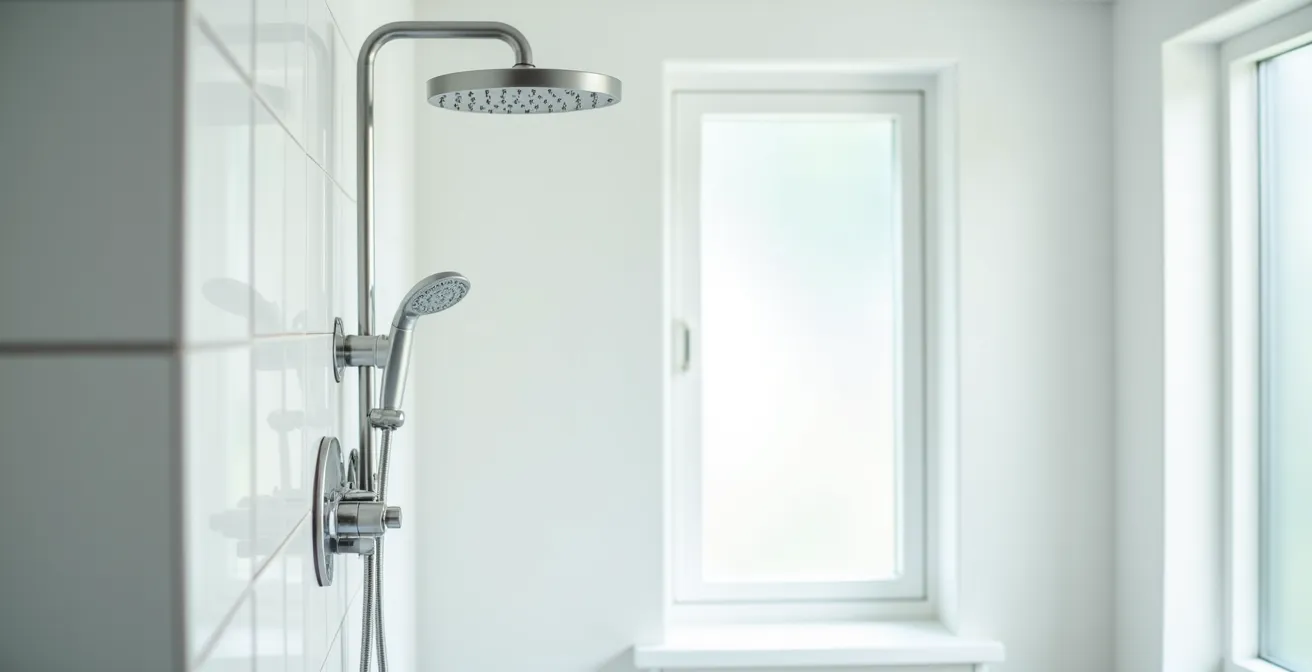
The goal is to reduce the litres-per-minute flow rate without sacrificing the feeling of pressure. This is achieved through aerators and regulators. A tap aerator mixes air into the water stream, making it feel soft and full while using up to 50% less water. A shower regulator, often a small disc inserted into the shower hose, limits the volume of water that can pass through without affecting the pressure built up in the head. They are hidden and their effect is subtle. Real-world projects have demonstrated their effectiveness. For example, a 2024 project by Ashford Council found that installing such devices led to average annual savings of £93 on water bills and a further £270 on energy bills from heating less water.
Choosing the right device depends on your goal and where you want to install it. Here is a comparison of common “invisible” water-saving devices:
| Product Type | Flow Rate | Feel/Pressure | Tamper Resistance | Price Range |
|---|---|---|---|---|
| Tap Aerators | 6L/min | Soft, aerated feel | Medium – visible | £2-5 |
| Shower Flow Regulators | 8L/min | Maintains pressure feel | High – hidden in hose | £10-15 |
| Smart Shower Timer | N/A | No change | Low – removable | £15-25 |
By investing a small amount in these devices, you take back control of your home’s maximum consumption rate. It’s a mathematical, not psychological, approach to managing the unpredictable usage patterns of a large family.
Where Exactly Does the Water Company’s Responsibility End on Your Street?
Understanding who is responsible for which part of the water pipe network is crucial, especially when a leak occurs. The rule is simple and legally defined: the boundary of responsibility is the external stop tap (also known as a stopcock or “toby”). This is the small valve typically located under a metal or plastic cover on the pavement or verge just outside your property boundary.
Your water company is responsible for the water main running down the street and the communication pipe that connects this main to your external stop tap. From the stop tap onwards, the pipework belongs to you. This means that according to the Water Industry Act 1991, homeowners are responsible for the maintenance and repair of the supply pipe running from the boundary into their home, as well as all the plumbing inside the property.
This clear division has major financial implications. If a leak occurs on the company’s side of the stop tap, they are legally obliged to fix it at their own cost. If the leak is on your side—even if it’s underground in your garden—the financial responsibility for the repair, and for the lost water if you have a meter, falls on you.
This situation can be complicated by older housing stock. Many Victorian and Edwardian terraces have shared supply pipes, where a single pipe from the main branches off to serve multiple houses. In this case, responsibility for repairs on the shared section is joint between all connected properties, which can lead to disputes and delays. While water companies cannot force you to separate a shared supply, they often encourage and may even offer assistance to do so, as it allows for accurate individual metering.
Why Must Kitchen Sink Water Be Treated as Black Water, Not Grey?
In the quest for sustainability, many families consider recycling “greywater”—water from showers, baths, and bathroom sinks—for uses like garden irrigation. However, a critical mistake is to include water from the kitchen sink or dishwasher in this category. For health and environmental reasons, UK regulations and environmental guidance are clear: kitchen wastewater must be treated as “black water,” the same as water from a toilet.
The primary reason is the high concentration of contaminants. Water from washing raw meat, contaminated vegetables, or just greasy pots and pans is fundamentally different from soapy bathwater. As the UK Environment Agency warns, kitchen sink water can contain high levels of pathogens like E.coli and Campylobacter. Using this water on a vegetable patch or even a lawn poses a significant health risk.
Beyond the biological hazards, kitchen wastewater contains large amounts of Fats, Oils, and Grease (FOG). While liquid when warm, FOG solidifies as it cools. When used for irrigation, it doesn’t just water plants; it rapidly clogs the pores in the soil. This prevents proper water absorption and creates an anaerobic (oxygen-free) environment that suffocates plant roots, effectively killing your garden within a matter of weeks. It also leads to foul odours and can attract pests. Because of this, greywater recycling systems are explicitly designed to exclude kitchen sink output, which must be directed to the main sewer for full treatment.
Understanding this distinction is vital for any family looking to save water. Attempting to reuse kitchen wastewater is not only ineffective but can be dangerous and destructive to your garden, making it a false economy.
Key takeaways
- Switching to a meter is not a gamble; it’s a diagnostic tool to understand and control your home’s water usage.
- The legal right to revert to fixed rates within 12-24 months in England makes the switch a risk-free financial audit.
- Your geographic location is a primary factor; families in the South of England with high rateable values have the most to gain.
Who Pays for the Leak: You or the Water Company if Pipes Burst Underground?
The moment you suspect an underground leak—perhaps a patch of unusually green grass in a dry spell or the sound of running water when all taps are off—the first question is always: “Who is going to pay for this?” As we’ve established, the answer depends entirely on which side of the external stop tap the leak is located. If it’s on your property, the responsibility for both the repair and the cost of the wasted water is yours.
This can be financially devastating on a metered supply. However, most water companies in England offer a “Leak Allowance Scheme” as a form of goodwill. This policy is designed to protect customers from the shock of a huge bill caused by their first significant leak. It’s crucial to understand the main condition: these schemes typically cover the cost of the water for the first leak only, provided you repair it promptly. It is not a recurring protection. Furthermore, many home insurance policies include “Trace and Access” cover, which pays for the cost of finding the leak (e.g., digging up your garden), even if it doesn’t cover the repair itself.
If your meter is spinning wildly and you suspect a leak on your property, you need to act immediately to mitigate the damage and cost. A clear emergency plan is essential.
Your Meter Is Spinning Wildly: A 5-Step Emergency Action Plan
- Turn off your internal stopcock immediately. This is usually under the kitchen sink. This will stop water flowing into your house and prevent internal flooding.
- Check if the meter stops spinning. If turning off the internal stopcock stops the meter, the leak is inside your house. If it continues to spin, the leak is on the supply pipe between the meter and your house.
- Contact your water company’s emergency line. Inform them of the leak immediately. This is the first step to becoming eligible for their Leak Allowance Scheme.
- Call your home insurance provider. Check if you have “Trace and Access” coverage to help with the costs of locating the leak.
- Find a WaterSafe approved plumber. For urgent repairs on your private supply pipe, use a plumber who is certified and approved to work on the water network.
By understanding your responsibilities and the support systems in place, you can navigate the stressful experience of a leak with a clear head and a structured plan.
The decision to switch is ultimately a calculated one. By using the meter as a diagnostic tool, leveraging the risk-free trial period, and understanding the financial levers at your disposal, you can move from a position of fear to one of empowered control. The next logical step is to contact your water supplier and begin your no-obligation trial period, armed with the knowledge to make it a success.