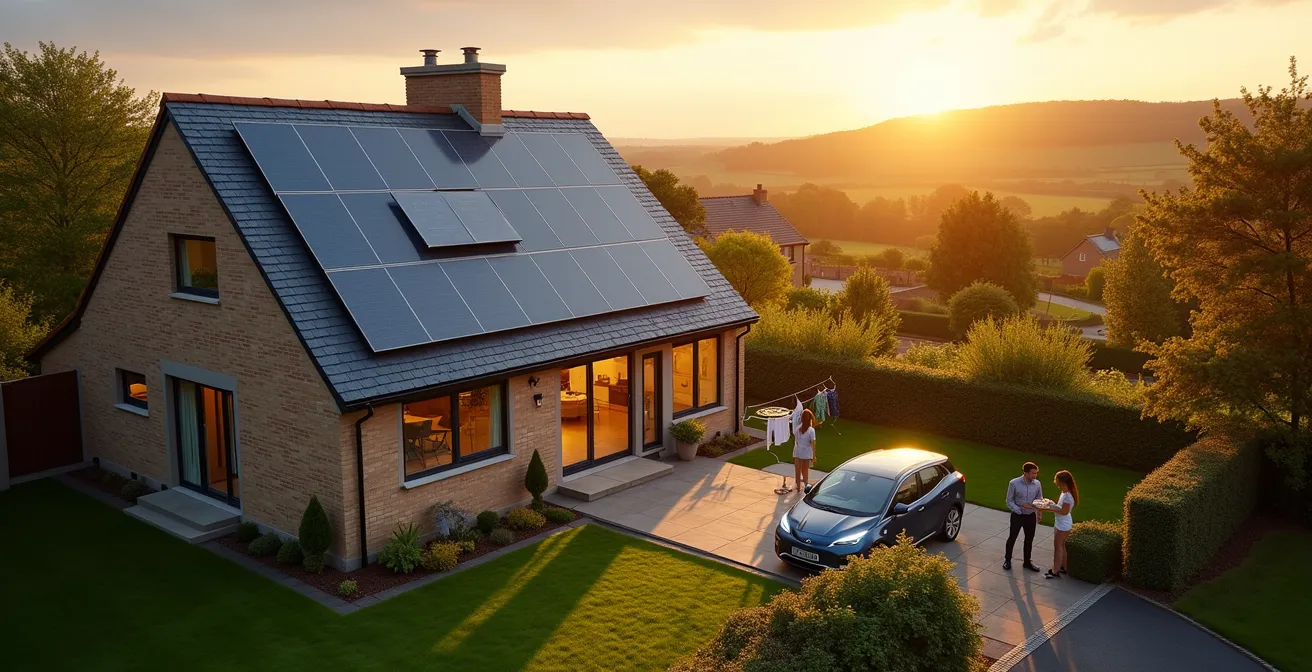
The frustrating truth for many UK solar panel owners is that generating free energy doesn’t automatically lead to lower bills; the key is mastering when you use it.
- Shifting high-load appliance schedules to midday (11 AM – 3 PM) is the single most effective, no-cost change you can make.
- Low-cost smart plugs offer more flexibility and a better return on investment for automation than expensive smart appliances.
- A home battery’s value isn’t just in storing solar power, but in smartly avoiding peak electricity rates, which requires careful configuration.
Recommendation: Start by focusing on “energy choreography”—the simple act of timing one major appliance, like your dishwasher, to run in the middle of the day. This single behavioural shift is the foundation for maximising your solar investment.
Installing solar panels on your roof feels like a huge step towards energy independence. You’ve made a significant investment to harness the sun’s power, expecting to see your electricity bills plummet. Yet, for many families across England, a frustrating reality sets in: the bills remain stubbornly high. The problem isn’t a lack of sunshine; it’s a fundamental mismatch. You generate a surplus of valuable energy during the day when the house is empty, only to sell it back to the grid for a pittance through the Smart Export Guarantee (SEG), and then buy expensive electricity back in the evening.
The common advice is often to “use your appliances during the day” or to invest thousands more in a home battery. While not wrong, this advice barely scratches the surface. It ignores the behavioural science and the simple, low-cost automation that truly unlock the value of your system. It treats your home as a passive generator rather than what it could be: an intelligent energy hub. This isn’t about making drastic lifestyle sacrifices or becoming a slave to the weather forecast. It’s about a mindset shift from focusing on generation to mastering consumption.
But what if the key wasn’t just *what* you do, but precisely *how* and *when* you do it? What if simple, automated “energy choreography” could double your self-consumption without you even noticing? This guide moves beyond the platitudes. We will break down the practical, behavioural, and low-cost automation strategies that turn your home into an efficient, cost-saving machine. We’ll explore how to time your existing appliances, evaluate whether hardware like solar diverters is truly worth the investment, and uncover the common mistakes that could be costing you hundreds per year.
This article provides a complete roadmap to transforming your relationship with your home’s energy. Below, you will find a detailed breakdown of each strategy, from simple manual adjustments to advanced automation that can even earn you money.
Summary: A Practical Guide to Mastering Solar Self-Consumption
- Why Running the Dishwasher at Noon Saves You £50 a Year?
- How to Automate Your Washing Machine to Start When the Sun Shines?
- Solar Diverters vs Timers: Is the Hardware Investment Worth It?
- The Charging Mistake That Drains Your Battery and Grid Simultaneously
- When Should You Dump Excess Solar into Your Hot Water Cylinder?
- How to Configure Geofencing So Your Heating Turns Off When You Leave?
- Smart Plugs or Smart Appliances: Which Is the Cheaper Route to Automation?
- How to Earn Money by Turning Off Your Appliances During Demand Service Events?
Why Running the Dishwasher at Noon Saves You £50 a Year?
The most powerful tool for increasing solar self-consumption is already in your home: the delay-start button on your appliances. The concept is incredibly simple yet profoundly effective. Your solar panels produce the most energy between 11 AM and 3 PM. Coincidentally, this is often when the house is quietest. By shifting the energy-intensive task of running a dishwasher or washing machine from the evening peak to this solar peak, you use your own free electricity instead of exporting it for a few pence and buying it back for much more later.
This isn’t a trivial gain. For an average family, simply running one high-load appliance per day using free solar energy instead of peak-rate grid electricity can easily save over £50 a year. This behavioural change is the cornerstone of intelligent consumption. It reframes your mindset from “when do I want to run this?” to “when is it smartest to run this?”. The scale of the opportunity is vast; University of Oxford findings on UK solar households show the average self-consumption rate is only 45%, leaving a huge margin for improvement through simple load shifting.
To get started, focus on your biggest energy consumers. Here’s a simple hierarchy for this “energy choreography”:
- Schedule your dishwasher to run between 11 AM and 2 PM for maximum solar coverage. It’s a set-and-forget task.
- Use the delay start feature on your washing machine to run during peak solar hours.
- Stagger high-load appliances: if you need to run both, set the dishwasher for noon and the washing machine for 2 PM to avoid overwhelming your generation capacity.
- Monitor real-time production via your inverter’s app on a sunny day to understand your personal generation curve and optimise timing manually.
This manual adjustment forms the baseline of your savings strategy. It costs nothing and builds the habits necessary for more advanced automation.
How to Automate Your Washing Machine to Start When the Sun Shines?
While manual scheduling is a great start, the key to consistency is automation. You don’t want your savings to depend on remembering to press a button every morning. Automating your washing machine to align with peak solar generation is one of the most satisfying and cost-effective upgrades for a solar home. The goal is to make the right choice the default choice. This can be achieved through several levels of investment, from free to a few hundred pounds.
The most basic level is your machine’s built-in timer, which is free but requires you to manually calculate the delay. The next step up, and often the sweet spot for value, is a simple smart plug from a brand like Tapo or Kasa, costing around £15-£30. This allows you to set precise schedules from your phone. The highest level is a fully “smart” appliance that might integrate with weather forecasts to automatically adjust its start time, but this comes at a significant price premium of £100-£300 over a standard model.
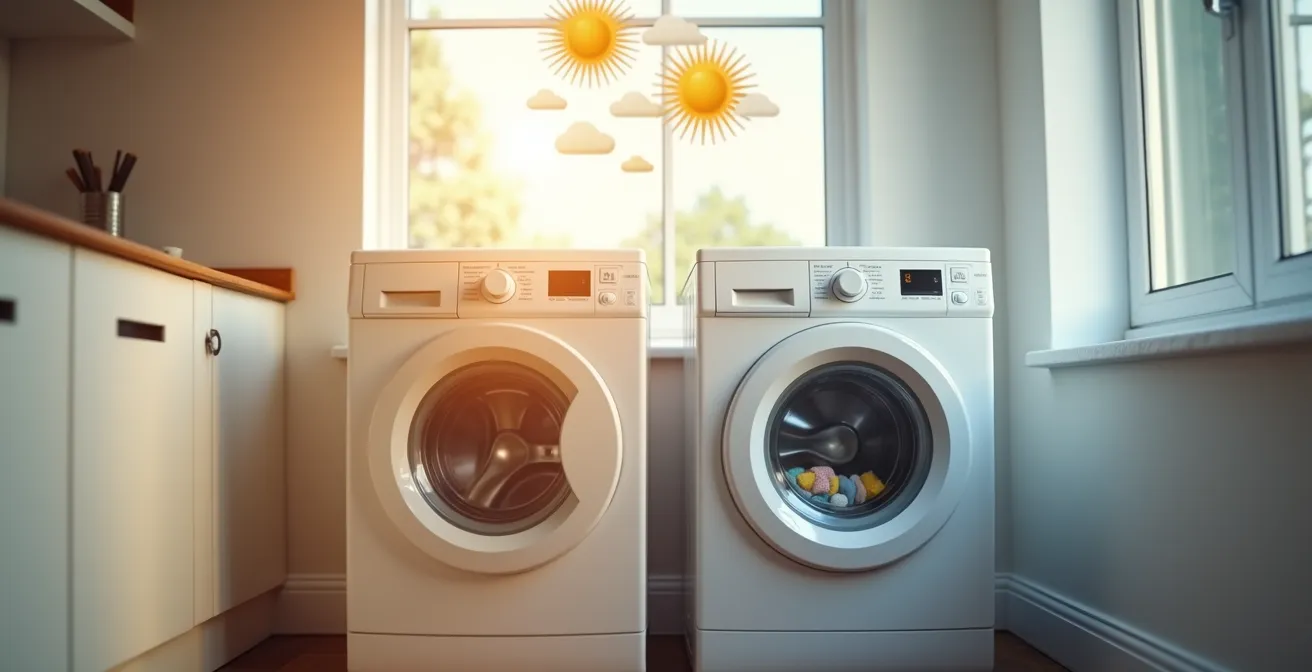
As the image suggests, the ultimate goal is a system that responds intelligently to its environment. However, you don’t need a complex setup to achieve great results. A UK-based content creator demonstrates this principle perfectly, running his entire YouTube production studio, including energy-intensive editing equipment, on a modest 480W DIY solar system. His strategy is pure load shifting: he schedules all heavy tasks between the peak solar hours of 10 AM and 3 PM, proving that smart timing beats raw power every time.
For most families, a smart plug is the perfect entry point. It turns your “dumb” appliance into a schedulable device, giving you 80% of the benefit of a fully smart appliance for 10% of the cost. This is the essence of pragmatic home energy management.
Solar Diverters vs Timers: Is the Hardware Investment Worth It?
Once you’re automatically running your dishwasher and washing machine on free solar energy, the next question is what to do with the remaining excess power on a bright summer’s day. For many UK homes with a hot water cylinder, a solar power diverter seems like the obvious answer. Devices like the Solar iBoost or MyEnergi Eddi detect when you’re about to export energy to the grid and, instead, “dump” that free electricity into your immersion heater, giving you a tank of free hot water.
The logic is sound, but the financial case requires careful consideration. A simple heavy-duty timer for your immersion heater costs as little as £30, while a fully automated diverter can cost £400-£500 plus installation. Is the extra “intelligence” worth the 10x price tag? It depends entirely on what fuel you are replacing. As this detailed cost comparison shows, the options vary significantly in price and functionality.
| Product | Price Range | Key Feature | Best For |
|---|---|---|---|
| Heavy-duty Timer | £30-£50 | Fixed schedule only | Predictable generation |
| Solar iBoost | £250-£300 | Automatic diversion | Simple set-and-forget |
| MyEnergi Eddi | £400-£500 | Trickle charge, app control | Smart home integration |
The return on investment (ROI) is the critical factor. If you use the diverter to displace expensive daytime electricity for heating water, the payback can be reasonable. However, most UK homes use much cheaper natural gas for their primary water heating. In this scenario, the payback period can be surprisingly long. In fact, real-world data from UK Eddi users shows a 9-year ROI when replacing electricity but a staggering 51-year ROI when replacing gas heating. For a gas-heated home, a simple £30 timer set to run the immersion for two hours at midday on sunny days often provides a much faster and more pragmatic return.
The Charging Mistake That Drains Your Battery and Grid Simultaneously
A home battery is the ultimate tool for solar self-consumption, allowing you to store your free daytime energy and use it in the evening. However, it can also be a source of costly mistakes if not configured correctly for the UK’s advanced time-of-use tariffs. Many homeowners fall into a common trap: they charge their battery from the grid during the day or let it discharge to power the home when solar energy is already abundant and grid electricity is cheap.
A prime example of this mistake occurs with popular tariffs like Octopus Agile. A detailed analysis of Octopus Agile users reveals a frequent error: using stored battery power during the cheap afternoon period (around 2 PM) instead of preserving it for the expensive evening peak from 5-7 PM, where prices can be ten times higher. The optimal strategy is a form of energy arbitrage: charge the battery from the grid during the ultra-cheap overnight window (e.g., 12:30-4:30 AM on Octopus Go), use free solar during the day, and only deploy the stored battery power during the costly evening peak. This simple configuration change can cut effective electricity rates by 50%.
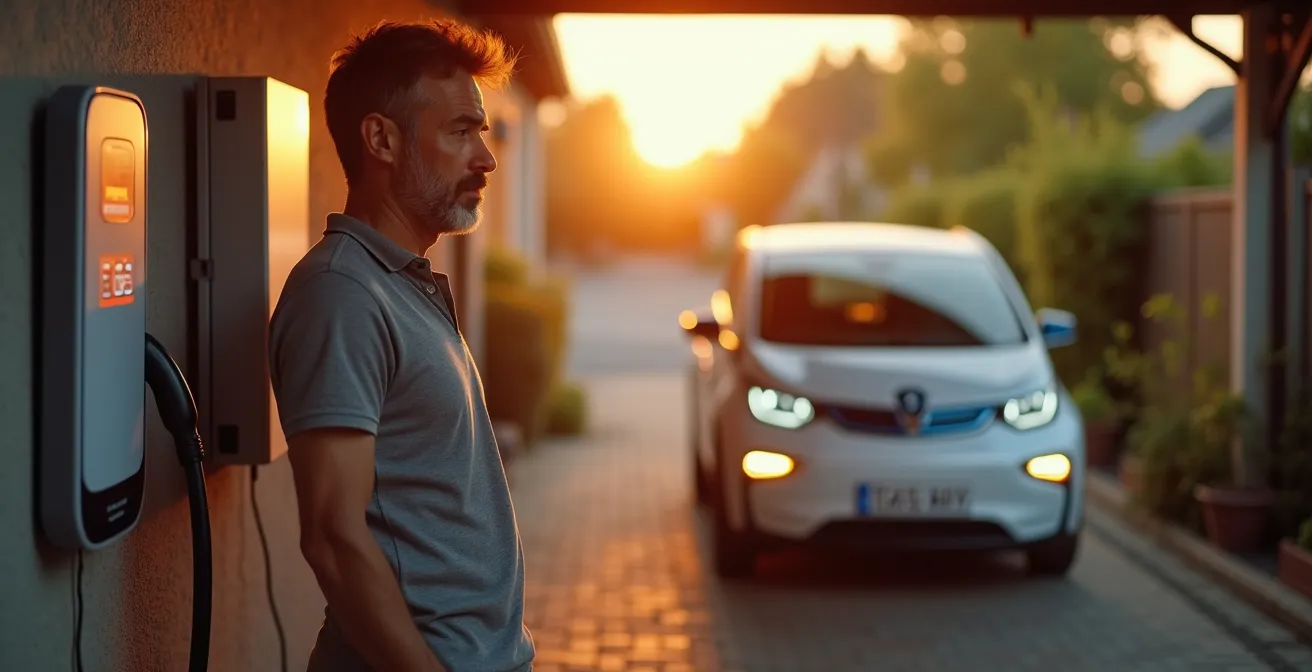
This intelligent management, as depicted in the image above, is about balance and timing. It’s not just about storing solar; it’s about actively managing three power sources—solar, battery, and grid—to always be using the cheapest available option. Avoiding the simple mistake of discharging your battery at the wrong time is just as important as charging it with free energy.
Your Battery Configuration Audit: 5 Key Checks
- Charging Source: Check your battery settings. Is it set to charge from the grid *only* during your specific tariff’s cheapest overnight window (e.g., 12:30 AM – 4:30 AM)?
- Charging Headroom: Review your grid-charge percentage. Never charge to 100% overnight; leave 20-30% headroom to capture the morning’s first solar generation.
- Daytime Mode: Confirm that during the solar peak (10 AM – 4 PM), your system is set to “self-consumption mode,” prioritising solar power for home loads first, then battery charging.
- Evening Mode: Ensure your system automatically switches to “battery priority” or “time of use” mode to power your home from the battery during the expensive 5-8 PM peak rate period.
- Grid Support Settings: Locate the “grid support” or “VPP” mode. Is it enabled only for specific Demand Side Response events, or is it draining your battery unnecessarily?
When Should You Dump Excess Solar into Your Hot Water Cylinder?
Even after you’ve charged your EV, topped up your home battery, and run your appliances, a long, sunny summer day in the UK can still produce a significant surplus of solar energy. The final destination for this excess power is often the immersion heater in your hot water cylinder. Since hot water heating represents around 18% of a typical UK household’s energy consumption, using free solar energy to heat it is a logical step. However, the question is not *if* you should do it, but *when* it should happen in your daily energy hierarchy.
Dumping energy into your hot water should be the last resort for your free electricity, not the first. Your hot water cylinder is effectively a simple, inefficient “thermal battery.” It’s great at storing energy, but once that energy is heat, it can’t be used to power your TV or computer. Therefore, you must prioritise more flexible uses first.
A case study of UK households reveals an optimal diversion hierarchy that maximises the value of every kilowatt-hour. This strategy of prioritised load shifting ensures your most valuable and flexible energy needs are met first:
- Daytime Loads First: Always prioritise powering the appliances running in your home (dishwasher, washing machine, home office).
- EV Charging: If an electric vehicle is at home, it’s the next priority. It’s a large, flexible battery on wheels.
- Home Battery to 80-90%: Your home battery is the most flexible storage. Charge it next, but leave some room for lulls in sunshine.
- Hot Water Cylinder: Only once your home battery is nearly full should your solar diverter start sending excess power to the immersion heater.
In the peak of summer, you may still have excess power after all these steps, which will be exported via the SEG. But by following this hierarchy, you ensure that you’ve extracted the maximum possible value from your solar generation before selling it for a minimal return.
How to Configure Geofencing So Your Heating Turns Off When You Leave?
One of the biggest hidden drains on your solar generation is “phantom load”—the energy consumed by appliances on standby or left running when no one is home. Your meticulously planned energy choreography is wasted if the TV, games console, and heating are consuming precious solar power in an empty house. This is where geofencing, a feature common in smart thermostats and smart plugs, becomes a powerful tool for phantom load hunting.
Geofencing uses your phone’s location to trigger actions automatically. When the last person leaves the house, it can switch your heating to an “Away” mode, turn off smart plugs connected to entertainment systems, and ensure you’re not wasting a single watt. According to an energy management specialist at EcoFlow UK, this simple automation is a game-changer:
Geofencing combined with smart plugs can eliminate phantom loads that waste precious solar generation when you’re away from home.
– Energy management specialist, EcoFlow UK Energy Guide
Setting this up correctly is crucial. You don’t want your heating to turn completely off, risking damp or frost in winter, nor do you want it to trigger every time you walk to the end of the garden. A well-configured system saves energy without impacting comfort. For example, you can create a routine using a service like IFTTT (If This Then That) that states: “When the last family member leaves the geofenced area, turn off the smart plugs for the TV and games console, and set the thermostat to 16°C.” The system can then reverse this action, pre-heating the house 30 minutes before your typical arrival time.
Here are key configuration tips for effective geofencing in the UK:
- Set your “Away” temperature to a frost-protection level like 16°C, not completely off.
- Configure a smaller radius (e.g., 500 metres) for urban areas to account for local walks, and a larger one (2 kilometres) if you primarily commute by car.
- Link geofencing not just to your heating but to smart plugs controlling non-essential, high-standby devices.
- Set a pre-arrival routine to begin warming the house 30 minutes before your typical return time, ensuring you always come back to a comfortable home.
Key takeaways
- The biggest barrier to solar self-consumption is not generation, but the timing of your energy use.
- Simple, low-cost automation with smart plugs often provides a better return on investment than expensive, fully integrated smart appliances.
- Correctly configuring a home battery for time-of-use tariffs is as crucial for savings as charging it with free solar power.
Smart Plugs or Smart Appliances: Which Is the Cheaper Route to Automation?
When embarking on home automation to maximise solar use, you face a key decision: do you invest in expensive “smart” appliances with built-in connectivity, or do you make your existing “dumb” appliances smart with cheap, flexible smart plugs? For a household focused on pragmatic savings and return on investment, the answer is almost always the latter.
A smart washing machine can cost £200-£400 more than its equivalent non-smart counterpart. It locks you into a specific brand’s ecosystem and offers low flexibility; you can’t move its “smartness” to another appliance. In contrast, a £15 Tapo smart plug can be attached to a washing machine, a dishwasher, or an immersion heater as your needs change. Its lifespan may be shorter, but its low upfront cost and high flexibility make it a clear winner for most applications.
Furthermore, there’s a hidden cost to many smart appliances: their constant standby power consumption. To stay connected to your Wi-Fi, these devices have an “always-online” energy draw. While small, this consumption adds up. A constant 2-5W draw equals 17-44 kWh of wasted energy annually—energy that you could have used or stored. Smart plugs also have a standby draw, but it’s typically lower, and their cost-effectiveness is far greater.
The most logical approach is to use smart plugs for any high-power, schedulable appliance that doesn’t already have a reliable built-in timer. This strategy allows you to build a flexible, low-cost automation system piece by piece, without being locked into a single brand or paying a massive premium for features you may not fully use.
How to Earn Money by Turning Off Your Appliances During Demand Service Events?
Reaching high solar self-consumption is about saving money, but the final frontier is actively earning money from your smart home setup. This is achieved by participating in Demand Side Response (DSR) schemes, often run by energy suppliers like Octopus and OVO. These schemes pay you to reduce your grid consumption during specific peak demand “events,” helping to stabilise the national grid.
This transforms your home from a simple consumer into a participant in a Virtual Power Plant (VPP). The strategy is simple but powerful: when a DSR event is announced (typically 4-7 PM), you configure your home to run entirely from your pre-charged battery, which was filled with free solar or cheap overnight electricity. You avoid drawing expensive peak-rate power from the grid and get paid a bonus for doing so. If you have enough stored energy, you can even export power back to the grid at peak rates, compounding your earnings.
The financial rewards are tangible. A case study of UK homeowners participating in Octopus Power-ups and OVO Power Move schemes found that they can earn an additional £50-£100 annually. This income is stacked on top of their regular savings from solar self-consumption and cheap overnight charging, creating multiple revenue streams from a single integrated system.
Joining these schemes is straightforward and is the ultimate expression of intelligent energy consumption. You are not only optimising your own finances but are also contributing to a more stable and efficient national energy grid. To get started, you typically need to:
- Sign up for a DSR scheme like Octopus Power-ups or OVO Power Move through your supplier.
- Ensure you have a smart meter installed, as this is a requirement for participation.
- Configure your battery system to respond to these events automatically, maintaining sufficient charge to cover the event period.
This is the pinnacle of the journey—transforming a capital investment in solar and batteries into an active, income-generating asset.
Now that you understand the principles, from simple timing shifts to earning money from the grid, the next step is to take action. Start with one change today—set your dishwasher on a delay timer—and begin your journey to true energy independence.