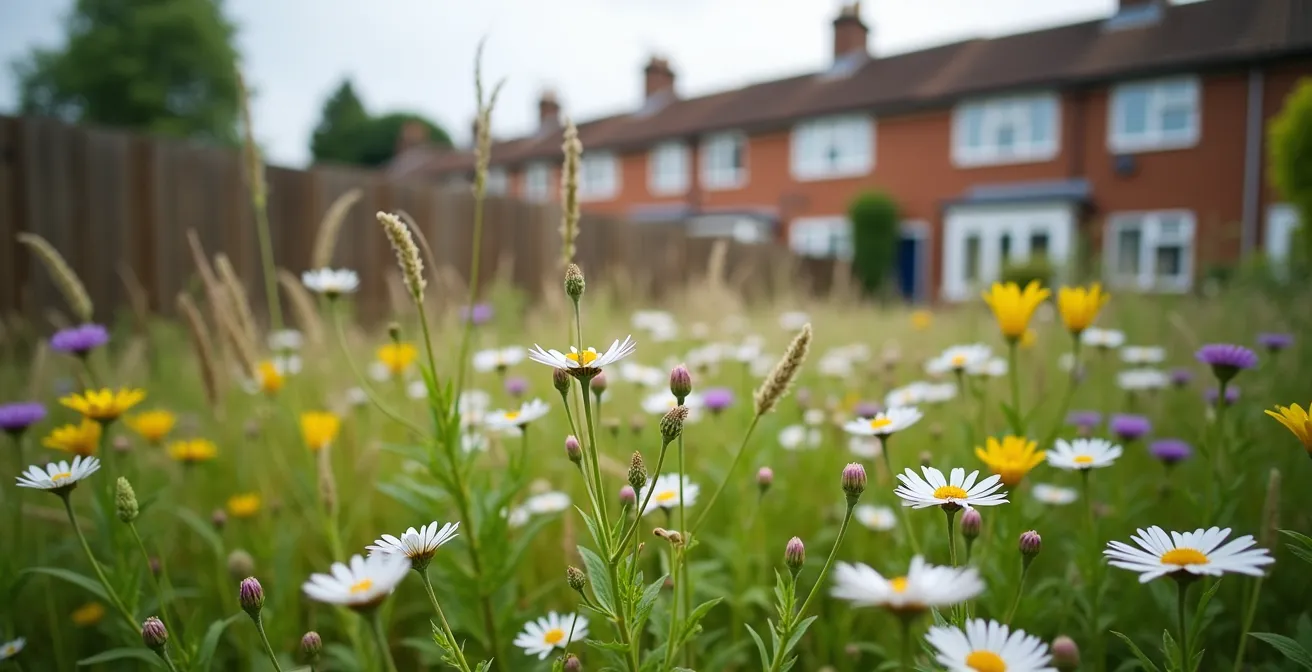
The secret to a beautiful urban wildflower meadow is not neglect, but deliberate ecological design that starves the soil to favour flowers over grass.
- Suppressing competitive grasses with semi-parasitic plants like Yellow Rattle is non-negotiable.
- Actively reducing soil nutrients is more important than the seed mix you choose.
- A single, late-summer “hay cut” is the key to long-term success and a tidy appearance.
Recommendation: Stop feeding your lawn and start managing its decline. This counter-intuitive approach is the most liberating path to creating a resilient, biodiverse, and intentional-looking habitat.
The dream is a powerful one: a patch of your own urban space, buzzing with life, a tapestry of colours and textures swaying in the breeze. You want to tear up the sterile green carpet of your lawn and do something meaningful for the bees. Yet, a fear holds you back—the fear that your noble effort will be mistaken for neglect, a weedy mess that draws disapproving glances from neighbours. Mainstream advice often says to “just stop mowing” or “scatter some seeds,” but this path almost always leads to a tangle of aggressive grasses and disappointment.
This is a battle for biodiversity that feels lost before it’s begun. Since the 1930s, the UK has lost approximately 97% of its species-rich grassland, turning our landscapes into ecological deserts. The desire to reverse this trend, even on a small scale, is a vital act of rebellion. But how do you do it without your garden looking like an abandoned lot? How do you create something that is clearly intentional, beautiful, and thriving?
The answer is liberating because it’s counter-intuitive. The key to a successful urban meadow isn’t about ‘letting go’ at all; it’s a thoughtful act of ecological design. It’s about actively managing decline. Instead of feeding your garden, you must starve it. Instead of encouraging growth, you must suppress it. This guide gives you permission to reject the pristine lawn, not through neglect, but through a smarter, more targeted strategy that creates a resilient habitat that looks as good as it feels.
This article will guide you through the essential strategic shifts required to make your urban meadow a success. We’ll explore the science of grass suppression, the art of soil starvation, and the crucial timing of maintenance that signals care, not chaos. Prepare to unlearn everything you know about traditional gardening.
Summary: A Practical Guide to Designing a Thriving Urban Meadow
- Why Is Yellow Rattle Essential for Suppressing Grass in Your Meadow?
- How to Strip Soil Nutrients Before Sowing Wildflowers?
- Cornflowers or Oxeye Daisies: Which Mix Suits Your Gardening Style?
- The Mowing Mistake That Kills Your Meadow Before It Sets Seed
- How to Make a Fading Meadow Look Intentional in Late Summer?
- The Artificial Grass Trap: Why It Increases Garden Temperatures and Stress?
- Why Do Your Bees Need Pollen Plants, Not Just Nectar, to Feed Their Young?
- How to Feed Bees in February and November When Most Gardens Are Empty?
Why Is Yellow Rattle Essential for Suppressing Grass in Your Meadow?
Before you can add beauty, you must first tackle the bully. In any English lawn, the primary obstacle to a wildflower meadow is the grass itself. Most lawns are sown with vigorous, competitive ryegrass that will outcompete and smother delicate wildflower seedlings. Simply scattering seeds onto an existing lawn is a recipe for failure. Your first act of ecological design is to introduce a secret weapon: Yellow Rattle (Rhinanthus minor).
This unassuming annual is known as the “meadow maker” for good reason. It’s a semi-parasitic plant that taps into the root systems of grasses, weakening them significantly. This process opens up space, light, and resources, giving wildflowers a fighting chance to establish. The transformation can be dramatic, as demonstrated by the project at King’s College Cambridge, which successfully established a meadow on its iconic lawn by using Yellow Rattle to suppress aggressive grasses. For it to be effective, however, you need to be bold. According to meadow specialists, you must aim for a density where Yellow Rattle colonies need to reach 100 plants per square metre to have a real impact.
Establishing it is straightforward. In late summer or autumn, cut your grass as short as possible and remove all the clippings. This process, known as scarifying, exposes patches of bare earth. Scatter the Yellow Rattle seeds directly onto the prepared ground. The seeds need a period of cold to germinate (vernalisation), which is why autumn sowing is perfect. By the following spring, you’ll see its distinctive serrated leaves, and from May, its yellow flowers will appear, quietly working to shift the balance of power beneath the soil in your favour.
How to Strip Soil Nutrients Before Sowing Wildflowers?
The second rule of urban rewilding is to unlearn a lifetime of gardening advice: wildflowers do not want your kindness. They thrive on neglect. Rich, fertile soil—the pride of most gardeners—is a death sentence for a perennial meadow, as it fuels the growth of coarse grasses and nutrient-hungry weeds like nettles and docks, which quickly overwhelm the delicate wildflowers. Your goal is to implement a starvation strategy by actively reducing the soil’s fertility.
For new projects on rich soil, the most effective, albeit drastic, method is subsoil inversion. This involves digging off the top 6-12 inches of nutrient-rich topsoil and bringing the poorer-quality, low-nutrient subsoil to the surface. This creates an ideal, impoverished seedbed for wildflowers from day one. It may sound extreme, but preliminary findings from the UK-based Break New Ground partnership showed that wildflowers planted in inverted soil had significantly improved establishment success. This technique creates the perfect lean conditions that native flowers are adapted to.
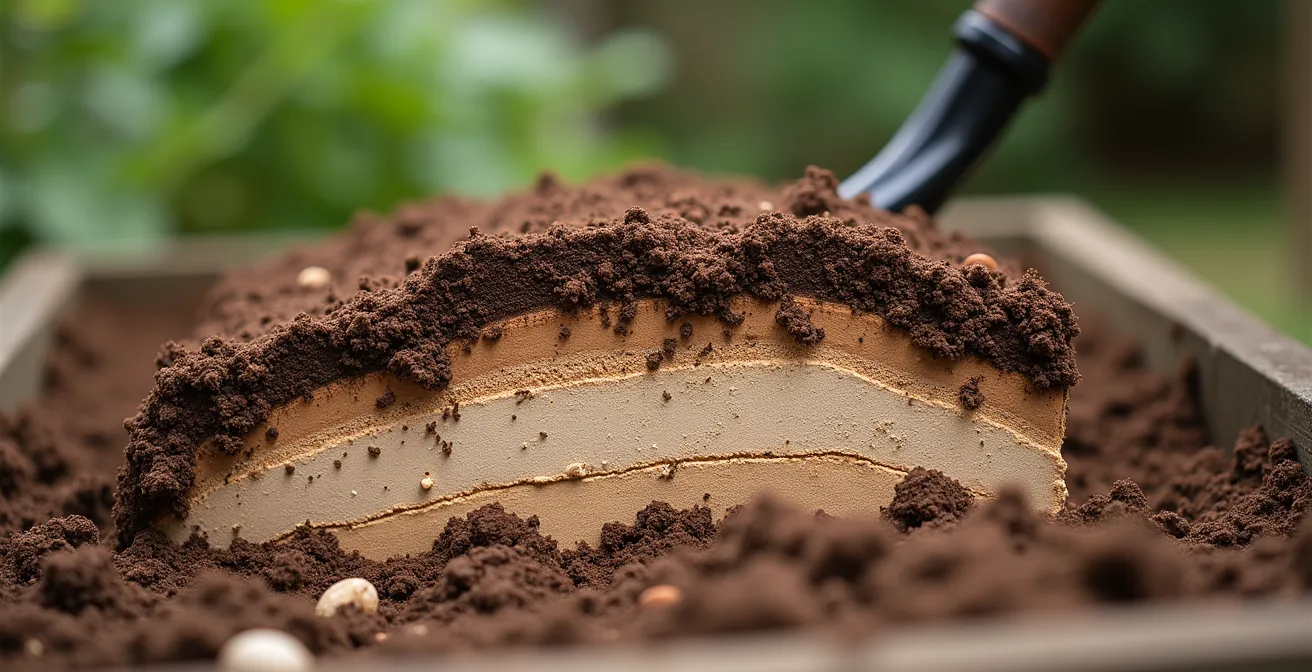
This image clearly shows the distinct layers: the dark, rich topsoil being set aside to expose the paler, stonier subsoil. This is the blank canvas your meadow needs. If full inversion isn’t practical in a small garden, there are other methods. The most basic is to completely remove the existing turf and a few inches of topsoil. You can also grow a “sacrificial crop” like mustard for a season; it will absorb a large amount of nitrogen from the soil, which is then removed when you cut and dispose of the crop. Any action you take to lower nutrients is a step in the right direction.
Your Plan for Reducing Soil Nutrients
- Assess your starting point: Is your lawn lush and green? If so, nutrient reduction is critical.
- Method 1 (High Impact): Plan for soil inversion. Remove the top 6-12 inches of topsoil to expose the subsoil.
- Method 2 (Medium Impact): Lift and remove all existing turf and scrape away the top 2-3 inches of soil.
- Method 3 (Slow Impact): Grow a nutrient-hungry “sacrificial crop” for one season and remove it before it sets seed.
- Final Prep: Once nutrients are reduced, lightly fork over the bare soil to create a fine, crumbly seedbed before sowing.
Cornflowers or Oxeye Daisies: Which Mix Suits Your Gardening Style?
With your canvas prepared—grass suppressed and soil starved—you face the most exciting decision: choosing your artist’s palette. Wildflower seed mixes generally fall into two categories, and the choice you make defines both the look of your meadow and its long-term behaviour. This isn’t just about picking pretty flowers; it’s about defining your goal. Do you want an immediate, high-impact splash of colour, or are you playing the long game for a resilient, self-sustaining native habitat?
The first option is the annual pictorial meadow. Often featuring non-native but wildlife-friendly species like cornflowers, poppies, and cosmos, these mixes deliver an explosive burst of colour in the very first year. They are what you often see at the RHS Chelsea Flower Show—a designed, painterly effect. This is a fantastic choice if you want to signal clear design intent from year one and avoid any “is it just weeds?” ambiguity. The trade-off is that these plants complete their life cycle in one year. To get the same effect again, you will need to re-prepare the soil and re-sow annually.
The second option is the perennial native meadow. This mix, rich in plants like Oxeye Daisies, Red Campion, and Knapweed, is an investment in the future. In the first year, you will see very little flowering; the plants are focusing their energy on establishing deep root systems. The visual reward is delayed, but from year two onwards, they will return reliably, creating a more subtle, naturalistic, and self-sustaining ecosystem that provides high-value support for specialist UK insects. The table below, based on insights from expert advice for creating mini-meadows, summarises the key differences.
| Characteristic | Cornflower-Heavy Mix | Oxeye Daisy Native Mix |
|---|---|---|
| Visual Impact Year 1 | High – immediate colour | Low – mainly foliage |
| Longevity | Annual – needs reseeding | Perennial – returns yearly |
| Biodiversity Support | Moderate – nectar only | High – supports specialist UK insects |
| Maintenance | Higher – annual reseeding | Lower – self-sustaining |
| Aesthetic | Pictorial/designed look | Natural meadow appearance |
A popular and effective strategy is to use a mix of both. Sowing 80% perennial and 20% annual seed gives you the immediate colour of the annuals in year one, which act as a ‘nurse crop’ while the perennials quietly establish underneath. This gives you the best of both worlds: instant gratification and long-term resilience.
The Mowing Mistake That Kills Your Meadow Before It Sets Seed
You’ve suppressed the grass, prepared the soil, and sown your seeds. Now comes the hardest part: waiting. As your meadow grows through spring and summer, you must resist the urge to tidy, trim, or mow. The single biggest mistake that kills a new meadow is cutting it too early, before the plants have had a chance to complete their life cycle and set seed for the following year. This is where your role shifts from an active creator to a patient guardian.
The correct management of a perennial meadow revolves around one key event: the “hay cut”. This isn’t just mowing; it’s a strategic intervention with two primary goals. First, it allows all your annual and perennial plants to flower and drop their seeds, ensuring continuity. Second, by removing all the clippings (the “hay”), you continue the starvation strategy, preventing nutrients from rotting back into the soil and feeding the aggressive grasses you’ve worked so hard to suppress.
The timing is critical. Natural England advises that for a spring-sown meadow, the main cut should happen in late summer. You must wait until after 15th July, and ideally into late August, to allow not just the flowers to seed but also for ground-nesting insects like grasshoppers to complete their life cycles. After the cut, it is vital to leave the clippings on the ground for 2-3 days to allow any remaining seeds to drop before raking them all off. This act of cutting and clearing is more than just maintenance. As one garden design expert notes, creating sharply mown paths around the meadow or a crisp mown edge is…
The single most effective way to signal to neighbours and councils in England that the space is deliberate, not neglected
– Garden Design Expert, Oxford Garden Design meadow management guide
This simple framing transforms the perception of the space from wild mess to curated habitat, giving you the social license to continue your valuable rewilding work.
How to Make a Fading Meadow Look Intentional in Late Summer?
As summer wanes, a perennial meadow’s riot of colour begins to fade. Petals drop, stems turn brown, and the vibrant greens shift to golds, ochres, and silvers. This is the moment when the fear of a “messy-looking” garden can be most acute. But for the ecological designer, this isn’t an ending; it’s a transition into a new kind of beauty. The key is to reframe your perception and see the architectural elegance of the fading garden—its structure, texture, and form.
This approach, popularised in England by garden designers inspired by the Dutch master Piet Oudolf, celebrates the entire life cycle of a plant. Instead of cutting everything back at the first sign of decay, you leave the strong, sculptural seed heads of plants like teasels, poppies, and ornamental grasses standing through autumn and winter. They become beautiful, skeletal sculptures in their own right, catching the low winter sun and providing essential shelter and food for birds and insects. Hugh and Fiona Boucher, owners of a beautiful mini-meadow, exemplify this approach by letting their successful flowers naturalise and stand through the colder months, creating a “one-off investment” in year-round structure.
This is where your meadow provides its most profound lesson: that a garden doesn’t have to be a permanent spectacle of colour to be beautiful or valuable. The quiet, monochrome beauty of a frosty seed head is a powerful statement of intent.

As you can see, frost transforms dried seed heads into intricate ice sculptures, creating a magical, Narnia-like landscape in your own back garden. This is the ultimate expression of intentional aesthetics. Mown paths or a neat clipped edge around this area of standing seed heads clearly communicates that this is not an oversight but a deliberate, curated display of nature’s four-season artistry. It’s a garden that is beautiful, alive, and useful, even in its dormancy.
The Artificial Grass Trap: Why It Increases Garden Temperatures and Stress?
In the quest for a low-maintenance, neat-looking garden, some are tempted by the ultimate sterile solution: artificial grass. It represents the polar opposite of a living meadow—a plastic carpet that actively harms the environment it covers. Understanding its downsides is a powerful motivator for choosing the living, breathing alternative. The artificial grass trap is not just an aesthetic one; it creates a hostile microclimate in your own backyard.
One of the most immediate and shocking impacts is on temperature. Unlike living turf, which cools the air through transpiration, plastic grass absorbs and radiates heat. During a UK heatwave, research has shown that artificial grass surfaces can reach temperatures up to 100°C, making the space unusable for children and pets and contributing significantly to the urban heat island effect. It creates a dead zone, offering no food, no shelter, and no water for any form of wildlife. It compacts the soil beneath it, destroying its structure and preventing rainwater from draining naturally, which can exacerbate local flooding.
The environmental case against it is so overwhelming that in 2022, the Royal Horticultural Society (RHS) took the landmark step of banning artificial grass from all its prestigious garden shows. The RHS cited its contribution to habitat destruction, microplastic pollution, and the heat island effect as key reasons. This decision from the UK’s leading gardening charity sends a clear message: plastic lawns have no place in a sustainable future. Choosing to create a wildflower meadow is an act of defiance against this lifeless trend, a choice to foster life instead of smothering it.
Checklist: The True Cost of an Artificial Lawn
- Microplastic Pollution: Does the product shed microplastics into the soil and waterways as it degrades? (The answer is yes).
- Heat Hazard: Will the surface become dangerously hot in summer, rendering the garden unusable?
- Habitat Destruction: Are you prepared to eliminate all soil life and create a “dead zone” for pollinators and insects?
- Drainage Issues: Will the non-permeable surface contribute to water runoff and potential flooding?
- End-of-Life Waste: How will you dispose of tonnes of non-recyclable plastic in 10-20 years? (It goes to landfill).
Why Do Your Bees Need Pollen Plants, Not Just Nectar, to Feed Their Young?
Creating a meadow “for the bees” is a wonderful goal, but a truly effective ecological design goes deeper. It requires understanding what bees actually need to thrive. We tend to think of flowers as nectar bars, providing a sugary energy drink for adult bees. While nectar (carbohydrate) is vital fuel for flying, it’s only half the story. The other, arguably more critical, resource is pollen. Pollen is the protein, fat, and vitamin source that bees, particularly bumblebees and solitary bees, collect to feed their developing young.
A garden filled only with high-nectar, low-pollen flowers is like a café that only serves coffee and cake—it provides a short-term buzz but no real sustenance for the next generation. A diverse meadow, on the other hand, acts as a complete pollinator cafeteria, offering a varied menu that caters to different needs. The biodiversity of your planting is key, as different bee species have evolved to feed on specific plants. A UK study highlighted this specificity, noting that Carder bees require pollen from the pea family like Bird’s-foot Trefoil, while the Hairy-footed Flower Bee prefers the pollen of Lungwort. A monoculture, even of a “bee-friendly” flower, cannot support a diverse community of native pollinators.
This is why a well-designed perennial meadow, including a mix of flower shapes, families, and flowering times, is so powerful. It moves beyond the simplistic goal of “feeding bees” to the more sophisticated aim of “supporting bee populations.” By including plants like clovers, vetches, knapweeds, and scabious, you ensure your garden provides the essential protein that allows bee larvae to grow into healthy adults. You are not just a host; you are a nursery, actively helping to build the resilient pollinator populations of the future.
Key takeaways
- Creating a meadow is an act of design, not neglect; success comes from actively reducing soil fertility.
- Yellow Rattle is the essential first step to weaken competitive grasses in an existing lawn.
- The “hay cut” in late summer is a critical, timed event to remove nutrients and allow plants to set seed.
How to Feed Bees in February and November When Most Gardens Are Empty?
A truly resilient habitat doesn’t just perform for three months in the summer. The ultimate goal of ecological garden design is to provide a reliable food source for pollinators across the entire year, especially during the “hungry gaps” of late winter and autumn. On a mild day in February, a queen bumblebee might emerge from hibernation, desperate for her first meal. In November, some hardy pollinators are still flying. Most gardens, however, are bare and empty at these times. By thinking in four dimensions—three of space, one of time—you can make your small patch a truly invaluable oasis.
While your main meadow is dormant, you can extend your pollinator cafeteria by creating a dedicated border or underplanting with species that flower outside the main summer season. This ensures there’s always something on the menu. A few carefully chosen plants can make all the difference, providing life-saving nectar when it’s needed most. These aren’t necessarily “wildflowers” in the traditional sense, but hardy shrubs and bulbs that integrate perfectly into a four-season, wildlife-friendly garden plan.
Consider planting a small clump of Winter Aconite or Snowdrops under a deciduous tree or at the edge of your meadow; they will flower and fade before the meadow grasses even begin to grow tall. For late winter, a shrub like Mahonia ‘Winter Sun’ or the intensely fragrant Sarcococca confusa (Christmas Box) provides a vital nectar source. These small additions complete the circle of your ecological design, ensuring your garden supports life not just at its peak, but when it is most vulnerable. This is the final, most thoughtful act of a true urban rewilding warrior.
By shifting your mindset from gardener to ecological designer, you can transform a small patch of urban lawn into a beautiful, intentional, and deeply valuable habitat. You have the power to create a space that nurtures biodiversity, provides year-round beauty, and stands as a proud testament to the fact that wildness and design can, and should, go hand in hand.