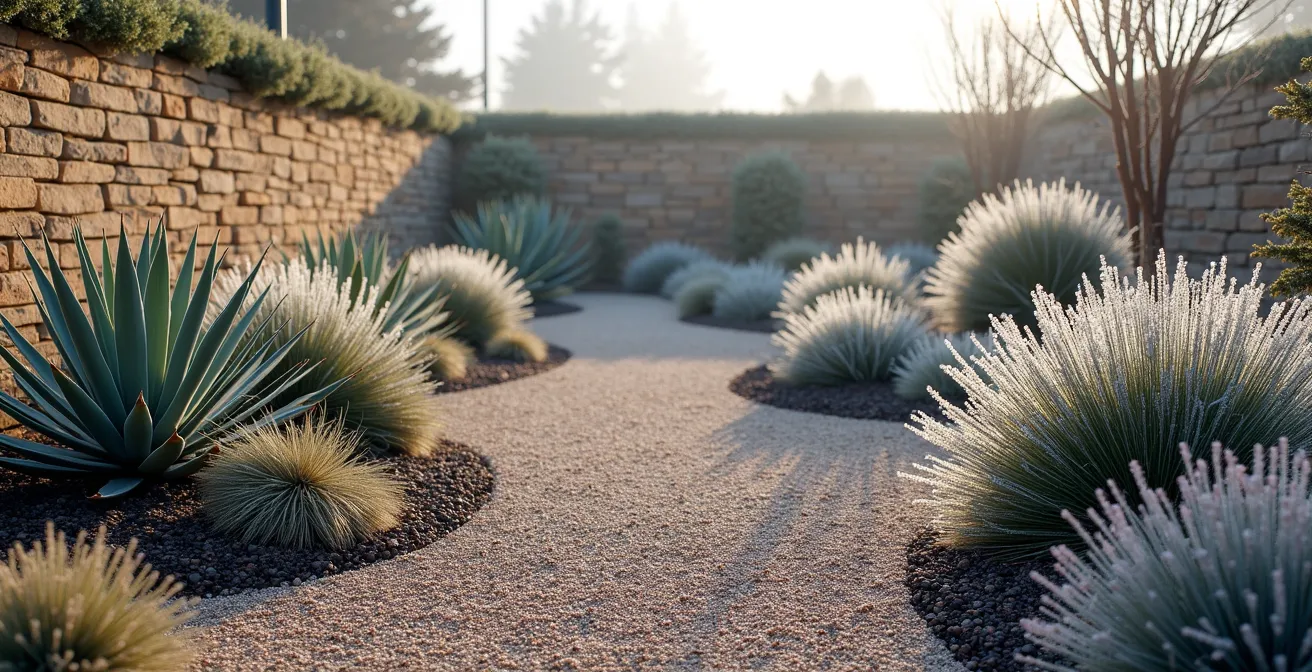
The secret to a thriving Mediterranean garden in Britain isn’t choosing drought-proof plants; it’s engineering a garden that can handle our wet winters.
- Success hinges on mastering soil drainage to prevent root rot, the number one killer of Mediterranean plants in the UK.
- Hardiness ratings are misleading; a plant that survives -10°C in dry frost will die in 0°C waterlogged soil.
Recommendation: Focus first on creating ‘grit pockets’ and raising plant crowns to actively shed winter rain, before you even consider summer watering.
For many English gardeners, the dream is a sun-drenched terrace reminiscent of Tuscany or Provence, filled with the silvery foliage of lavender and the architectural spikes of agaves. The reality, however, is often a soggy, brown mess come February. We’re told to choose “drought-tolerant” plants, to add a bit of grit for drainage, and to hope for the best. Yet, year after year, prized plants succumb not to a lack of water in August, but to an excess of it in December.
This common advice misses the fundamental challenge of the UK climate. The problem isn’t just about surviving dry spells; it’s about enduring the relentless, cold dampness of our winters. The ‘Wet-Cold Factor’ is the true enemy of the Mediterranean garden, a unique combination of low temperatures and waterlogged soil that proves far deadlier than a simple frost. Standard hardiness ratings often fail to account for this, lulling us into a false sense of security.
But what if the solution wasn’t to fight the rain, but to outsmart it? The key to a resilient dry garden in the UK lies in a radical shift in thinking: from passive plant selection to active water management. It’s about engineering a micro-environment where plants are protected from winter wet, encouraging them to develop deep, resilient roots, and creating a garden that works with our climate’s eccentricities, not against them. This guide moves beyond the platitudes to reveal the specific soil engineering and planting techniques that make this vision a sustainable reality.
In the following sections, we will deconstruct the core principles of creating a successful dry garden adapted for British weather. From amending heavy clay to understanding the real meaning of plant hardiness, you’ll gain the strategic knowledge to build a beautiful, low-water garden that doesn’t just survive, but truly thrives.
Summary: How to Create a Dry Garden That Survives UK Winters?
- Why Is Sharp Sand Essential for Planting Mediterranean Herbs in Clay?
- How to Train Your Plants to Root Deeply by NOT Watering Them?
- Why Are Silver-Leaved Plants Better at Reflecting Heat?
- The Hardiness Myth: Why Wet Cold Kills Agaves Faster Than Dry Frost?
- How to Plant Directly into Gravel to Eliminate Weeding and Watering?
- How to Lock Moisture into Soil So You Only Need to Water Once a Week?
- Cornflowers or Oxeye Daisies: Which Mix Suits Your Gardening Style?
- How to Legally Water Your Garden During a Strict Hosepipe Ban?
Why Is Sharp Sand Essential for Planting Mediterranean Herbs in Clay?
Heavy clay soil, common across much of England, is the nemesis of Mediterranean plants. It acts like a sponge in winter, holding cold water directly against roots and causing fatal rot. The common advice to “just add grit” is an oversimplification. Simply mixing a small amount of sand into dense clay can create a substance akin to concrete. The real solution is not just amending the soil, but performing targeted soil engineering to create a free-draining “grit pocket” where the plant can live.
This technique involves excavating a larger-than-necessary planting hole and fundamentally changing the structure of the soil in that immediate zone. By creating a dedicated drainage layer at the bottom and backfilling with a custom mix of clay, sharp sand (not fine builder’s sand), and organic matter, you build a protective biome. The most crucial step is positioning the plant’s crown—the point where the stem meets the roots—well above the surrounding soil level on a small mound. This ensures that even during the heaviest downpour, water is actively shed away from the vulnerable base of the plant, preventing crown rot.
As the celebrated Essex-based gardener Beth Chatto demonstrated in her world-famous Dry Garden, this approach works even on the most challenging sites. Her garden was built on dry, compacted ground, but success came from improving the soil with just enough organic matter. As her team notes, making the soil too rich results in “lush, green growth which would need more water,” a counter-intuitive insight that highlights the goal is resilience, not rapid growth.
Action Plan: The ‘Grit Pocket’ Method for Clay Soils
- Excavate: Dig a planting hole twice the width and 1.5 times the depth of the plant’s root ball.
- Drainage Layer: Create a 10cm drainage layer at the bottom using coarse grit or crushed aggregate. Never use fine sand alone.
- Custom Mix: Mix the excavated clay with approximately 30% sharp sand and 20% organic matter (like garden compost) to create a free-draining pocket.
- Mound Planting: Position the plant so its crown sits 5cm above the surrounding soil level on a raised mound within the hole.
- Backfill & Slope: Backfill around the plant with your improved mixture, creating a gentle 45-degree slope away from the crown to shed water.
- Gravel Mulch: Top-dress with a 5cm layer of gravel mulch, keeping it away from the immediate crown, to prevent soil splash and rot.
How to Train Your Plants to Root Deeply by NOT Watering Them?
Once you’ve engineered the perfect planting pocket, the next challenge is to encourage your plants to become self-sufficient. The common instinct is to water new plants little and often, but this is a critical mistake. Frequent, shallow watering encourages the development of a weak, shallow root system that remains dependent on you. In a dry garden, the goal is the opposite: deep root training. This involves a strategic watering schedule that forces the plant to send its roots searching deep into the soil for moisture, making it far more resilient to summer droughts.
The process starts at planting. By soaking the rootball thoroughly before it goes into the ground and giving it one more deep watering, you provide all the moisture it needs to begin establishing. After that, a period of tough love begins. You must resist the urge to water again for at least a week or two. This initial dry period is what signals the plant to start exploring downwards. Over the first year, supplemental watering should be infrequent, deep, and targeted only at the roots, gradually tapering off until the plant is surviving on rainfall alone. An advanced technique for particularly wet gardens is to utilise a ‘rain shadow’, planting sensitive species on the leeward side of a wall or hedge, which naturally creates a drier microclimate.
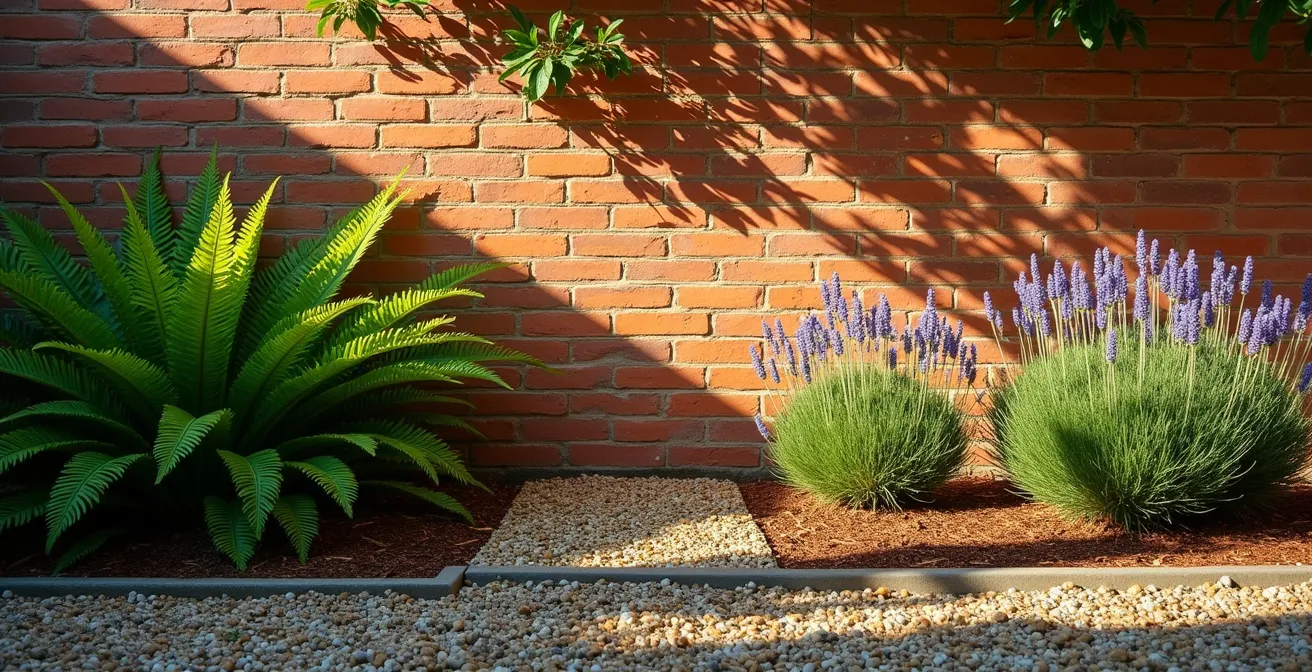
As the illustration shows, a simple structure like a south-facing wall can create a significantly drier zone, protecting plants from the prevailing British rain. This deliberate creation of microclimates is a hallmark of an advanced climatic garden designer. For the first year, especially for larger shrubs, you must monitor the plant for signs of serious stress (wilting that doesn’t recover overnight), but the goal is to intervene as little as possible. Planting in autumn or spring, when the ground naturally holds more moisture, gives plants the best possible start on this journey to resilience.
Why Are Silver-Leaved Plants Better at Reflecting Heat?
Walking through a successful dry garden, you’ll notice a predominance of plants with silver or grey foliage, such as Lavender, Santolina, and Artemisia. This is no coincidence. These plants are masterpieces of natural engineering, perfectly adapted to hot, dry conditions. Their silvery appearance is created by a dense covering of fine hairs (trichomes) or a waxy coating. This surface has two primary functions: it reflects a significant portion of intense sunlight, keeping the leaf tissue cool, and it traps a layer of humid air close to the leaf surface, dramatically reducing moisture loss through evaporation.
This makes them ideal candidates for a UK dry garden, as they are inherently equipped to handle summer heatwaves. Furthermore, many of these plants are evergreen, providing valuable structure and interest during the bleak winter months. However, it’s vital to select species appropriate for our climate. While their foliage is adapted for heat, their roots still despise the wet cold. According to RHS guidance, over 75% of silver-leaved Mediterranean plants rated H4 or higher can survive UK winters, but only if they are planted in the exceptionally sharp drainage we’ve discussed. Garden designer Tom Hoblyn, working in low-rainfall Suffolk, confirms this: “some tender drought plants make it through if their roots are kept dry and the stems have developed enough protective wood.”
Choosing the right silver plant depends on your specific region within the UK. A hardy Stachys byzantina (Lamb’s Ear) will thrive almost anywhere, while the more delicate Brachyglottis ‘Sunshine’ is better suited to the milder conditions of the south.
| Plant | RHS Hardiness | Suitable UK Regions | Winter Care Needed |
|---|---|---|---|
| Santolina chamaecyparissus | H4 | All except Scottish Highlands | Good drainage essential |
| Brachyglottis ‘Sunshine’ | H4 | Southern UK, sheltered northern | Protect from wet |
| Artemisia ‘Powis Castle’ | H4 | Midlands and south | Cut back in spring |
| Stachys byzantina | H5 | All UK regions | Minimal – fully hardy |
The Hardiness Myth: Why Wet Cold Kills Agaves Faster Than Dry Frost?
The single biggest mistake gardeners make when choosing Mediterranean plants in the UK is relying solely on the RHS Hardiness Rating. This system, while useful, primarily measures a plant’s ability to withstand low temperatures in relatively dry conditions. It does not adequately account for the ‘Wet-Cold Factor’. An Agave or Echeveria rated H4 might be able to tolerate a sharp, dry frost of -10°C in its native habitat, but it will quickly turn to mush in a +2°C waterlogged English clay soil over a prolonged winter week.
The problem is root and crown rot. When soil is saturated, it denies oxygen to the roots, causing them to suffocate and decay. This damage prevents the plant from taking up water, so it effectively dies of thirst in a puddle. Succulents and many Mediterranean species are particularly vulnerable as their fleshy tissues are not designed to withstand prolonged contact with cold moisture. As one guide from Tates of Sussex bluntly puts it, hardiness ratings don’t reflect a plant’s ability to withstand waterlogging, meaning even H4-rated plants that can survive -10°C can fail if the soil is saturated.
This is why all the previous steps—creating grit pockets, raising crowns, and choosing sloped sites—are more important than a plant’s hardiness number. For borderline-hardy specimens like many Agaves, additional winter protection is not about warmth, but about dryness. A simple ‘rain hat’—a sheet of clear Perspex angled over the plant—can be the difference between life and death. It keeps the crown dry while allowing air to circulate, preventing the fatal combination of cold and wet.
- Install temporary ‘rain hats’ using clear Perspex sheets angled at 45° over the plant’s central crown.
- Always plant agaves and other succulents on steep slopes or raised mounds to ensure water never pools at their base.
- Apply a thick gravel collar (up to 10cm) around the crown to lift foliage off damp soil.
- For particularly precious specimens, overwintering in a cold greenhouse or under the eaves of the house provides the ultimate protection from rain.
- Choose species adapted to colder, wetter climates, such as Agave montana, which can tolerate -15°C if its roots are kept dry.
How to Plant Directly into Gravel to Eliminate Weeding and Watering?
For the ultimate low-maintenance dry garden, you can take the principles of drainage to their logical conclusion by eliminating soil from the surface entirely and creating a ‘living gravel’ garden. Popularised by gardener Beth Chatto, this technique involves planting directly into a deep layer of aggregate (gravel). This method virtually eliminates weeding, as most weed seeds cannot germinate in the dry, sterile surface. It also drastically reduces water loss from evaporation, keeping the soil cool and moist underneath.
Retrofitting a traditional English lawn into a gravel garden is an intensive but rewarding project. It involves completely removing the turf and, on heavy clay, installing a ‘drainage chimney’ of sand before adding a 7-10cm layer of angular gravel. It is crucial to use angular aggregate (like crushed concrete or slate chippings) rather than rounded pea shingle, as the flat-sided stones lock together to create a stable, walkable surface, while rounded pebbles act like marbles and are difficult to plant in. A common question is whether to use a landscape fabric underneath; the expert consensus is no. Fabric prevents plants from self-seeding and eventually breaks down, creating a maintenance nightmare. A deep enough layer of gravel is a more effective and sustainable weed barrier.

This style of garden quickly becomes a haven for wildlife, with self-seeding plants like Erigeron karvinskianus and California poppies filling the gaps between more permanent perennials, creating a dynamic, naturalistic tapestry that supports a huge range of pollinators.
| Aggregate Type | Cost per Tonne | Coverage (5cm depth) | Best For |
|---|---|---|---|
| Cotswold Buff | £45-65 | 12-14 sqm | Traditional cottage gardens |
| Welsh Slate | £55-75 | 10-12 sqm | Contemporary schemes |
| Scottish Pebbles | £50-70 | 12-14 sqm | Coastal-style gardens |
| Recycled Crushed Concrete | £25-35 | 14-16 sqm | Budget-conscious, sustainable |
How to Lock Moisture into Soil So You Only Need to Water Once a Week?
While much of the focus is on surviving winter wet, a successful dry garden must also withstand summer drought. The key to reducing watering to once a week—or even less—is to create a ‘soil sponge’ that can absorb rainfall and lock it in, protecting it from evaporation. This is achieved through two main strategies: improving soil structure with organic matter and applying a protective mulch to the surface.
Adding organic matter like well-rotted manure or peat-free garden compost is what the RHS calls ‘the single most important element of preparation’. It acts like a sponge, holding many times its own weight in water and releasing it slowly to plant roots. Applying beneficial mycorrhizal fungi at planting time further enhances this effect by creating a vast network of fungal threads that extend the plant’s root system, enabling it to access moisture from a much larger volume of soil. Building this living soil takes time, often two to three years, but is the foundation of long-term resilience.
The second strategy is mulching. While a gravel mulch is excellent, a ‘living mulch’ of low-growing, mat-forming plants is even better. Creeping thymes, sedums, and cottage garden favourites like Erigeron karvinskianus or Alchemilla mollis spread to cover the soil completely. This living carpet shades the soil, keeps it cool, and dramatically reduces evaporation, all while providing a continuous habitat and food source for British wildlife. Unlike bark chips, which can wash away in heavy rain and do little for soil life, a living mulch creates a self-sustaining ecosystem adapted to the UK’s unpredictable rainfall.
- Inoculate at Planting: Apply mycorrhizal fungi inoculant (available at UK garden centres) directly to plant roots when planting to boost water absorption.
- Add Organic Matter: Incorporate plenty of organic material, such as well-rotted manure or UK-made peat-free compost from brands like Dalefoot or Melcourt.
- Apply Surface Mulch: Use a 5-8cm layer of gravel or, for a more dynamic ecosystem, plant living groundcovers.
- Plant Groundcover: Use creeping thymes, sedums, Erigeron, and other mat-forming plants to create a living mulch that suppresses weeds and locks in moisture.
- Be Patient: Allow 2-3 years for the soil biology to fully develop its moisture-retention capacity.
Cornflowers or Oxeye Daisies: Which Mix Suits Your Gardening Style?
A dry garden does not have to be a static collection of architectural plants. It can be a vibrant, evolving space that reflects a specific gardening aesthetic. The two dominant styles that have emerged in UK dry gardening are the ‘Gravel Cottage Garden’ and the ‘New English Prairie’. Your choice between them will determine your plant palette and maintenance approach, influencing whether your garden is filled with the ephemeral charm of cornflowers or the stately grace of oxeye daisies.
The Gravel Cottage Garden style is a controlled chaos. It relies heavily on self-seeding annuals like cornflowers, California poppies, and Nigella (Love-in-a-Mist). These plants thrive in the disturbed soil of a new gravel garden, quickly filling gaps with an explosion of summer colour. The maintenance involves “editing”—pulling out seedlings where they are not wanted—and allowing them to set seed to ensure a different, but equally beautiful, display the following year. It’s a dynamic, ever-changing style that is perfect for the creative, hands-on gardener.
The New English Prairie style, pioneered by designers like Piet Oudolf, is more structured and architectural. It uses a backbone of long-lived perennials and grasses, such as Oxeye Daisies, Achillea, and the magnificent Stipa gigantea. Plants are arranged in naturalistic drifts to create a sense of movement and rhythm. This style offers year-round interest, with seed heads providing structure and wildlife value through the winter. Maintenance is simpler, often involving a single ‘cut back’ in late winter. As seen at the Beth Chatto Gardens, these two styles can even be combined, using annuals as ‘pioneer crops’ while the slower-growing perennials establish.
| Style Element | New English Prairie | Gravel Cottage Garden |
|---|---|---|
| Key Plants | Oxeye Daisies, Stipa gigantea, Achillea | Cornflowers, California poppies, Nigella |
| Structure | Perennial-based, naturalistic drifts | Self-seeding annuals, controlled chaos |
| Maintenance | Cut back annually | Allow to self-seed, edit as needed |
| UK Wildlife Value | Year-round pollinator support | Summer nectar explosion |
| Best UK Suppliers | Pictorial Meadows | Seedball, Chiltern Seeds |
Key takeaways
- The biggest threat to Mediterranean plants in the UK is wet winter soil, not frost. Excellent drainage is non-negotiable.
- Train plants for drought by watering them deeply and infrequently during their first year, forcing them to grow deep roots.
- Choose plants with natural adaptations like silvery, hairy leaves, and always prioritise winter dryness over simple cold hardiness ratings.
How to Legally Water Your Garden During a Strict Hosepipe Ban?
The ultimate reward for creating a resilient dry garden is its ability to thrive during the increasingly common summer hosepipe bans. While your neighbours watch their lawns turn brown, your garden will remain a vibrant oasis. However, even the most established dry garden may need occasional water for new plantings or container displays. Understanding the rules of a hosepipe ban is therefore essential for every UK gardener.
During a Temporary Use Ban (TUB), the use of a hosepipe for most garden activities is prohibited, with fines potentially reaching £1,000. However, the law provides several crucial exemptions. The most important is that you are always permitted to use a watering can or bucket filled from a tap. While laborious, this remains a legal option for saving precious plants. Drip irrigation systems are only permitted if they are fed from a stored water source, like a water butt, not directly from the mains tap.
The most sustainable and legally sound strategy is to maximise your collection of rainwater. A system of linked water butts can store thousands of litres of water, providing a free and exempt supply throughout the summer. Another valuable resource is ‘greywater’—recycled water from baths, showers, and washing machine rinse cycles. This can be safely used on established ornamental plants, provided it is cooled and does not contain harsh chemicals like bleach or borax.
- Use Greywater Safely: Use cooled bathwater or washing machine rinse water on the soil around established plants, not on leaves or edible crops.
- Avoid Harmful Water: Never use water from dishwashers (too salty/alkaline) or any water containing bleach, borax, or strong cleaning agents.
- Rotate Application: Apply greywater to different areas of the garden each time to prevent the build-up of salts or soap residues in the soil.
- Prioritise Rainwater: The primary alternative should always be rainwater collected from roofs into water butts. This is the best quality water for all plants.
The threat is real; in 2025, a hosepipe ban was triggered in one region after reservoir storage falling to only 53.8%, affecting millions of households. By implementing these strategies, your garden becomes part of the solution, not the problem.
Frequently Asked Questions on How to Create a “Dry Garden” That Survives UK Winters?
Can I still use a watering can during a hosepipe ban?
Yes—hand-filled watering cans or buckets from the tap are exempt from hosepipe bans and are always a permitted method for watering your garden.
Are drip irrigation systems allowed?
Only if they are fed by a stored water supply, such as rainwater from a water butt or greywater. It is illegal to connect a drip irrigation system directly to the mains tap via a hose during a ban.
What are the penalties for breaking a hosepipe ban?
Water company officials can issue notices under Section 76 of the Water Industry Act 1991. If prosecuted, fines can reach up to £1,000.