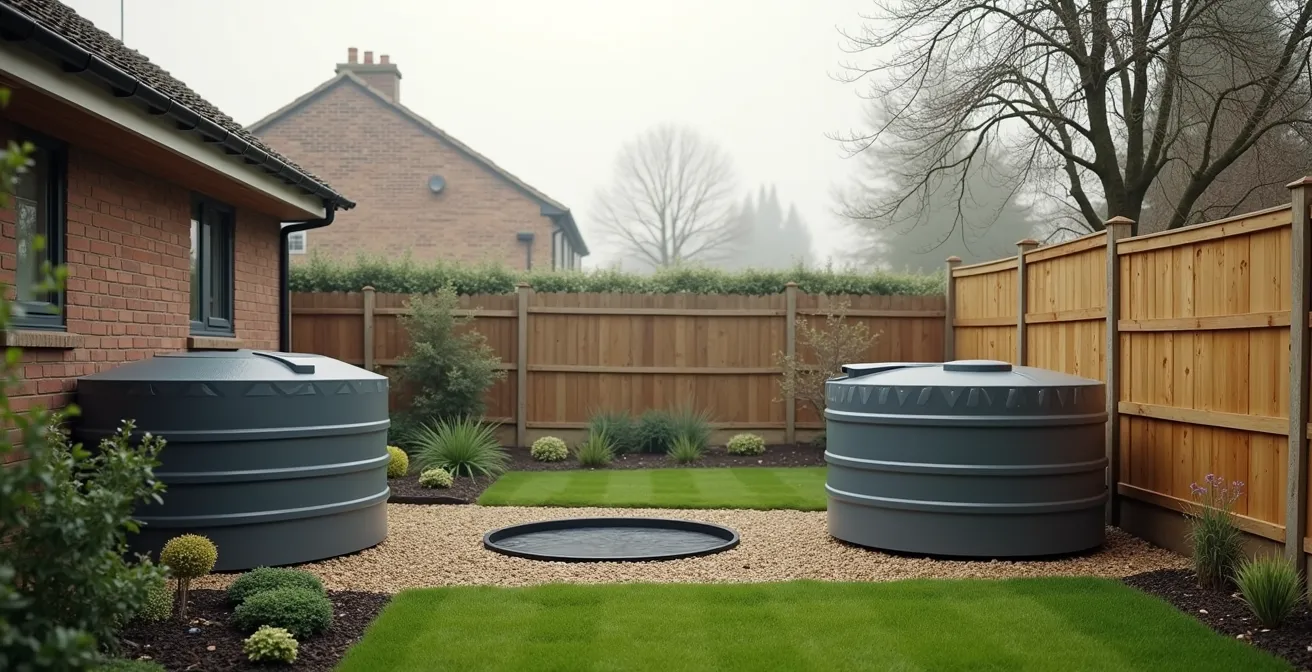
Running out of water butt capacity is a symptom, not the core problem. True drought-proofing requires calculating your garden’s 3-week ‘water deficit’ and engineering a system to meet it.
- Calculate your roof’s potential ‘yield’ based on its area and precise local rainfall data.
- Design a ‘storage cascade’ of interconnected tanks to hold more water than your calculated deficit.
- Diversify your supply with a safely installed greywater system to build true system resilience.
Recommendation: Shift your mindset from being a passive water collector to an active water resource manager for your own garden.
There’s a familiar feeling for many English gardeners: a week of sun, a thirsty garden, and the hollow sound of a tap on an empty water butt. The common advice is to buy a bigger butt or simply to use less water. But this approach is reactive, not strategic. For those who find their single water butt runs dry within three days of a heatwave, a more robust methodology is required. This isn’t just about collecting rain; it’s about water resource planning on a domestic scale.
The key is to stop thinking about the size of your tank and start calculating the size of your problem: the ‘water deficit’. This is the precise volume of water your garden consumes over a 21-day dry spell that your storage must cover. To solve this, you must think like an engineer, quantifying your potential supply (system yield) and designing a storage and distribution network that reliably bridges this gap, even during a strict hosepipe ban.
This guide provides the mathematical framework to do just that. We will move beyond simple collection to a full system design, covering yield calculation, storage engineering, water quality, and legal compliance. It’s time to build a system that makes drought an inconvenience, not a disaster for your garden.
While our focus is on planning for UK home gardens, the core principles of water management apply at all scales. The following video, showing a visit to a large agricultural farm, illustrates the universal importance of strategic resource planning, whether for a few potted plants or hundreds of acres.
This article provides a structured, mathematical approach to achieving water resilience. We will break down the process into logical steps, from calculating your roof’s potential to understanding the legalities of watering during a hosepipe ban. Use the summary below to navigate to the section most relevant to your current planning stage.
Contents: A Planner’s Guide to Garden Water Resilience
- How Much Water Can Your Shed Roof Actually Catch in a Downpour?
- How to Daisy-Chain Water Butts to Triple Your Storage Capacity?
- Solar Pump or Watering Can: Is Automating Rainwater Distribution Worth It?
- The Smelly Water Problem: How to Keep Stored Rainwater Sweet?
- Wall-Mounted or Pillar Tanks: How to Hide 500 Litres in Plain Sight?
- How to Build a Safe Laundry-to-Landscape System for Summer Watering?
- Manicured Lawn vs Wild Patch: Which Absorbs More Rainwater?
- How to Legally Water Your Garden During a Strict Hosepipe Ban?
How Much Water Can Your Shed Roof Actually Catch in a Downpour?
The first step in any resource plan is to quantify your income. In this case, your ‘water income’ or system yield is the volume of rain you can realistically collect. This isn’t guesswork; it’s a calculation based on three key variables: roof area, local rainfall, and system efficiency. A larger roof on a house is your primary asset, but even a standard 8ft x 6ft shed (roughly 4.5m²) in a rainy part of the country can yield a surprising amount.
The formula is straightforward: Roof Area (m²) x Annual Rainfall (mm) = Potential Annual Yield (Litres). However, ‘annual rainfall’ is a misleading national average. The amount of water you can collect is highly dependent on your specific location within the UK, with significant variations between regions. This is a critical factor in determining if your collection potential can meet your garden’s demand.
The table below, based on data from rainwater system specialists, illustrates this regional disparity and shows the potential yield for a small 10m² roof, demonstrating why a one-size-fits-all approach to tank sizing is flawed. As this analysis of UK rainfall data shows, a gardener in Cardiff has nearly double the collection potential of one in East Anglia.
| UK City | Annual Rainfall (mm) | Rainy Days/Year | Collection Potential (10m² roof) |
|---|---|---|---|
| Cardiff | 1,152 | 149 | 11,520 litres |
| East Anglia | 625 | 112 | 6,250 litres |
| North West England | 1,080 | 140 | 10,800 litres |
Your Action Plan: Calculate Your Roof’s True Water Yield
- Measure Collection Area: Calculate the plan view (top-down) area of your collection roofs (house, shed, garage) in square metres. This is often similar to the building’s ground floor footprint.
- Find Local Rainfall: Source the specific average annual rainfall for your postcode from Met Office data, not a national average. Convert this figure to metres for the calculation.
- Factor in Inefficiency: Multiply your result by a filter efficiency coefficient. Assume 0.9 for a modern filter and 0.8 for a basic diverter to account for spillage and evaporation.
- Calculate Daily Average Yield: Divide your annual yield by 365 to get your average daily water income. This figure is the baseline for determining how quickly you can refill your storage.
- Determine Your 3-Week Deficit: Estimate your garden’s daily water need in litres during a dry summer week (e.g., 2 watering cans = 20 litres). Multiply by 21. This is the minimum storage volume you need to survive a 3-week drought.
Once you have an accurate figure for both your potential yield and your 3-week deficit, you can make an informed decision on the total storage volume required. If your deficit is 420 litres (20L/day), a single 200-litre butt is clearly insufficient.
How to Daisy-Chain Water Butts to Triple Your Storage Capacity?
When a single water butt is insufficient, the logical next step is to increase volume. Rather than investing in one enormous, expensive tank, a more flexible and cost-effective solution is to create a ‘storage cascade’ by linking multiple smaller butts together. This modular approach allows you to scale your storage incrementally to match your calculated water deficit. The principle is simple: a connector kit links the first butt (receiving water from the downpipe) to a second, and a third, and so on.
The key to an effective cascade is gravity. By placing subsequent butts at a slightly lower level than the one before it, water automatically flows from the full butt to the next empty one. This creates a single, large reservoir spread across multiple containers. For this to work, all butts must be on a solid, level base (like paving slabs), with a small drop of a few centimetres between each one. A standard water butt connector pipe, fitted near the top of the butts, manages the overflow from one to the next.
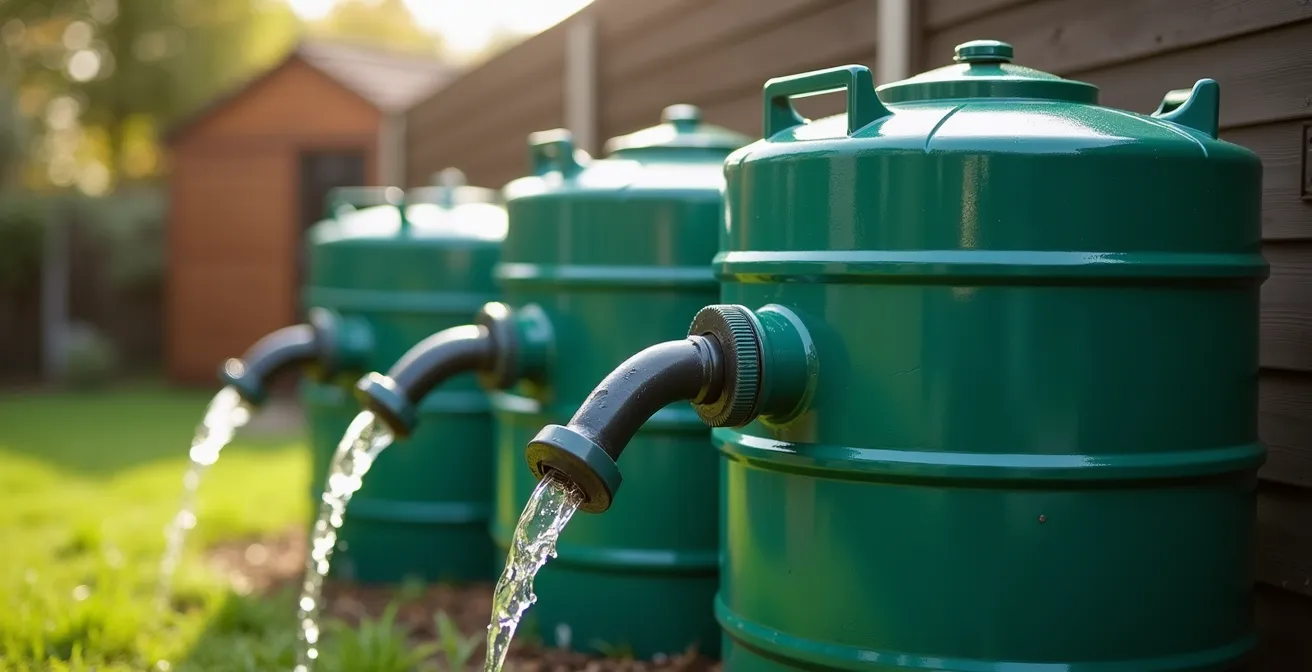
This method transforms simple containers into a managed water storage system. For example, three 250-litre butts linked together provide 750 litres of storage, often enough to cover the 3-week deficit for a small-to-medium garden. While this is a domestic scale, the principle is proven in large commercial premises, where linked systems collecting 1,000 to 7,500 litres are common for non-potable uses like toilet flushing. This demonstrates the powerful scalability of a chained-tank approach.
Ultimately, a storage cascade allows you to capture more of the intense downpours that might otherwise overwhelm a single butt, storing that surplus for the inevitable dry spell that follows.
Solar Pump or Watering Can: Is Automating Rainwater Distribution Worth It?
Having a 750-litre storage system is excellent, but the water is only useful if you can get it to your plants efficiently. This brings us to a crucial cost-benefit analysis: the logistics of distribution. The choice is between manual labour (the watering can) and automated assistance (a pump). The ‘right’ answer depends on your system’s size, your garden’s layout, and how you value your time and physical effort.
The watering can is the baseline: zero initial cost, zero running cost, but high in time and labour. For a small garden with butts located near the vegetable patch, it is perfectly adequate. However, as the distance between storage and plants increases, or for gardeners with mobility issues, automation becomes more attractive. A simple, low-voltage solar-powered pump can be dropped into a water butt, providing enough pressure to run a hose and spray gun, dramatically reducing watering time. This introduces an initial cost but offers significant convenience.
To make a purely mathematical decision, you must weigh the upfront cost of automation against the long-term savings on mains water. The following table outlines the typical investment and return, but the true value depends on the price of your mains water. With current UK water and sewerage costs around £2 per cubic metre (1,000 litres), every full 250-litre water butt you use saves you 50p, a saving that accumulates over the lifetime of the system.
| System Type | Initial Cost | Annual Savings | Maintenance |
|---|---|---|---|
| Simple Water Butt | £70-80 | Up to 20% water bill | Annual cleaning |
| Solar Pump System | £100-150 | Up to 40% water bill | Pump maintenance |
| Full Automated System | £2000-3000 | Up to 50% water bill | Professional service |
For most gardeners scaling up to a multi-butt system, a mid-range solar pump offers the best balance of affordability and utility, transforming a large storage reserve from a static resource into an active, easily deployable one.
The Smelly Water Problem: How to Keep Stored Rainwater Sweet?
Storing water for a 3-week period introduces a new challenge: quality. Water that sits for a long time, especially in the warmth of summer, can become stagnant and develop an unpleasant smell. This is caused by anaerobic bacteria breaking down organic debris like leaves, moss, and bird droppings that have washed off the roof. Keeping your stored water ‘sweet’ is essential for a healthy garden and requires proactive management.
The core principle is to minimise organic matter and reduce bacterial growth. This starts at the source: ensure your gutters are clean and consider installing a mesh guard. A good downpipe diverter with a built-in filter will also trap a significant amount of debris before it ever reaches the tank. The location of the butt is also critical; the Royal Horticultural Society (RHS) advises that you should site the rainwater butt in the shade to keep the water cooler, which significantly slows down the rate of bacterial multiplication.
A common concern with stored water is the risk of Legionella bacteria. However, this is primarily a risk when the water is aerosolised into fine, inhalable droplets, such as from a sprinkler or a fine-mist hose. As the RHS highlights, this risk can be effectively managed. According to their guidance, informed by official research:
Public Health England research in 2018 found that using water butt water in a watering can will mitigate Legionella risk, which is likely to be far outweighed by the benefits of exercise and outdoor activity.
– Public Health England, via the Royal Horticultural Society
Therefore, using a watering can with a coarse spray or simply pouring water directly at the base of plants makes its use very safe. Regular maintenance, such as an annual cleaning of your water butts with a stiff brush to remove any sediment, is the final step in ensuring your stored water remains a clean, healthy resource for your garden throughout the summer.
In essence, treating your water storage system with the same basic cleanliness as any other garden tool will prevent almost all issues of stagnation or odour.
Wall-Mounted or Pillar Tanks: How to Hide 500 Litres in Plain Sight?
The mathematical reality of your water deficit calculation may be that you need 500 litres or more of storage. In a typical, space-conscious English garden, particularly in urban areas or Victorian terraces, accommodating this volume can seem impossible. The traditional, bulky, round water butt is often too intrusive. However, modern tank design offers a range of slimline, wall-mounted, and decorative options that integrate significant capacity into tight spaces.
The key is to think vertically and utilise ‘dead’ space. Slimline tanks are designed with a very narrow profile, allowing them to sit flush against a wall without obstructing a pathway. A 500-litre wall-mounted tank might be 2 metres tall but less than 40cm deep. Pillar-style tanks, often designed to look like architectural features or even Roman columns, can hold hundreds of litres on a very small footprint. Many are available in colours like sandstone or charcoal to blend in with brickwork and fencing.
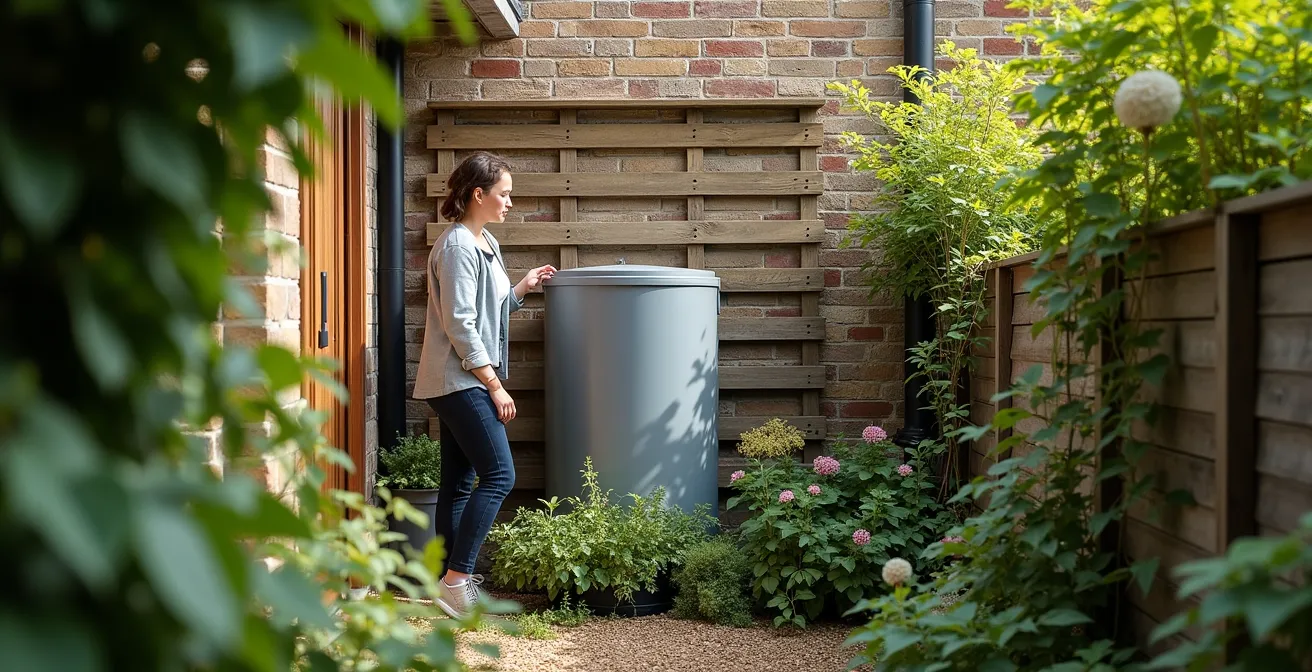
These solutions allow for the discreet integration of large-scale water storage. By placing a trellis in front of a slimline tank, it can be quickly hidden by climbing plants like clematis or jasmine, turning a functional object into part of the garden’s green infrastructure. The availability of these space-efficient designs means that achieving your calculated storage target is a practical possibility, not just a theoretical exercise. Indeed, modern rainwater harvesting systems offer flexible storage options with residential tanks readily available in capacities from 1,500 to 7,500 litres, proving that significant volume can be accommodated.
By choosing a tank that fits the aesthetic and spatial constraints of your property, you can meet your water storage goals without compromising the beauty or usability of your garden.
How to Build a Safe Laundry-to-Landscape System for Summer Watering?
To further increase your ‘system yield’ and build true resilience, you can look beyond rainfall to other sources of water. Greywater—the relatively clean wastewater from baths, showers, and washing machines—is a valuable resource for watering ornamental plants and lawns during a drought. A ‘laundry-to-landscape’ system, which diverts rinse-cycle water directly to the garden, can provide hundreds of litres of water each week. However, its use in the UK is governed by strict safety regulations.
The primary concern is preventing any possible cross-contamination between the recycled greywater and the mains drinking water supply. This is not optional; it is a legal requirement. The Water Supply (Water Fittings) Regulations mandate a clear separation to protect public health. The most critical component is the ‘air gap’. According to UK regulations, there must be a physical air gap separation required by law between any rainwater or greywater system and the mains water supply. This means the two systems must never be physically connected.
Implementing a safe greywater system requires adherence to several key rules. It is not a case for DIY plumbing without a clear understanding of the legal requirements. To ensure your system is compliant, you must follow these guidelines:
- Only use ‘clean’ greywater from baths, showers, and laundry—never from toilets or kitchen sinks.
- Use plant-friendly, low-sodium soaps and detergents to avoid harming your soil and plants.
- Ensure the system includes a WRAS-Approved mains water top-up unit if it’s part of a larger automated system, which guarantees it has been independently tested for safety.
- Run all greywater and harvested rainwater through pipes that are completely separate from your mains water plumbing.
- Clearly mark all pipes, fittings, and taps associated with the greywater system with the words ‘Not Drinking Water’.
- It is often a legal requirement to inform your local water supplier before installing any system that is connected to their supply network.
When implemented correctly, a laundry-to-landscape system can be a powerful tool, effectively drought-proofing your ornamental garden by providing a consistent supply of water independent of rainfall.
Manicured Lawn vs Wild Patch: Which Absorbs More Rainwater?
The other side of the water deficit equation is demand. While increasing your stored supply is crucial, reducing your garden’s need for watering in the first place is an equally powerful strategy. This can be achieved by improving your garden’s ability to capture and retain rainwater directly in the soil. The structure of your garden surfaces plays a major role here, with a stark contrast between a traditional manicured lawn and a more natural, wilder planting area.
A conventional, compacted lawn acts much like a hard surface. During a heavy downpour, water struggles to penetrate the dense turf and compacted soil, leading to significant runoff that flows into drains instead of replenishing the groundwater. In contrast, a ‘wild patch’ or a wildflower meadow area has a much more porous and absorbent structure. The deep roots of various plants create channels into the soil, while the build-up of organic matter acts like a sponge, holding onto moisture for longer.
This principle is fundamental to modern Sustainable Drainage Systems (SuDS), which are now a government-endorsed strategy. The goal is to slow down and absorb rainwater where it falls. By converting a portion of a high-maintenance lawn into a low-maintenance meadow or a dedicated ‘rain garden’ in a low-lying spot, you actively reduce your garden’s water demand. This is particularly vital in areas like South East England, where the Environment Agency warns that there is less water available per person than in many Mediterranean countries. Maximising natural absorption is not just a gardening choice; it’s a critical environmental adaptation.
Every litre of water absorbed by the soil is a litre you don’t have to supply from your meticulously calculated water storage, extending its longevity during a drought.
Key Takeaways
- Calculate, Don’t Guess: Determine your 3-week water deficit (Daily Use x 21) and your roof’s potential yield (Area x Local Rainfall) to accurately size your system.
- Build a Cascade: Use interconnected water butts to create a scalable storage system that can capture and hold your target volume.
- Prioritise Safety and Legality: Ensure any greywater system is legally compliant with an air gap, and always use stored water in a way that minimises aerosol risk (e.g., a watering can).
How to Legally Water Your Garden During a Strict Hosepipe Ban?
The ultimate purpose of this entire planning exercise is to be able to confidently and legally water your garden when mains water use is restricted. A hosepipe ban, officially known as a Temporary Use Ban (TUB), is the final test of your system’s resilience. Understanding the rules is therefore critical. The most important rule is simple: the ban applies to the use of mains water supplied by the water company. It does not apply to the use of your own, privately collected rainwater.
This means that any water stored in your water butts or larger tanks is yours to use as you see fit. You can legally use a hosepipe connected to a pump in your water butt to water your garden, even when your neighbours cannot. This is the single biggest advantage of a well-designed rainwater harvesting system. However, the legislation is specific about what is prohibited for mains water use, and the list has expanded in recent years.
During a strict hosepipe ban, you are legally prohibited from using mains water for the following activities:
- Watering a garden using a hosepipe.
- Cleaning a private motor-vehicle with a hosepipe.
- Watering plants on domestic or other non-commercial premises using a hosepipe.
- Cleaning a private leisure boat with a hosepipe.
- Filling or maintaining a domestic swimming or paddling pool.
- Drawing water for domestic recreational use.
- Filling or maintaining a domestic pond (with some exceptions).
- Cleaning walls, windows, patios, or other artificial outdoor surfaces using a hosepipe.
Despite the clear benefits and legal advantages, the adoption of comprehensive rainwater harvesting remains surprisingly low, with some estimates suggesting only about 400 RWH systems are installed annually in the UK. This means that by following this guide and engineering a resilient system, you are joining a small but growing group of gardeners who are proactively future-proofing their green spaces against the increasing certainty of summer droughts.
Your investment in planning and infrastructure pays off precisely at the moment when restrictions are highest, ensuring your garden can thrive when others are struggling.