In summary:
- Bees, especially emerging queens, need protein-rich pollen in late winter and autumn, not just sugary nectar.
- Avoid ‘double’ flowers whose complex petals block access to pollen and nectar for pollinators.
- Create ‘ecological architecture’ with native hedges and gaps in fences to support birds and insects.
- Choose plants confirmed to be grown without systemic pesticides like neonicotinoids to avoid poisoning pollinators.
- Even a small urban pot or balcony can become a vital perennial meadow for year-round support.
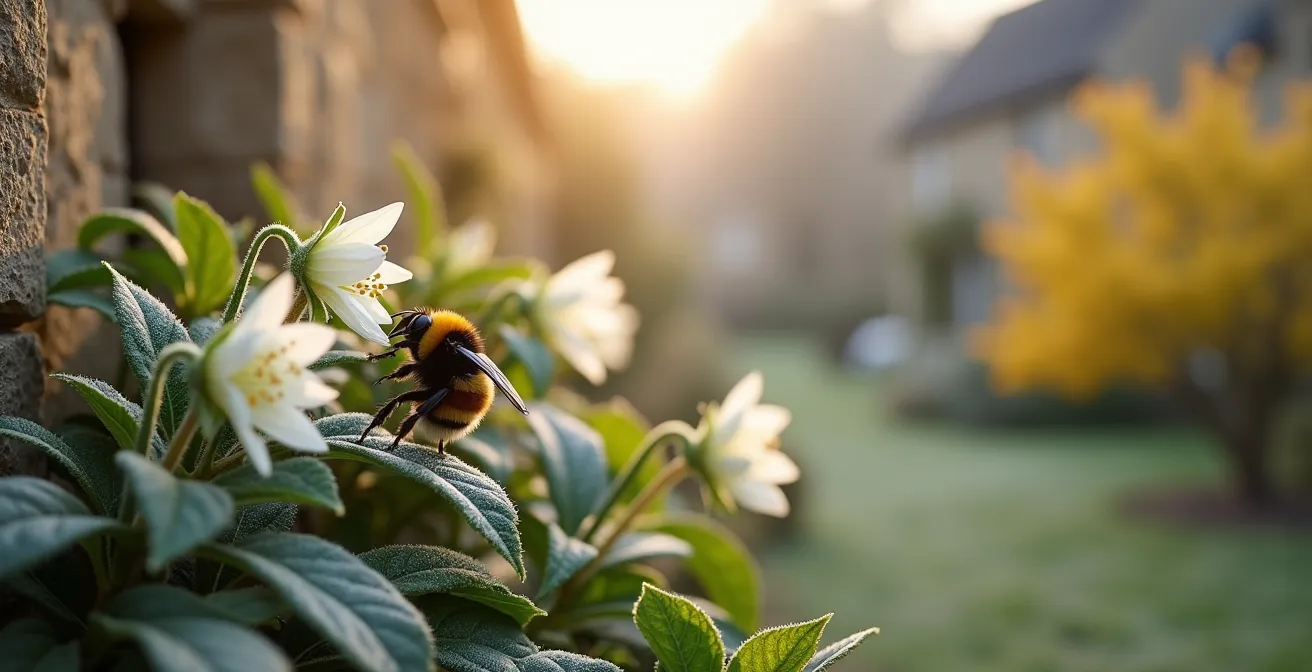
As a wildlife gardener in England, it’s a common sight: a sluggish bumblebee on a cold February path. The instinctive reaction for many is to offer a spoonful of sugar water, a well-intentioned but limited solution. This approach, along with scattering generic ‘bee bomb’ seed mixes, forms the popular understanding of how to help our pollinators. We are often told to simply plant flowers for nectar. However, this advice misses the most critical need of bees during the lean months of late winter and late autumn—the period known as the ‘hungry gap’.
The issue is far more complex than a simple energy deficit. While nectar provides fuel for flight, it is pollen that provides the essential proteins and lipids required for bees to raise their young and for queens to build their strength after hibernation. Many common garden centre plants, despite their ‘bee-friendly’ labels, are either sterile ‘double’ varieties or, more alarmingly, treated with systemic pesticides. They offer a feast for the eyes but a famine for insects. It’s a form of ‘pollinator deception’ that we, as gardeners, can unwittingly participate in.
But what if the key to year-round support was not just providing a sugary snack, but curating a complete, high-quality ‘pollen pantry’? This guide moves beyond the platitudes to explore the science of pollinator nutrition. We will examine why pollen is paramount, how to identify deceptive flowers, and why the physical structure of your garden—its ‘ecological architecture’—is as important as the plants within it. We’ll even look at how to support the vital ‘night shift’ of moths. This is about creating a truly resilient, life-sustaining habitat, from the soil up.
This article will guide you through the essential strategies for creating a garden that genuinely sustains pollinators through the toughest months. Explore the sections below to build a comprehensive ‘pollen pantry’ and supportive habitat in your own space.
Summary: A Year-Round Pollinator Support Strategy
- Why Do Your Bees Need Pollen Plants, Not Just Nectar, to Feed Their Young?
- How to Spot “Double” Flowers That Are Useless for Pollinators?
- Do Non-Native Plants Like Lavender Support UK Insect Species?
- The Nursery Trap: Are Your “Bee-Friendly” Plants Pre-Sprayed with Neonicotinoids?
- Why You Should Plant White Flowers to Support the Night Shift?
- Why Do UK Songbirds Abandon Gardens With Wooden Fences?
- Why Is Yellow Rattle Essential for Suppressing Grass in Your Meadow?
- How to Create a Perennial Wildflower Meadow in a Small Urban Garden?
Why Do Your Bees Need Pollen Plants, Not Just Nectar, to Feed Their Young?
For an emerging queen bumblebee in February, finding food is a matter of life and death, not just for her, but for her entire future colony. While we often focus on nectar as an energy source, it is pollen that is the true foundation of bee life. Nectar is essentially sugar water, providing carbohydrates for flight energy. Pollen, on the other hand, is a complex package of proteins, fats, vitamins, and minerals. It is the only food source for bee larvae, making it the building block of the next generation. Without a reliable pollen supply, a queen cannot produce her first brood of workers.
England is home to a surprising diversity of bees. Beyond the honeybee, there are around 270 species of bees in the UK, including many solitary bees and 24 bumblebee species. Many of these, like the Buff-tailed bumblebee (Bombus terrestris audax), are active in a long season from February to November. The queen emerges from hibernation starving and must build her fat reserves and develop her ovaries, a process entirely dependent on protein-rich pollen. This is why early-flowering plants like Goat Willow (Salix caprea) and Blackthorn (Prunus spinosa) are not just a bonus; they are critical life-support systems.
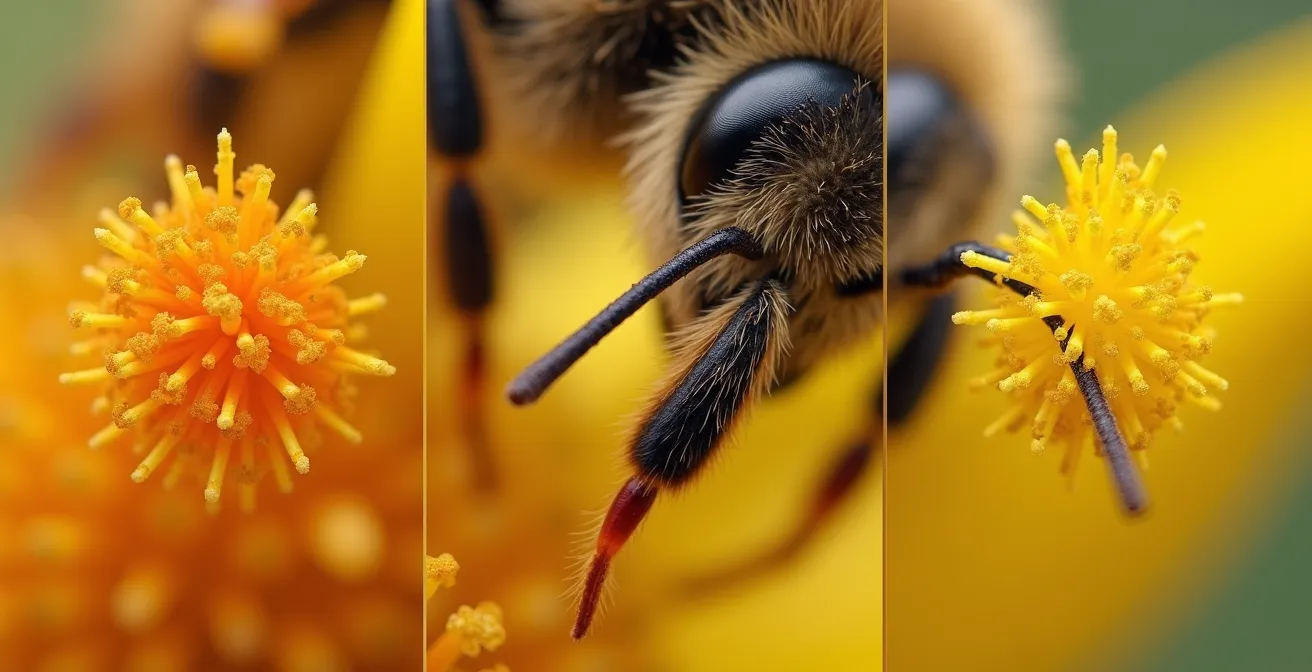
The vibrant colours you see packed into a bee’s pollen baskets, or ‘corbiculae’, on its legs are a visual testament to this vital work. The bright orange comes from willows, the pale cream from blackthorn. This is not just ‘bee food’; it is a carefully curated pantry of proteins and amino acids essential for raising a healthy colony. Providing a diversity of these early and late pollen sources is the single most effective action a gardener can take to support bee populations through the ‘hungry gap’.
Your Garden’s Pollinator Pantry Audit
- Map the Gaps: Walk your garden and note which months between November and March have no flowers. These are your ‘hungry gaps’ to fill.
- Inventory Your Assets: List your existing early and late flowering plants. Are they single-flowered and pollen-rich (e.g., hellebores, mahonia, winter heather)?
- Check for Pollen Quality: Research your key plants. Do they provide high-quality pollen (like willows and fruit trees) or just nectar? Prioritise those offering both.
- Assess Structural Diversity: Do you have a mix of trees, shrubs, and perennials? A lack of vertical layers limits nesting and foraging opportunities.
- Plan Your Planting: Based on your audit, create a shopping list of specific plants (e.g., Salix caprea, Erica carnea) to fill the seasonal and nutritional gaps.
How to Spot “Double” Flowers That Are Useless for Pollinators?
Garden centres can be a minefield of ‘pollinator deception’. Many of the most visually stunning flowers, particularly those with lush, dense petals, are classified as ‘double flowers’. These cultivars have been selectively bred for aesthetics, resulting in the reproductive parts of the flower—the stamens, which produce pollen—being converted into additional petals. While beautiful to us, they are often a frustrating and barren landscape for a foraging bee. The dense petals create a physical barrier, and even if a bee can force its way in, it will find little to no pollen or nectar.
Spotting these flowers is a crucial skill for a wildlife gardener. A ‘single’ flower, the type most useful to pollinators, has a simple, open structure: a ring of petals surrounding a clearly visible centre of stamens (pollen-producing parts) and pistils (nectar-producing parts). Think of a wild dog rose or a simple cosmos. A ‘double’ flower, in contrast, looks like a pom-pom or a dense ruff, with no obvious centre. Many popular varieties of roses, dahlias, and chrysanthemums fall into this category. The difference in pollinator activity is stark; garden surveys have shown that single-flowered varieties can attract significantly more bee visits than their double-flowered counterparts.
The Royal Horticultural Society’s ‘Plants for Pollinators’ logo is a helpful starting point, but it doesn’t always tell the whole story. It confirms a plant provides some nectar or pollen, but it doesn’t differentiate between a minimal snack and a rich, life-sustaining feast. The key is to train your eye to see flowers as a bee does: look for an open, accessible structure with a visible, pollen-dusted centre. Choosing the ‘single’ or wild-type version of a plant over its highly cultivated double form is a simple switch with a profound impact.
Making informed choices at the garden centre can dramatically increase your garden’s value to pollinators. The following table, based on guidance from sources like BBC Gardeners’ World, offers simple swaps for common ornamental plants.
| Avoid (Double Flowers) | Choose Instead (Single Flowers) | Benefit to UK Bees |
|---|---|---|
| Double Dahlia ‘Pom-Pom’ | Single Dahlia ‘Bishop of Llandaff’ | Open centre provides easy nectar access |
| Double-flowered Cherry | Wild Cherry (Prunus avium) | Supports 30+ UK insect species |
| Double Roses | Dog Rose (Rosa canina) | Native species, accessible pollen |
| Double Chrysanthemums | Single Asters | Late season nectar for winter bees |
Do Non-Native Plants Like Lavender Support UK Insect Species?
The “native is always best” mantra is a sound principle in wildlife gardening, as native plants have co-evolved with our local insect populations, often supporting specialist species that can feed on nothing else. However, in the context of climate change and the ‘hungry gap’, the picture becomes more nuanced. Our winters are becoming milder, and as a result, some bumblebee species are remaining active for longer. Research has shown that since the 1990s, queen bumblebees have been increasingly recorded actively foraging right through the November to February period in the UK, particularly in warmer urban areas.
This shift in bee behaviour presents a problem: the bees are waking up, but many of their traditional native food sources haven’t caught up with this new schedule. This is where carefully selected, non-invasive, non-native plants can play a vital role as ‘bridge species’. They flower during the hungry gap, providing a lifeline when native options are scarce. Plants like Mahonia x media ‘Winter Sun’, with its fragrant yellow flowers from November to March, or Winter-flowering Honeysuckle (Lonicera x purpusii) are invaluable. They offer a rich source of nectar and pollen, sustaining early-emerging queens and other insects.
As the Bumblebee Conservation Trust highlights, this is not a free-for-all on exotic plants, which can be invasive and ecologically damaging. It’s about a strategic, informed selection. The Bumblebee Conservation Trust notes this emerging reliance on garden plants:
Carefully selected, non-invasive non-natives like Mahonia x media, flowering in Nov-Feb, are becoming critical ‘bridge species’, providing food when native plants haven’t caught up with earlier bee emergence.
– Bumblebee Conservation Trust, Winter-active bumblebees research
The goal is a garden that blends the best of both worlds: a strong backbone of native species to support specialists, enriched with non-invasive, long-flowering non-natives like Lavender and Cosmos to support generalist pollinators and extend the foraging season. This integrated approach creates a more resilient food supply for a wider range of our precious insect life.
The Nursery Trap: Are Your “Bee-Friendly” Plants Pre-Sprayed with Neonicotinoids?
Perhaps the most insidious form of ‘pollinator deception’ is purchasing a vibrant, healthy-looking plant labelled ‘bee-friendly’, only to bring home a silent killer. Many ornamental plants sold in garden centres and DIY stores are grown on a large scale and are pre-treated with systemic pesticides to keep them looking perfect. Among the most concerning are neonicotinoids (‘neonics’), a class of insecticide that is absorbed into every part of the plant, including its pollen and nectar. A bee feeding on a treated plant ingests a neurotoxin that can impair its navigation, reduce its reproductive success, or kill it outright.
While the EU and UK have banned the outdoor use of several key neonics, the threat has not vanished. These chemicals can still be used in greenhouses, and loopholes persist. For instance, the 2023 emergency authorisation for a neonicotinoid seed treatment on sugar beet in England demonstrates that these chemicals remain present in the wider agricultural landscape, posing a continued risk to pollinators. When you buy a plant, there is often no transparency about its chemical history. The label won’t tell you if it was grown in peat-free compost or if it’s laced with a systemic poison.
As a conscientious gardener, the best defence is to become an inquisitive customer. Don’t be afraid to ask direct questions at your nursery. An independent nursery that grows its own plants is often more transparent and more likely to use Integrated Pest Management (IPM) — a holistic approach that uses beneficial insects and physical barriers before resorting to chemicals. Seek out suppliers who are certified organic or can explicitly state their plants are grown without systemic pesticides. By voting with your wallet, you send a powerful message to the horticultural industry that a truly bee-friendly plant is one that is clean, safe, and nutritious, not just one with a pretty flower.
Why You Should Plant White Flowers to Support the Night Shift?
Our focus on pollinators often centres on the daytime activity of bees and hoverflies, but a vital ‘night shift’ takes over after dusk. Moths are among our most important, yet overlooked, nocturnal pollinators. In the UK, many species of moth are in serious decline, and providing for them is a crucial part of creating a complete wildlife garden. Because they operate in low light, they navigate not by vibrant colour, but by pale shades and strong fragrance. This is why planting white or pale-coloured, night-scented flowers is so effective.
Flowers like Evening Primrose (Oenothera biennis), which unfurl their pale yellow petals at twilight, and Night-scented Stock (Matthiola longipetala), which releases a powerful, sweet scent after dark, are beacons for nocturnal insects. Native species such as White Campion (Silene latifolia) are perfectly adapted to attract moths. These plants often have long, tubular flowers, ideal for the long tongues (proboscis) of moths like the Elephant Hawkmoth. By planting them, you are creating a night-time service station, offering essential nectar to a group of pollinators that other plants ignore.
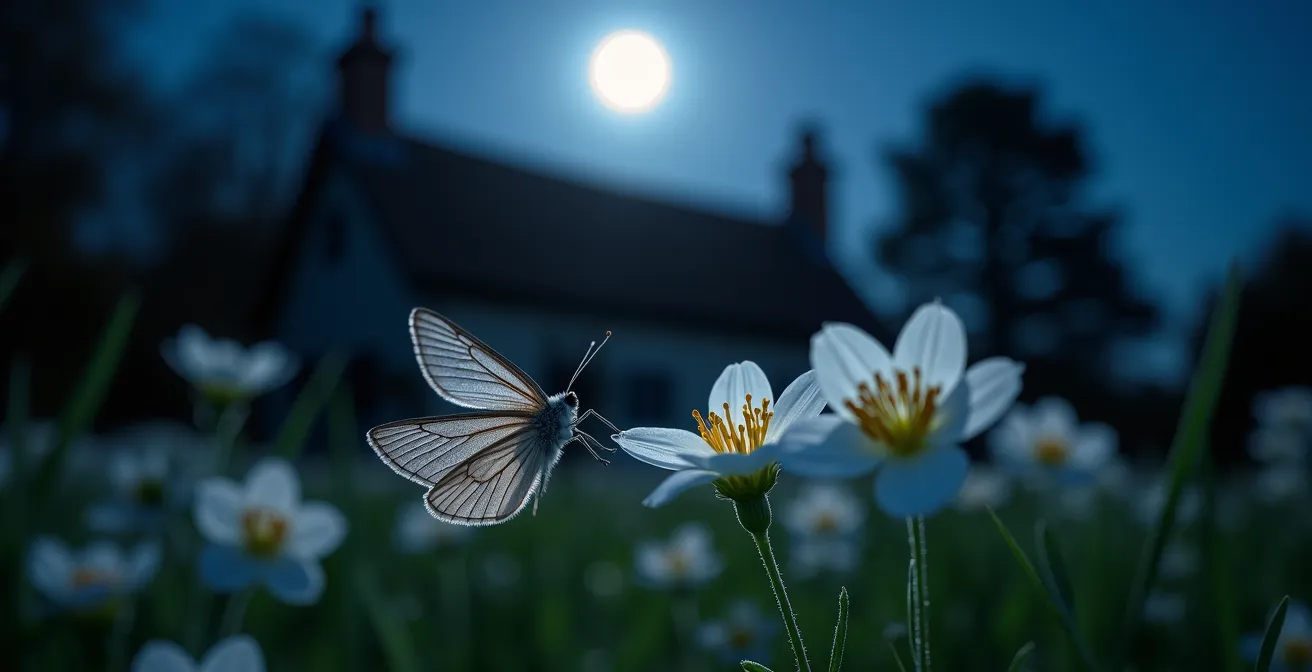
Creating a moth-friendly garden goes beyond just flower choice. Moths and their caterpillars are a fundamental part of the food chain, providing essential food for bats and baby birds. Allowing a small patch of your lawn to grow long with native grasses, or leaving a pile of old logs, provides shelter for caterpillars and pupae. Reducing or eliminating outdoor lighting is also critical, as artificial lights can disorient nocturnal moths, disrupting their feeding and breeding cycles. By catering to the night shift, you are not just helping moths; you are strengthening the entire ecological architecture of your local environment, making it more resilient and diverse.
Why Do UK Songbirds Abandon Gardens With Wooden Fences?
A garden can be filled with the best pollen-rich flowers, but if it is an isolated island, its value to wildlife is severely limited. Solid wooden fences and pristine walls, while providing privacy, create impenetrable barriers that fragment the landscape. For many ground-dwelling creatures, from hedgehogs to beetles, a fence turns a neighbourhood of potential habitats into a series of disconnected cages. This fragmentation also impacts our garden birds. While some birds can fly over, many species like robins, wrens, and blackbirds prefer to forage and move through dense, connected cover. A solid fence is a dead end; a native hedge is a super-highway and a pantry combined.
Mixed native hedges of Hawthorn, Blackthorn, and Field Maple offer a multi-layered habitat. They provide nesting sites safe from predators, shelter from harsh weather, and a continuous food source throughout the year. The early spring flowers offer pollen and nectar for bees, followed by berries in the autumn for birds like blackbirds and thrushes. The dense twiggy structure and leaf litter at the base also harbour a rich community of insects, providing crucial protein for feeding young birds in the spring. A fence offers none of this. It is a sterile barrier, contributing to the silent decline of bird populations in urban and suburban areas.
The scale of this issue is immense. As BBC Gardeners’ World Magazine reports, UK private gardens cover a combined area larger than all of the country’s nature reserves. This puts a huge responsibility on gardeners to think beyond their own patch. The ‘Hedgehog Highway’ initiative, which encourages cutting a simple 13cm x 13cm hole at the base of a fence, is a perfect example of how small actions can reconnect a landscape. Gardens that have adopted this, alongside planting hedges instead of erecting fences, report a visible increase in wildlife activity. It is a shift from owning a plot of land to stewarding a piece of a larger, living ecosystem.
Why Is Yellow Rattle Essential for Suppressing Grass in Your Meadow?
For any gardener in England dreaming of a perennial wildflower meadow, the biggest challenge is not the flowers, but the grass. Vigorous native grasses can quickly outcompete delicate wildflowers, turning a diverse meadow back into a simple lawn. The secret weapon in this battle is a charming native wildflower called Yellow Rattle (Rhinanthus minor). Known traditionally as ‘the meadow maker’, this plant is hemi-parasitic, meaning it derives some of its nutrients by tapping into the roots of nearby grasses.
This parasitic action is the key to its success. By drawing water and nutrients from the grasses, Yellow Rattle can reduce their vigour by up to 60%. This suppression of the competition creates open spaces and allows less competitive, but highly valuable, wildflowers to establish and thrive. Species like Devil’s-bit Scabious, Knapweed, and Ox-eye Daisy, all of which are superb late-season nectar sources for pollinators, get the chance they need to flourish. Without the intervention of Yellow Rattle, these essential flowers would be choked out. It is a perfect example of nature’s own system of checks and balances.
Establishing Yellow Rattle requires an understanding of its life cycle. It is an annual plant, and its seeds need a period of prolonged cold to trigger germination—a process called stratification. This means the ideal time to sow Yellow Rattle seed is in the autumn, from late August to November, directly onto a well-scarified lawn where the soil is visible. The winter cold will do its work, and the seedlings will emerge the following spring, ready to latch onto the grass roots. By introducing this single species, you are not just adding another flower; you are hiring a tiny, tireless garden helper that fundamentally shifts the ecological dynamics in favour of biodiversity and floral abundance.
Key Takeaways
- True pollinator support means providing protein-rich pollen, especially from February to March, not just nectar.
- Choose ‘single’ flowers with open, accessible centres over sterile ‘double’ flowers.
- A garden’s structure (hedges, fence gaps) is as important as its plants for creating a connected habitat.
How to Create a Perennial Wildflower Meadow in a Small Urban Garden?
The idea of a wildflower meadow often conjures images of sprawling countryside acres, but the principles can be scaled down to fit even the smallest urban garden, balcony, or container. In fact, urban spaces have a unique role to play. Cities create ‘heat islands’, meaning they stay warmer than the surrounding countryside. This extends the foraging season for insects, with winter-active bumblebees recorded in cities as far north as Edinburgh. A small patch of urban meadow can become a disproportionately valuable resource in this context, acting as a vital service station in a concrete desert.
Creating a container meadow is an excellent way to start. Choose a large, deep pot to provide ample root space. A mix of perennial wildflowers and native grasses will create a resilient, low-maintenance ecosystem. For year-round value, combine bulbs for early spring colour (like Snake’s-head Fritillary), mid-summer flowers (like Betony), and late-season nectar sources (like Devil’s-bit Scabious). Including a fine native grass like Tufted Hair-grass (Deschampsia cespitosa) provides year-round structure and overwintering sites for insects. Don’t be too tidy—leaving the seed heads on over winter provides food for birds and shelter for invertebrates.
The impact of these small-scale interventions is not trivial. The ‘River of Flowers’ initiative in London, a project supported by groups like Friends of the Earth, has demonstrated this powerfully. By transforming small urban plots into perennial wildflower meadows, some as small as one square metre, participating councils have seen dramatic results. Some sites reported a staggering 300% increase in bee diversity within just two years. It proves that you don’t need a country estate to make a significant difference. By applying the principles of providing a complete ‘pollen pantry’ and building ‘ecological architecture’ on any scale, your small urban space can become a thriving hub of biodiversity.
By shifting your perspective from simple decoration to active ecological stewardship, you can transform any garden in England into a resilient, year-round sanctuary. The next logical step is to audit your own space and begin planting the specific species that will bridge the ‘hungry gap’ for your local pollinators.