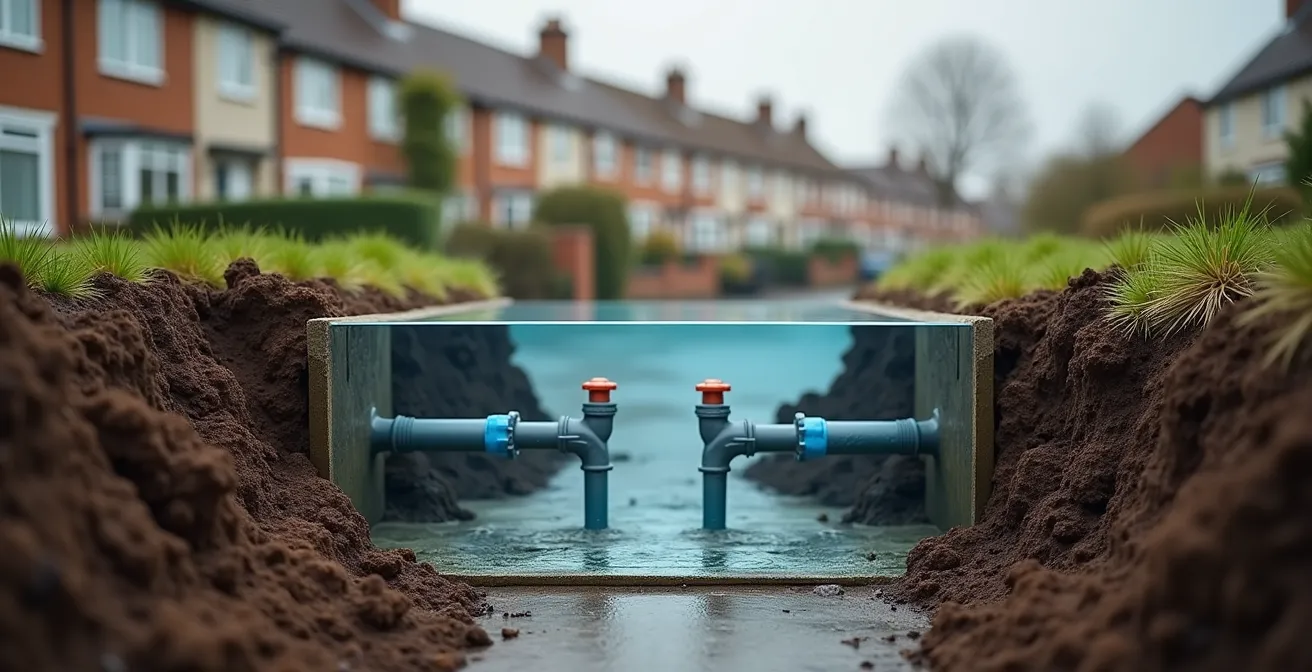
The financial liability for a burst underground water pipe is determined not just by its location, but by the procedural evidence you provide.
- Your responsibility (the supply pipe) typically begins at the external stop tap, but shared pipes in older English homes can complicate this boundary.
- Standard home insurance often only covers finding the leak (‘trace and access’), not the repair itself, making your water company’s own assistance schemes a crucial first step.
Recommendation: Immediately perform a stop-tap test using your water meter and document all findings before contacting your water company or a private plumber.
The sudden dread of an unusually high water bill, or the faint, persistent sound of running water when all taps are off, is a fear for many homeowners on a meter. An unseen leak in the underground supply pipe connecting your home to the public main represents a significant financial risk. The immediate question is always the same: who pays for the burst pipe and the thousands of litres of lost water? Many believe the answer is a simple matter of property lines, where the water company’s responsibility ends and yours begins.
While this boundary is a starting point, it is a dangerously simplistic view. The conventional wisdom—to simply call a plumber and check your insurance—can lead to costly procedural errors that leave you fully liable for both the repair and the water bill. The reality is that navigating a dispute with a utility provider is less about a single rule and more about a strategic process. Your power lies not in arguing, but in methodically building an evidentiary trail.
This guide moves beyond the basics. It is a protective framework for the English homeowner, outlining the precise steps to establish liability, gather proof, and mitigate your financial exposure. We will dissect the nuances of insurance policies, explain how to leverage your smart meter as a forensic tool, and detail the critical errors you must avoid. The objective is to shift you from a position of fear to one of control, armed with the knowledge to defend your financial interests effectively.
This article provides a structured approach to managing the crisis of an underground leak. By understanding each stage of the process, from identification to resolution, you can protect yourself from unfair charges and ensure the issue is resolved correctly. The following sections break down your rights, responsibilities, and the strategic actions you must take.
Summary: An Underground Water Leak: Who is Liable for the Bill, You or the Water Company?
- Where Exactly Does the Water Company’s Responsibility End on Your Street?
- How to Perform a “Stop-Tap Test” to Confirm an Underground Leak?
- Does Standard Home Insurance Cover Excavating a Burst Supply Pipe?
- The Lead Pipe Danger: Should You Replace Your Supply Pipe for Health?
- How Installing a Pressure Reducing Valve Can Prevent Future Bursts?
- How to Use Your Smart Meter to Detect a Silent Toilet Leak?
- Why Do You Pay £300 a Year Even If You Don’t Use Any Energy?
- The Switching Error: Can You Go Back to Fixed Rates if Bills Soar?
Where Exactly Does the Water Company’s Responsibility End on Your Street?
The foundational principle of water pipe liability in England appears straightforward. Water companies are responsible for the large water mains that run under public roads and the communication pipes that branch off to the boundary of your property. Your responsibility, and therefore your financial liability, begins with the private water supply pipe that crosses your property line and runs into your home. This point of transfer is typically marked by an external stop tap or stopcock, often located in the pavement or a small box at the edge of your front garden.
However, this simple liability demarcation can become complex, particularly in older housing stock. In terraced or semi-detached houses, especially those built before the 1940s, it’s common to find a joint or shared supply line. This is where a single supply pipe serves multiple properties. In such cases, all homeowners connected to that shared pipe are jointly responsible for its maintenance and repair. Before assuming sole responsibility, it is imperative to consult your property deeds and, if necessary, obtain Land Registry titles to clarify any shared arrangements.
Determining this boundary with certainty is the first and most critical step in building your case. A water company may offer to provide a map of their assets, but this should be cross-referenced with your own legal documents. An error in identifying this boundary can result in you paying for repairs that were legally the responsibility of the water company or your neighbours. This initial investigation forms the bedrock of your entire claim.
How to Perform a “Stop-Tap Test” to Confirm an Underground Leak?
Before you contact your water company or a plumber, you must gather proof that a leak exists on your supply pipe. A classic “stop-tap test” is the universally accepted method. The first step is to ensure no water is being used inside your property—turn off all taps, washing machines, dishwashers, and ensure toilet cisterns are not filling. Next, locate your water meter. If it has a traditional spinning dial and it continues to move, you have a leak. However, the advent of smart meters provides a far more powerful evidentiary tool.
Modern smart meters, like those being rolled out across the Thames Water region, provide up to 24 readings a day. This allows for a precise forensic analysis. After ensuring no water is being used overnight, you can check the time-stamped data the next morning. A continuous flow reading, especially one exceeding 20 litres per hour, is strong evidence of a persistent leak. This data is not just an indicator; it is a crucial part of your evidentiary trail. Documenting these readings provides objective proof to your water company and insurer. In fact, programmes like these are highly effective; a report on one initiative noted that it helped identify over 84,000 customer-side leaks, demonstrating their diagnostic power.
This paragraph introduces the concept of using a smart meter for leak detection. The illustration below shows a close-up of such a device, highlighting the flow indicators that are central to this process.

As you can see, the internal mechanism is designed for precision. By monitoring these indicators for continuous movement when all appliances are off, you can confirm the presence of a leak with a high degree of certainty. This self-diagnosis is a non-negotiable step before escalating the issue, as it provides you with the data needed to make a compelling case.
Does Standard Home Insurance Cover Excavating a Burst Supply Pipe?
One of the most common and costly mistakes a homeowner can make is assuming their standard buildings insurance will cover the full cost of an underground leak. While policies vary, most in the UK make a critical distinction between three elements: finding the leak, repairing the pipe, and fixing the damage caused by the water. Most standard policies include a clause for ‘trace and access’. This covers the cost of locating the source of the leak, which can involve expensive work like digging up driveways or gardens. However, it often explicitly excludes the cost of the actual pipe repair.
Furthermore, insurance policies almost universally exclude repairs for damage caused by gradual wear and tear, which is often the cause of older pipes failing. This leaves a significant gap in coverage that can expose you to substantial costs. Before authorising any work, you must scrutinise your policy documents. It is also crucial to explore your water company’s own assistance schemes. According to the Consumer Council for Water (CCW), many water companies offer a one-off free repair service for domestic customers. This should always be your first port of call. When the repair is complete, they should also offer a ‘leakage allowance’, which is a credit for the estimated volume of water lost. This is a vital tool for mitigating your financial exposure.
The table below, based on typical UK plumbing and insurance terms, breaks down what different types of cover generally include and exclude. This illustrates the potential financial gaps you must be prepared for.
| Coverage Type | What’s Typically Covered | What’s Usually Excluded |
|---|---|---|
| Trace and Access | Finding the leak location | Actual pipe repair |
| Buildings Insurance | Resulting damage from the leak (e.g., to property foundations) | Repair of the pipe itself due to wear and tear |
| Home Emergency Cover | Temporary, emergency repairs to stop the leak | Full, non-emergency pipe replacement |
The Lead Pipe Danger: Should You Replace Your Supply Pipe for Health?
If investigations reveal that your underground supply pipe is not only leaking but also made of lead, the situation takes on an additional dimension of urgency. Homes built before 1970 are likely to have lead pipes connecting them to the water main. While water companies treat water to reduce lead dissolving into the supply, the only permanent solution to eliminate the health risk is to replace the entire pipe. This is particularly important for households with pregnant women or young children, who are most vulnerable to the effects of lead exposure.
The financial responsibility for replacing the private section of the pipe rests with the homeowner. However, recognising the public health implications, many water companies across England have established schemes to encourage and assist with this process. These programmes are a critical resource that can significantly reduce the financial burden of replacement. You should contact your provider to see what assistance is available, as it can make a necessary but expensive upgrade much more manageable.
These schemes vary by provider but generally fall into several categories. The table below outlines the typical types of lead pipe replacement schemes offered by English water companies, giving you an idea of what to ask for when you contact them.
| Scheme Type | Water Company Commitment | Homeowner Responsibility |
|---|---|---|
| Matching Replacement | Replace public lead pipes if homeowner replaces private section | Pay for private pipe replacement |
| Subsidy Scheme | Provide financial assistance or a grant towards the cost | Arrange for an approved contractor to perform the work |
| Free Detection | Help identify if your pipes are made of lead | The decision and cost to replace remain with the homeowner |
A leaking pipe presents a perfect opportunity to address this underlying health risk. While it involves an upfront cost, replacing a lead pipe is a long-term investment in your family’s health and your property’s value.
How Installing a Pressure Reducing Valve Can Prevent Future Bursts?
Repairing a burst pipe solves the immediate problem, but it does not address the underlying cause. One of the most common culprits for pipe failure, especially in older systems, is excessive water pressure. While good pressure is desirable, pressure that is too high puts constant strain on your pipes, joints, and appliance fittings. This can lead to recurring leaks and catastrophic bursts. The water regulator, Ofwat, sets standards for water pressure, which should generally not exceed 7 bar (70-metre head). If your home is at the bottom of a hill or close to a pumping station, your pressure may be significantly higher.
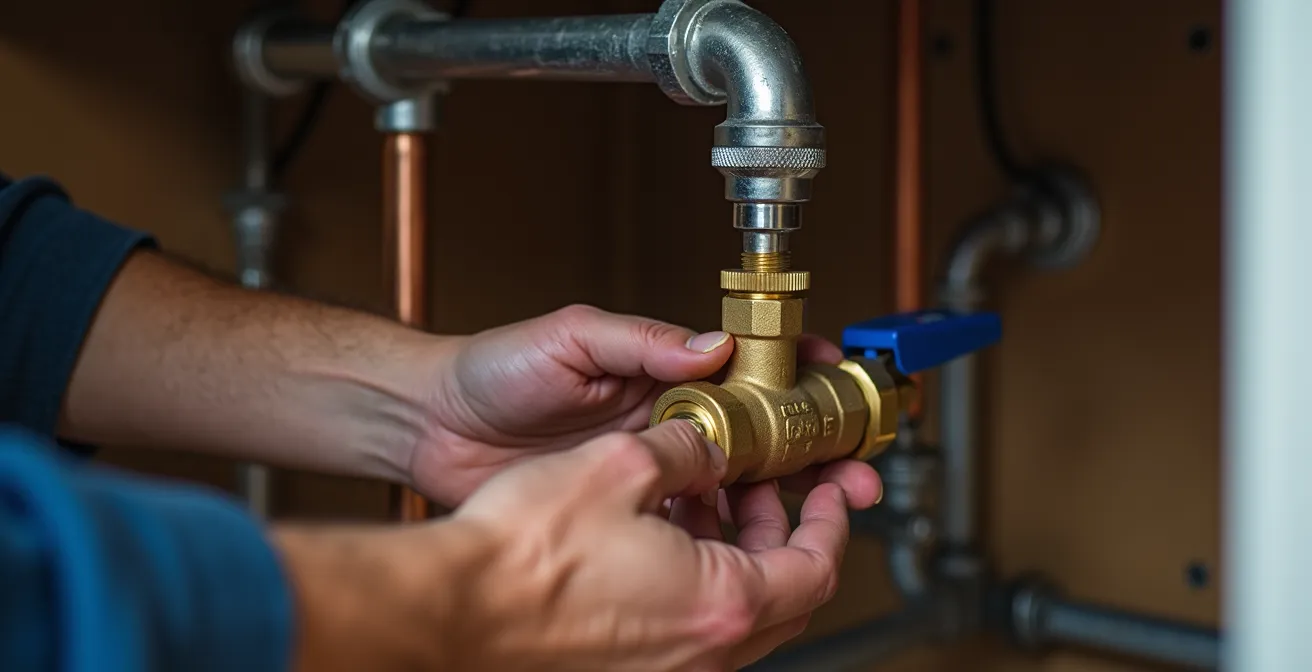
A crucial step in proactive mitigation is to check your water pressure. If it is found to be too high, the definitive solution is the installation of a Pressure Reducing Valve (PRV). This device is fitted to your supply pipe, usually near the internal stopcock, and regulates the pressure of all water entering your home’s plumbing system. By capping the pressure at a safe level (typically around 3 bar), a PRV protects your entire system, extends the life of your appliances, and can significantly reduce the risk of future bursts. It is a relatively small investment that provides immense long-term protection.
The image below shows a plumber installing a brass PRV, the key device for managing water pressure in your home’s plumbing system.
By taking control of your water pressure, you shift from a reactive to a proactive mindset, preventing future financial shocks and protecting your property from water damage. It is a vital component of a resilient home water system.
Your action plan: Checking your water pressure against Ofwat standards
- Purchase or borrow a water pressure gauge, which can be attached to an outside tap.
- With no other water being used in the house, attach the gauge and turn the tap on fully to get a static pressure reading.
- Compare this reading to the Ofwat standards. The minimum required pressure is 1 bar (10m head), but for proactive protection, you are concerned with high pressure exceeding 7 bar.
- If your pressure is consistently above this upper limit, you should first contact your water company, as they may be obligated to take action to reduce pressure in the main.
- Regardless of their action, consider installing a WRAS-approved PRV on your private supply pipe to provide a definitive safeguard for your home’s entire plumbing system.
How to Use Your Smart Meter to Detect a Silent Toilet Leak?
While the focus is often on dramatic underground bursts, the financial drain from small, internal leaks can be just as severe over time. A common culprit is a ‘silent’ toilet leak, where the cistern continuously and quietly trickles water into the bowl. This can waste hundreds of litres a day without any obvious sign. Once again, your smart meter is your most valuable diagnostic tool. The same method used to detect an underground leak—monitoring for continuous flow during a period of no use—is perfectly effective at identifying these smaller, internal issues.
The granular data from a smart meter can reveal a low but constant flow that would be almost imperceptible on a traditional mechanical meter. Identifying and fixing these leaks has a direct and immediate impact on your bill. The evidence is clear: homeowners who have access to this data and act on it use significantly less water. Studies have shown that providing customers with this detailed usage information is a powerful behavioural tool. For instance, one analysis showed that smart-metered customers use on average 17% less water than their unmetered counterparts.
This reduction comes not just from more conscious usage habits but primarily from the rapid identification and repair of leaks that would otherwise go unnoticed for months or even years. By regularly checking your smart meter data for anomalies, you empower yourself to cut waste, lower your bills, and manage your home’s water consumption with precision. A toilet leak may seem minor, but its cumulative cost justifies the small effort required to check your data.
Why Do You Pay £300 a Year Even If You Don’t Use Any Energy?
A common point of confusion and frustration for metered customers is the concept of the standing charge. This is the fixed daily fee you pay, regardless of how much water or energy you use. It appears on your bill alongside your variable consumption charges and can amount to a significant sum over the year. The question often arises: what exactly am I paying for if I’m already paying for the water I use? The standing charge is your contribution to the immense cost of maintaining the vast network of pipes, reservoirs, treatment plants, and staff required to deliver safe water to your tap and take wastewater away.
This infrastructure requires constant monitoring, repair, and replacement. The costs associated with a failure in this network are astronomical. To put it in perspective, even a modest leak can result in a colossal loss. For example, it’s been estimated that a modest leak of one litre per second could cost a business roughly £55,000 per year in lost water. The standing charge is a collective insurance policy to fund the maintenance that prevents such widespread failures and ensures the system’s reliability for millions of customers.
While nobody enjoys paying fixed fees, they are a fundamental part of how utility services are funded in the UK. The alternative would be significantly higher per-unit costs for the water itself, which would disproportionately affect high-usage households. The standing charge ensures that all connected properties contribute to the upkeep of the shared system they rely on. Even with this fixed cost, having a meter remains the fairest system, as it gives you direct control over the largest, variable portion of your bill.
Key takeaways
- Your legal boundary is the external stop tap, but always verify shared supply pipes on property deeds before accepting liability.
- ‘Trace and Access’ insurance is not the same as repair cover; always explore your water company’s free repair scheme first.
- Use your smart meter to build a time-stamped ‘evidentiary trail’ of the leak before making any calls to the water company or a plumber.
The Switching Error: Can You Go Back to Fixed Rates if Bills Soar?
In the context of a water leak, the most damaging “switching error” has nothing to do with tariffs. It refers to the critical procedural mistake of prematurely accepting liability or commissioning work before you have followed the correct diagnostic and notification process. Once you have hired a private plumber to excavate and repair a pipe, it becomes incredibly difficult to later argue that the water company was responsible or to claim on their assistance schemes. You have, in effect, taken matters into your own hands and accepted the financial consequences.
Avoiding this error is paramount. You must never call a private plumber to deal with a suspected underground leak until you have first contacted your water company, presented your evidence from the stop-tap test, and enquired about their one-off repair assistance. Accepting a “goodwill gesture” or free repair from your water company can also have unintended consequences, as it may sometimes affect your ability to make a future claim on your home insurance for the same issue. It is vital to document all communications and clarify the terms of any assistance offered.
The stakes for getting this process wrong are high. If a water company identifies a leak on your property and you fail to act, they have legal powers under the Water Industry Act 1991. They can issue a legal notice requiring you to fix the leak within a specified timeframe. As confirmed by Ofwat, if you fail to comply, the company is entitled to carry out the work themselves and bill you for the entire cost. This demonstrates why a methodical, evidence-led approach is not just advisable; it is a legal and financial necessity.
By following the strategic steps outlined in this guide—from identifying the correct liability boundary to gathering meter evidence and understanding your insurance—you arm yourself with the tools needed to effectively manage this stressful situation. Your first step should always be to diagnose and document, transforming you from a potential victim of circumstance into an informed advocate for your own financial interests.