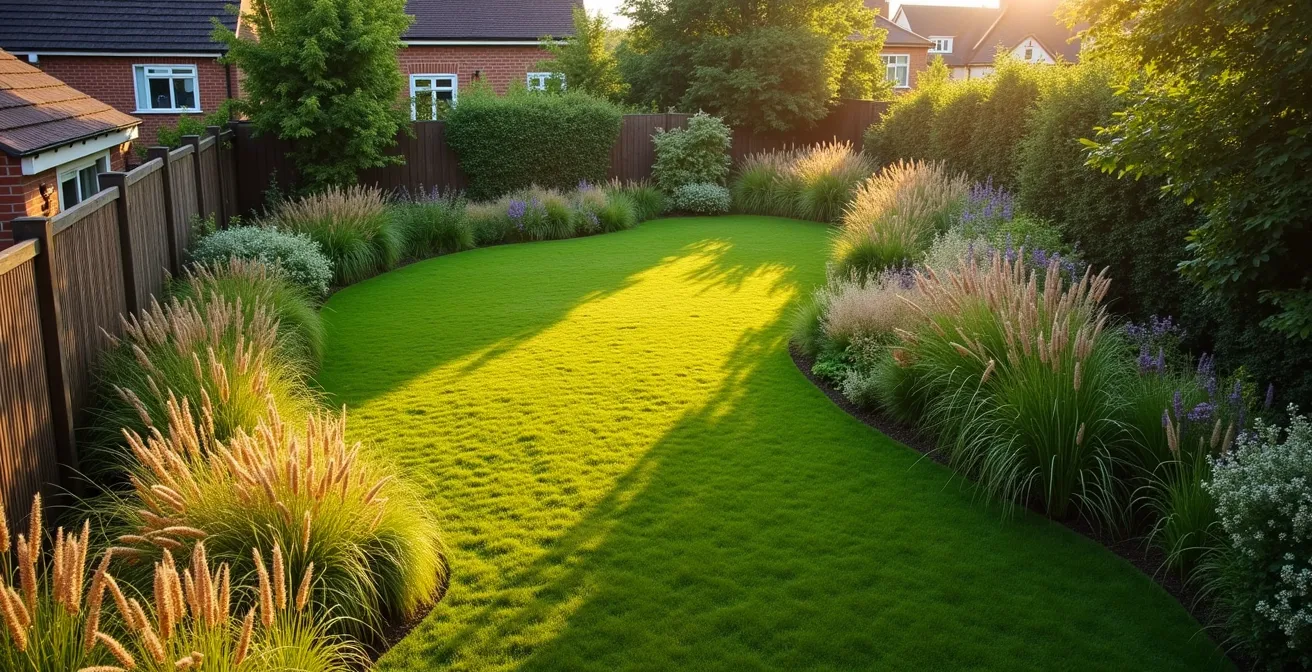
Contrary to popular belief, rewilding isn’t about neglect; it’s about precision ecological engineering that turns your garden into a high-performance asset for UK wildlife and climate resilience.
- A 20% wild patch acts as a micro-Sustainable Drainage System (SuDS), absorbing far more rainwater than a compacted lawn and reducing local flood risk.
- Connecting gardens with 13x13cm holes creates “Hedgehog Highways,” which are critical to reversing the catastrophic decline of this iconic British species.
Recommendation: Start by identifying the downwind corner of your garden, checking local seed provenance, and speaking to one neighbour about linking your green spaces.
The quintessential British garden, with its neatly manicured lawn, is an image of order and control. For generations, this has been the standard. But as the climate crisis intensifies and our native wildlife faces unprecedented threats, this green desert is no longer a viable model. The common advice is often simplistic: “just let it grow” or “scatter some wildflower seeds”. This approach, however, misses the point entirely and can sometimes do more harm than good.
The urgency of the situation demands more than passive neglect. We are facing a biodiversity collapse, with iconic species disappearing from our neighbourhoods. The solution isn’t to abandon our gardens to chaos, but to see them for what they could be: a network of millions of interconnected, high-functioning nature reserves. This requires a radical shift in perspective. What if we stopped thinking like gardeners and started thinking like ecological engineers?
This isn’t about surrendering your entire garden. The proposition is a strategic allocation: dedicating just 20% of your space to a purpose-built rewilding zone. This article will dismantle the myths and provide a pragmatic blueprint for transforming that small patch into a powerful engine for local ecology. We will explore the science-backed interventions that create functional corridors for nature, act as crucial flood defences, and even measurably improve your own health and wellbeing. It’s time to move beyond the aesthetic of the lawn and embrace the function of a living ecosystem.
This guide provides a detailed roadmap for implementing a rewilding zone. We will cover the critical “why” behind each action, from creating essential wildlife corridors to selecting the right plants and avoiding common, costly mistakes.
Summary: Engineering a Functional Rewilding Zone in Your UK Garden
- Why Are Hedgehog Highways Crucial for Local Populations?
- How to Build a Beetle Bank Without Attracting Vermin?
- Manicured Lawn vs Wild Patch: Which Absorbs More Rainwater?
- The “Wildflower” Seed Packet Mistake That Introduces Invasive Weeds
- Where to Place Your Rewilding Zone to Avoid Hay Fever Issues?
- The Infill Housing Mistake That Blocks Ancient Wildlife Routes
- Why Does Seeing Fractal Patterns in Plants Lower Your Blood Pressure?
- How to Convince Your Neighbours to Create a Hedgehog Highway Street?
Why Are Hedgehog Highways Crucial for Local Populations?
The decline of the hedgehog is a tragic emblem of the UK’s biodiversity crisis. These beloved creatures are vanishing from our landscape at an alarming rate. Conservation research confirms a catastrophic 33% decline in the UK hedgehog population in the last 25 years. The primary cause isn’t a single predator or disease, but something far more mundane: fences. Our tidy, enclosed gardens have fragmented their habitat, preventing them from foraging, finding mates, and escaping danger. A single hedgehog needs to roam across a vast area, and our garden walls create insurmountable barriers.
This is where the concept of the Hedgehog Highway moves from a quaint idea to a critical conservation tool. It is the most direct and effective piece of ecological engineering a homeowner can perform. A simple 13cm x 13cm hole at the bottom of a fence is all it takes to reconnect a fragmented world. It’s not just a theory; it’s a proven success. A 2021 study revealed that over 120,000 of these highways have already connected a quarter of a million gardens across the country, creating the first threads of a nationwide nature recovery network. Each new hole is another vital link in this chain.
Creating a highway is astonishingly simple. It involves getting your neighbour’s agreement, marking the hole, and using a basic saw to create the opening. The national ‘Hedgehog Street’ campaign even provides resources to make it a community project. By doing this, you are not just helping a hedgehog pass through; you are actively dismantling the barriers that have driven them to the brink and restoring a functional corridor for one of Britain’s most cherished animals.
How to Build a Beetle Bank Without Attracting Vermin?
While hedgehogs capture our hearts, the unsung heroes of a healthy garden ecosystem are the insects, particularly beetles. The UK Wildlife Trusts report there are over 4,000 species of beetles in the UK, many of which are voracious predators of common garden pests like slugs and aphids. A beetle bank is a purpose-built habitat to house these beneficial allies. However, a common and valid fear is that creating a mound of earth and organic matter will simply become a haven for rats and other vermin. This is a legitimate concern, but one that is easily solved with smart ecological engineering.
The key is to build a structure that is attractive to insects but completely uninteresting to rodents. This means avoiding compostable materials, food scraps, or deep, warm nesting sites. A properly constructed beetle bank is a simple, raised ridge of earth, not a compost heap. The illustration below shows a cross-section of an effective, vermin-proof design.

As the image demonstrates, the structure is based on a core of subsoil or even chalk and rubble, which offers no food or comfortable bedding for rodents. It is then planted with native, tussock-forming grasses like Cock’s-foot. These grasses create a dense, cool, and complex micro-habitat at their base, perfect for overwintering ground beetles and other invertebrates, but unsuitable for vermin. This intentional design provides all the benefits for biodiversity without the unwanted side effects.
Action Plan: Building a Rat-Deterrent Beetle Bank
- Create a mound using subsoil rather than compostable materials.
- Site the bank at least 5 metres from compost bins or bird feeders.
- Avoid incorporating any food waste into the structure.
- Plant with tussock-forming grasses like Cock’s-foot or Tufted Hair-grass.
- Keep the bank as a simple raised earth ridge without added organic matter.
Manicured Lawn vs Wild Patch: Which Absorbs More Rainwater?
The manicured lawn is an ecological desert in more ways than one. Beyond its lack of biodiversity, it’s also remarkably inefficient at managing one of our most pressing climate challenges: intense rainfall. Years of mowing, foot traffic, and soil compaction turn the typical lawn into a hard, impermeable surface, not dissimilar to asphalt. When heavy rain hits, water sheets off it, overwhelming domestic drains and contributing to localised flash flooding. Your rewilding zone, however, functions as a highly effective natural sponge, a piece of green infrastructure known as a micro-SuDS (Sustainable Drainage System).
The difference lies entirely beneath the surface. A wild patch, populated with a diverse range of native plants, develops a deep and complex network of roots. These roots create channels in the soil, allowing water to penetrate deep into the ground rather than running off. Research shows that healthy meadows, with their dense, intricate root systems, are incredibly effective at stabilising soil and mitigating flooding. The table below starkly contrasts the performance of a standard lawn against a wild meadow patch.
| Feature | Manicured Lawn | Wild Meadow Patch |
|---|---|---|
| Water Absorption | Low – compacted soil | High – complex root systems |
| Runoff Rate | High – similar to asphalt | Low – acts as natural sponge |
| Soil Structure | Compacted, lifeless | Aerated, rich with mycorrhizal fungi |
| Drainage Impact | Increases flood risk | Functions as micro-SuDS |
| Root Depth | Shallow (5-10cm) | Deep (up to 2m for some species) |
This data makes it clear that transforming just 20% of your lawn is not a passive act. It is a direct intervention that enhances your property’s resilience to extreme weather. Your wild patch becomes a functional component of the local drainage system, absorbing thousands of litres of water that would otherwise contribute to flooding. It is a perfect example of how small-scale ecological engineering can have a significant and tangible impact on climate adaptation.
The “Wildflower” Seed Packet Mistake That Introduces Invasive Weeds
One of the most common first steps in rewilding is to buy a colourful packet of “wildflower seeds.” Unfortunately, this well-intentioned act can quickly turn into an ecological disaster. Many generic seed mixes, especially those marketed as “bee bombs” or “pictorial meadows,” are filled with non-native, and sometimes highly invasive, species. Plants like Pot Marigold or Cosmos might look pretty, but they offer little value to UK native pollinators and can outcompete genuine native flora. In the worst-case scenario, you could be illegally introducing a harmful species.
The UK has strict laws to prevent this. The Wildlife and Countryside Act 1981 contains specific provisions to control the spread of invasive non-native plants. As the act makes clear, this is not a trivial matter:
Intentionally introducing certain invasive non-native species listed under Schedule 9 can lead to legal consequences.
– UK Wildlife and Countryside Act 1981, Schedule 9 provisions
This highlights the critical importance of provenance. For your rewilding zone to be an authentic ecological asset, the seeds must be not only native to the UK but, ideally, sourced from your local region. A “Dorset mix for a Dorset garden” ensures the plants are perfectly adapted to the soil and climate, and that they support the local insect populations that co-evolved with them. A reputable supplier will always list species by their Latin names, specify their local provenance, and be accredited by schemes like ‘Flora Locale’. Anything less is a gamble that could create an ecological trap—an area that looks good but harms local biodiversity.
Where to Place Your Rewilding Zone to Avoid Hay Fever Issues?
Another practical barrier that stops many families from rewilding is the fear of exacerbating hay fever. The thought of a wild patch full of pollen-producing grasses and weeds right next to the patio is enough to put anyone off. However, like the fear of vermin, this is a problem that can be completely designed out of the system. The solution lies in strategic placement and intelligent plant selection, turning your rewilding zone into a low-allergen space.
The key is understanding the difference between wind-pollinated and insect-pollinated plants. Hay fever is primarily caused by plants that release vast quantities of small, lightweight pollen into the air, such as grasses and trees like silver birch. Conversely, insect-pollinated plants have evolved to have large, heavy, sticky pollen that adheres to bees and butterflies. This pollen does not travel on the wind and poses a minimal risk to allergy sufferers. A rewilding zone filled with UK natives like Foxglove, Red Campion, and Knapweed will be buzzing with pollinators but perfectly comfortable for someone with hay fever.
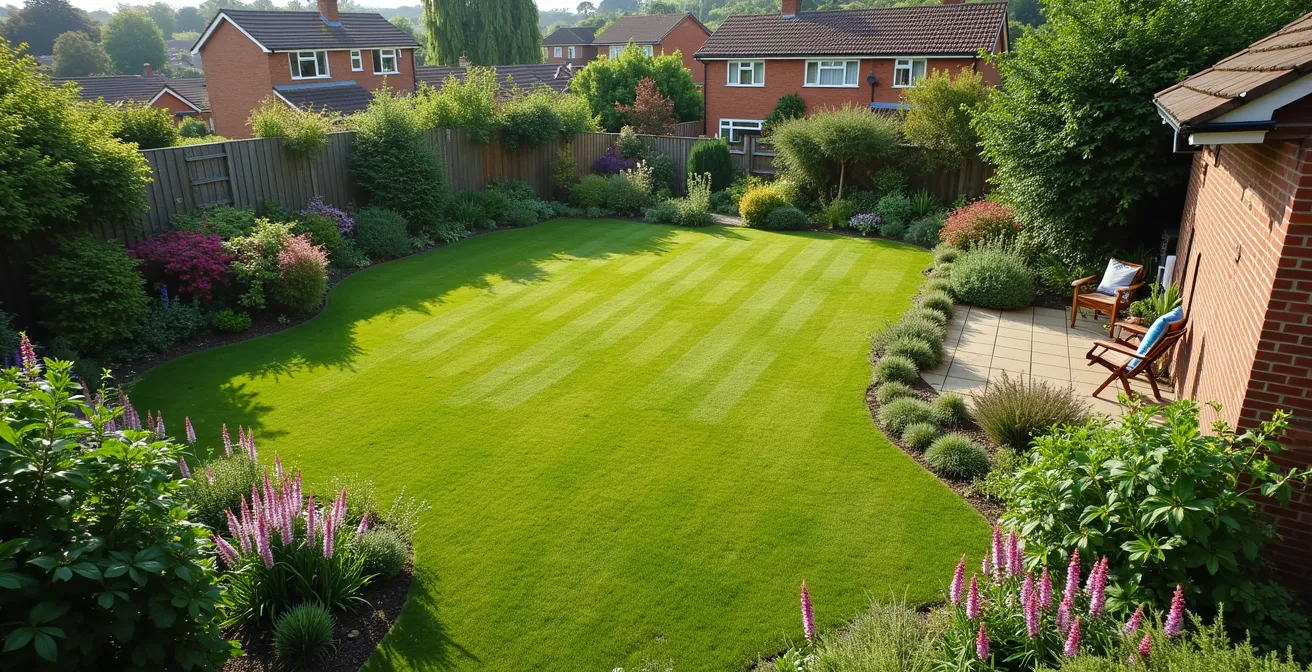
Placement is the second part of the solution. By observing the prevailing wind direction in your garden (typically from the south-west in the UK), you can position your rewilding zone in the downwind corner, as shown in the aerial view above. This ensures that any airborne pollen from neighbouring gardens or distant trees is blown away from your house, windows, and main seating areas. This simple act of strategic placement makes the garden a sanctuary, not a source of suffering.
The Infill Housing Mistake That Blocks Ancient Wildlife Routes
Our gardens do not exist in isolation. They are part of a much larger ecological tapestry, and modern development, particularly “infill” housing that develops small plots between existing homes, is shredding this tapestry to pieces. These developments often block what were once ancient, unrecognised wildlife routes—pathways used by animals for centuries. The collective power of our gardens to counteract this is immense. It’s estimated that gardens in Britain cover an area more than twice as large as all of our national nature reserves combined. This makes them the single greatest opportunity for large-scale habitat restoration.
Your 20% rewilding zone is therefore not just an island; it is a potential stepping stone in a vast suburban nature reserve. But how do you know which species historically used your land? You can become a wildlife detective by using the National Biodiversity Network (NBN) Atlas, an incredible free resource for UK residents. By entering your postcode, you can access decades of historical species records for your immediate area, revealing which birds, mammals, and insects have been recorded on or near your property. This data is transformative.
Using the NBN Atlas allows you to move from generic rewilding to highly targeted ecological restoration. Here’s how you can do it:
- Visit the National Biodiversity Network (NBN) Atlas website.
- Enter your postcode in the location search tool.
- Explore the historical species records for your specific area.
- Identify which wildlife—like specific butterflies or declining birds—historically used your garden as part of their corridor.
- Use this data to inform your plant choices, specifically selecting species that support the historical wildlife of your patch of land.
This approach turns your rewilding project from a personal endeavour into a piece of a larger, data-driven conservation strategy, actively working to repair the damage caused by habitat fragmentation.
Why Does Seeing Fractal Patterns in Plants Lower Your Blood Pressure?
The benefits of a rewilding zone are not just for wildlife and the climate; they are for you, too. The positive impact of nature on human health is so profound that the NHS is now actively embracing it as a form of preventative healthcare. This shift is a powerful endorsement of the tangible health benefits of daily exposure to natural environments.
NHS ‘green prescription’ pilots are now prescribing time in nature as a form of preventative healthcare, recognizing the measurable health benefits of exposure to natural environments.
– NHS England, Green Social Prescribing Programme
One of the key mechanisms behind this effect is our brain’s response to fractal patterns. Fractals are complex, self-repeating patterns found throughout nature, from the branching of an oak tree to the delicate unfurling of a fern frond. Our brains are hardwired to process these patterns with effortless fluency, an effect known as “fractal fluency.” Looking at them triggers an alpha brainwave response, inducing a state of calm, wakeful relaxation that has been scientifically shown to lower heart rate, reduce stress, and even lower blood pressure.
A manicured lawn has a very low fractal dimension—it is simple, uniform, and monotonous. A wild patch, in contrast, has an extremely high fractal dimension. It is a complex, layered, and diverse tapestry of shapes: the spirals of snail shells, the branching veins of leaves, the repeating segments of a fern like Bracken. Spending time simply looking at this complexity provides a greater stress-reduction benefit than staring at a featureless lawn. By engineering a wild zone, you are not just creating habitat; you are cultivating a personal source of free, on-demand mental restoration.
Key takeaways
- Dedicating 20% of your garden to rewilding is not neglect; it’s high-impact ecological engineering.
- Wild patches act as vital micro-SuDS, absorbing storm water and reducing local flood risk far more effectively than compacted lawns.
- Simple 13x13cm “Hedgehog Highways” are a critical tool to reconnect fragmented habitats and reverse the decline of UK wildlife.
- Contact with the fractal patterns found in diverse native plants has been shown to reduce stress and lower blood pressure.
How to Convince Your Neighbours to Create a Hedgehog Highway Street?
The ultimate power of your 20% rewilding zone is unleashed when it connects to your neighbour’s, and their neighbour’s, and so on down the street. A single garden is a refuge; a connected street is a functioning ecosystem. This is especially true for wide-roaming species like hedgehogs. With a need for ranges between 10 and 20 hectares, a single garden is simply not enough. The goal is to scale up from a Hedgehog Highway to a ‘Hedgehog Highway Street’, creating a super-corridor for local wildlife.
Convincing neighbours, however, can be daunting. The key is to frame it not as a personal request about garden aesthetics, but as a collective contribution to a recognised national conservation effort. Leveraging the official branding and resources from campaigns like ‘Hedgehog Street’ lends legitimacy and a sense of shared purpose. Transforming the task from a chore into a social community event—a “hole-cutting weekend”—can build enthusiasm and camaraderie. Small incentives and a bit of organisation can turn a few interested households into a street-wide movement.
Appointing a volunteer ‘Hedgehog Officer’ to coordinate efforts and registering your newly connected street on the national BIG Hedgehog Map provides a powerful sense of collective achievement. It’s no longer about individual gardens; it’s about putting your entire street on the map as a beacon of community-led conservation. This collaborative action is the final, most impactful step in ecological engineering, transforming a row of houses into a unified, life-sustaining habitat.
Your garden is more than just property; it’s a critical node in a network that can bring Britain’s nature back from the brink. Start today by planning your 20% zone and having that first conversation over the fence.
Frequently asked questions on Why Should Every UK Garden Dedicate 20% of Space to a Rewilding Zone?
Which UK plants should hay fever sufferers avoid in rewilding zones?
Avoid wind-pollinated species like grasses, silver birch, hazel, and oak. These release lightweight pollen that travels on air currents. Instead, opt for insect-pollinated flowers like Foxglove, Red Campion, and Knapweed, which have heavy, sticky pollen that doesn’t cause allergies.
When is the UK pollen season most intense?
The UK pollen season has three main peaks. According to Met Office data, tree pollen is most intense from March to May, grass pollen peaks from May to July, and weed pollen is at its highest from June to September.
How can I check daily pollen levels for my area?
You can use the Met Office pollen forecast tool on their website. It allows you to enter your postcode to check the daily pollen levels for your specific area, helping you plan garden activities to minimise exposure on high-count days.