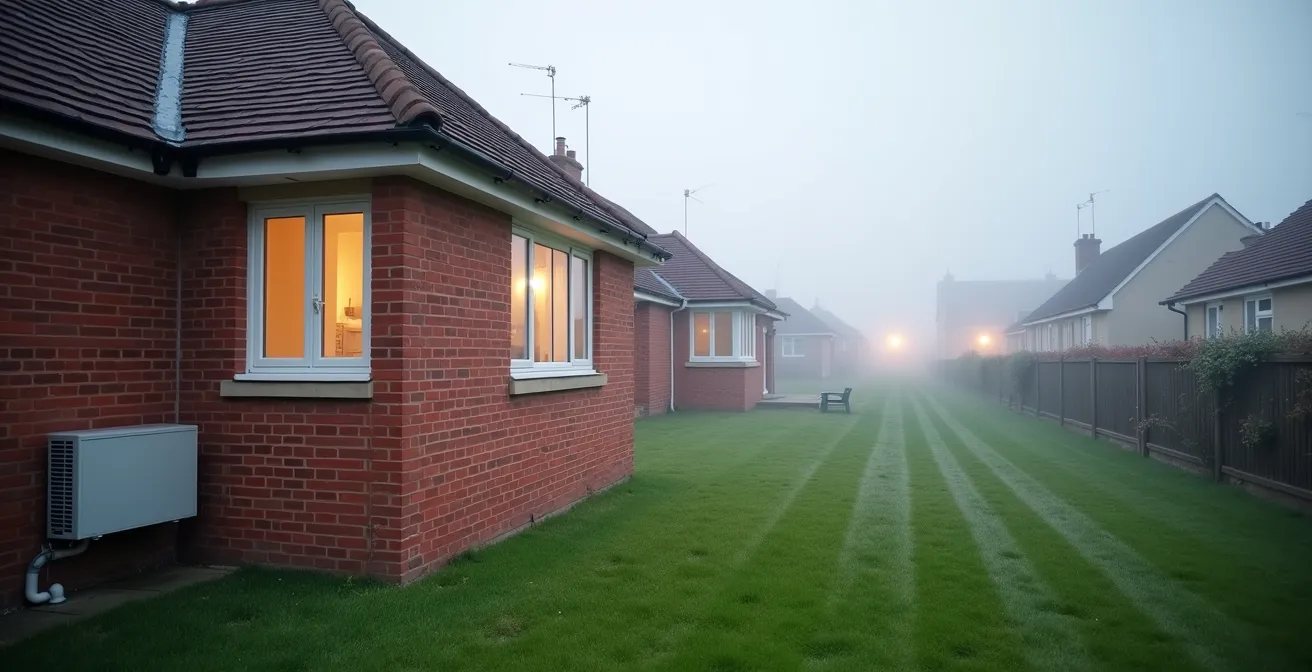
The best low-carbon heating for a 1990s house is not a specific product, but a system correctly sized and controlled for the home’s specific heat loss and emitter setup.
- Heat pump efficiency demands low flow temperatures (35-45°C), which dictates the suitability of existing radiators or the need for upgrades.
- Accurate, room-by-room heat loss calculations are non-negotiable to avoid inefficient oversizing and high running costs.
Recommendation: Prioritise a full heat loss survey from an MCS-certified engineer before committing to any technology.
For owners of detached houses built in the 1990s, the moment to replace a failing gas boiler presents a significant crossroad. The market is saturated with low-carbon alternatives, from air source heat pumps to infrared panels, yet the advice is often contradictory and confusing. Many homeowners are told to “insulate everything first,” a valid but incomplete starting point. Others are warned that heat pumps don’t work in the UK’s climate, a persistent myth that overlooks the core engineering principles at play.
The reality is that these homes, often with cavity walls and double glazing, occupy a middle ground. They are not new builds, but neither are they poorly insulated period properties. This specific context makes the choice of a new heating system less about a single “best buy” and more about a series of technical trade-offs. The discussion often focuses on the heat source itself, but the true key to efficiency and comfort lies elsewhere.
This guide moves beyond the sales pitches to provide a technical framework for your decision. The central argument is this: the most suitable system is not determined by the product, but by a correct understanding of your home’s heat loss, the physics of your heat emitters (radiators), and the intelligence of the system’s controls. Rather than a simple product-versus-product comparison, we will analyse the underlying principles you must grasp to make an informed engineering choice.
By understanding these core concepts, you can navigate the options with clarity, ask installers the right questions, and ultimately select a system that is not only low-carbon but also cost-effective and comfortable for your specific 1990s home. This article breaks down the essential technical considerations, from radiator temperatures to grant eligibility, to equip you for that decision.
Summary: A Homeowner’s Technical Guide to Replacing a Gas Boiler in a 1990s House
- Why Must Radiators Feel Tepid for Heat Pumps to Work Efficiently?
- How to Calculate Your Heat Loss to Avoid Oversizing Your System?
- Infrared Panels or Heat Pumps: Which Is Better for a Draughty Extension?
- The Electric Boiler Trap: Why Are Running Costs 3x Higher Than Gas?
- How to Set Weather Compensation Curves for Constant Comfort?
- Why Must You Have No Open Cavities to Claim the Heat Pump Grant?
- High Heat Retention Storage Heaters vs Gas: Which Scores Higher on EPC?
- Do Air Source Heat Pumps Really Work in Freezing UK Winters?
Why Must Radiators Feel Tepid for Heat Pumps to Work Efficiently?
The single biggest adjustment when moving from a gas boiler to an air source heat pump (ASHP) is understanding the concept of flow temperature. A gas boiler operates by sending very hot water, typically 60-75°C, to radiators in short, powerful bursts. In contrast, a heat pump achieves its efficiency by operating continuously at a much lower flow temperature, ideally between 35°C and 45°C. This is not a flaw; it is fundamental to how they work. A heat pump’s efficiency, measured by its Coefficient of Performance (COP), is the ratio of heat output to electricity input. This efficiency is highest at lower output temperatures.
Forcing a heat pump to produce 55°C water on a cold day drastically reduces its effectiveness. For instance, detailed efficiency data shows that a typical unit’s COP can drop from 5.34 at a 35°C flow temperature to just 3.0 at 55°C. This means you are paying for significantly more electricity to achieve the same amount of heat. The radiators in a 1990s home were likely sized for high-temperature gas heating. To deliver the same amount of heat into a room with 40°C water, the radiator’s surface area must be larger. This is why installers often recommend replacing standard radiators with larger models.
However, this doesn’t always mean a complete and costly system-wide replacement. Several strategies can be employed:
- Install K3 radiators (triple panel, triple convector) where wall space is limited to maximise heat output from a small footprint.
- Consider modern aluminium radiators, which are specifically designed to work effectively with low-temperature systems.
- Add fan-assisted convectors in rooms that require a rapid heat-up time, such as a home office.
- Combine radiator upgrades with underfloor heating in renovated areas like kitchens or extensions, as it is an ideal low-temperature emitter.
How to Calculate Your Heat Loss to Avoid Oversizing Your System?
Once you understand that a heat pump must run at a low, steady temperature, the next logical question is: what temperature is needed? The answer depends entirely on your home’s heat loss. Every building loses heat to the outside through its walls, windows, roof, and floor. The rate of this loss determines how much heat your system must continuously supply to maintain a comfortable indoor temperature. Calculating this accurately is the most critical stage of designing any low-carbon heating system, especially for a heat pump.

A common mistake is to “guess” the required system size, often leading to an oversized unit. An oversized heat pump will “cycle”—turn on and off frequently—which is highly inefficient, increases wear and tear, and provides poor comfort levels. A proper heat loss calculation, conducted room by room according to MCS (Microgeneration Certification Scheme) standards, is therefore non-negotiable. An engineer will measure each room, assess window types, and factor in insulation levels and air change rates. This process determines the precise heat requirement in kilowatts (kW) for each room and for the property as a whole. According to industry data, over 60% of heat pump efficiency depends on proper pre-installation heat loss calculations.
For context, a typical four-bedroom detached house from the 1990s will generally have a heat loss that requires an 8-12kW heat pump, depending on factors like whether the cavity walls have been insulated or if the double glazing has been upgraded. This precise calculation not only determines the correct size of the heat pump but also informs the radiator sizing for each room, ensuring the entire system is balanced and effective. Without this data, you are simply guessing.
Infrared Panels or Heat Pumps: Which Is Better for a Draughty Extension?
Many 1990s homes have had extensions added over the years, which can sometimes be harder to heat or less well-insulated than the main property. This raises the question of whether a single, whole-house system is appropriate, or if a zoned or hybrid approach is better. This is where infrared (IR) heating panels present an interesting alternative or complement to a heat pump. Unlike heat pumps or boilers, which heat the air (convection), infrared panels emit radiant heat, which directly warms objects and people in their path, much like the sun.
This makes IR particularly effective in spaces that are used intermittently or are prone to draughts, as you are not wasting energy heating a large volume of air that is quickly lost. For a single, hard-to-heat room like a conservatory or a home office in an extension, IR can provide near-instant comfort. However, for a whole house, relying solely on IR would be very expensive to run. This is where a strategic, zoned approach comes in. As heating expert Tom Coles notes in Homebuilding Magazine:
A zoned approach for 1990s homes works particularly well where the main house uses a heat pump and a specific, hard-to-insulate extension uses infrared, controlled intelligently to minimise grid load.
– Tom Coles, Homebuilding Magazine heat pump expert
The decision often comes down to installation and running costs for the specific area. Extending a heat pump system with underfloor heating into a new extension is highly efficient but comes with significant upfront cost and disruption. Infrared panels are cheaper and easier to install but have higher running costs per hour. A comparison for a typical 15m² extension in the UK highlights the trade-offs.
| Heating System | Installation Cost | Annual Running Cost (2024 rates) | BUS Grant Eligible |
|---|---|---|---|
| Infrared Panels | £1,500-2,500 | £450-600 | No |
| Heat Pump Extension | £3,000-5,000 | £150-250 | Yes (£7,500) |
| Electric Radiators | £800-1,500 | £600-800 | No |
The Electric Boiler Trap: Why Are Running Costs 3x Higher Than Gas?
Faced with the high upfront cost and potential radiator upgrades associated with a heat pump, some homeowners are tempted by what seems like a simple, cheap alternative: a direct electric boiler. An electric boiler looks and feels like a gas boiler, uses the existing radiators and pipework without modification, and has a very low installation cost. However, this is almost always a financial trap due to the fundamental difference between the cost of electricity and gas in the UK, and the system’s inherent inefficiency.
An electric boiler works on a principle of 1:1 efficiency. For every 1 kilowatt (kW) of electricity it consumes, it produces 1kW of heat. A heat pump, by contrast, uses 1kW of electricity to move 3 to 4kW of heat from the outside air into your home, giving it an efficiency of 300-400% (a COP of 3-4). This efficiency difference is critical when you consider the unit price of energy. As current UK energy prices show, electricity costs approximately £0.24/kWh versus £0.06/kWh for gas as of early 2024. This means that even before factoring in the heat pump’s efficiency advantage, the fuel itself is four times more expensive.
When you combine the high cost of electricity with the 1:1 efficiency of an electric boiler, the running costs become punitive. Heating a typical 1990s detached house with an electric boiler would result in annual bills three to four times higher than with a gas boiler. A heat pump, with its 300%+ efficiency, effectively bridges this price gap, bringing its running costs broadly in line with, and often lower than, natural gas. An electric boiler is only a viable option in very specific, niche circumstances, such as a very small, highly insulated modern flat, or as a backup system that is rarely used. For a detached family home, it is a recipe for extreme fuel poverty.
How to Set Weather Compensation Curves for Constant Comfort?
One of the most powerful but least understood features of modern heat pump systems is weather compensation. Unlike a traditional boiler that is either on or off, a heat pump with weather compensation intelligently adjusts its output based on the outdoor temperature. It uses an external sensor to monitor conditions and automatically adjusts the flow temperature of the water going to the radiators to precisely match the house’s heat loss at that moment. This ensures a constant, stable indoor temperature without the “overshoots” and “undershoots” common with basic thermostatic control.

The system operates based on a “curve” set by the installer. This curve tells the heat pump what flow temperature to produce for any given outside temperature. For example, on a mild 10°C day, it might only need a 35°C flow temperature, but on a freezing -2°C day, it might increase this to 45°C. Setting this curve correctly is vital for both comfort and efficiency. An incorrectly set curve can lead to rooms feeling cool on cold days or wasting energy by running too hot on mild days. While the initial setup is done by the installer, fine-tuning it can maximise your system’s performance.
Fine-tuning the curve is a process of small, incremental adjustments over several days. The goal is to find the lowest possible curve that still maintains a comfortable temperature in the coldest weather. This maximises the heat pump’s COP and minimises running costs.
Action Plan: Fine-Tuning Your Weather Compensation Curve
- Start with the manufacturer’s baseline curve recommended for your UK region (e.g., a milder curve for Southern England versus a steeper one for Northern Scotland).
- Monitor the indoor temperature for 2-3 days without making any adjustments to observe the system’s natural behaviour.
- If rooms feel consistently too cold or too warm, adjust the curve gradient in small 0.1 increments as per the manufacturer’s instructions.
- If your system allows for different heating zones (e.g., upstairs and downstairs), set and adjust separate curves for each.
- Fine-tune the night setback temperature and times separately from the daytime settings to save energy while you sleep.
- Plan to review your settings seasonally, as a curve perfected in autumn may need a slight tweak for the depths of winter.
Why Must You Have No Open Cavities to Claim the Heat Pump Grant?
A significant incentive for homeowners in England and Wales to switch to a heat pump is the Boiler Upgrade Scheme (BUS). This government scheme provides a grant to help cover the upfront cost of the installation. For a property to be eligible, it must have a valid Energy Performance Certificate (EPC) issued within the last 10 years that has no outstanding recommendations for loft or cavity wall insulation. For a 1990s house, the key focus is typically on cavity wall insulation.
The logic behind this rule is simple: it is a “fabric first” approach. The government will not subsidise the installation of a new, efficient heating system if the building’s basic thermal envelope is not up to standard. Pouring heat from any source into a poorly insulated building is inefficient and wasteful. Since most 1990s homes were built with wall cavities, ensuring they are filled is a prerequisite for grant eligibility. This requirement ensures that public money is spent on installations that have the best chance of performing efficiently and effectively reducing carbon emissions. The Boiler Upgrade Scheme offers a £7,500 grant for air and ground source heat pumps in England and Wales, provided this and other criteria are met.
For a homeowner, the process to ensure eligibility is straightforward:
- First, check your current EPC. You can find this online via the government’s register. Look for any recommendations under “cavity wall insulation.”
- If a recommendation exists, you must have the work done. Contact a CIGA (Cavity Insulation Guarantee Agency) approved installer for an assessment and quote. The typical cost for a detached house is between £500 and £1,500.
- Once the insulation is complete, you must obtain a new EPC certificate that reflects the upgrade and shows no outstanding insulation recommendations.
- You can then apply for the BUS grant through your chosen MCS-certified heat pump installer, who will handle the paperwork and deduct the grant amount from your final bill.
Key Takeaways
- Heat pump efficiency is directly tied to low flow temperatures, making radiator sizing or underfloor heating a critical factor.
- An MCS-certified, room-by-room heat loss calculation is the essential first step to correctly size any system and prevent high running costs.
- Direct electric systems like boilers have running costs 3-4 times higher than gas, making them a financial trap despite low installation costs.
High Heat Retention Storage Heaters vs Gas: Which Scores Higher on EPC?
Another electric heating option often considered is high heat retention storage heaters. These are not the inefficient, bulky units of the past. Modern versions are slimmer, have better controls, and are designed to store heat overnight using cheaper off-peak electricity tariffs (like Economy 7) and release it throughout the day. For homes without gas, they have traditionally been a common solution. However, when comparing them to gas or heat pumps, their performance and EPC rating must be carefully considered.
The Energy Performance Certificate (EPC) methodology rates homes based on cost per square metre. Because storage heaters rely on electricity, which is more expensive per unit than gas, a house heated by them will typically receive a lower EPC rating than an identical one with a gas boiler, even if the carbon emissions are lower. However, an air source heat pump turns this on its head. Because a heat pump is so efficient (300%+), it can deliver heat at a running cost comparable to gas, and therefore scores much better on an EPC than other electric systems. Furthermore, the UK’s electricity grid is rapidly decarbonising. With over 50% of generation now coming from low-carbon sources like renewables and nuclear, using this electricity in a hyper-efficient heat pump results in significantly lower carbon emissions than burning gas in a boiler.
Beyond the EPC rating, the user experience differs significantly. The table below compares the key comfort factors for a 1990s house.
| System Type | Response Time | Temperature Control | Running Pattern | Comfort Level |
|---|---|---|---|---|
| Storage Heaters | Slow (hours) | Limited | Set & forget | Variable |
| Gas Boiler | Fast (minutes) | Precise | On demand | Consistent |
| Heat Pump | Moderate | Weather compensated | Continuous low | Steady |
Do Air Source Heat Pumps Really Work in Freezing UK Winters?
A persistent concern among UK homeowners is whether an air source heat pump can genuinely function effectively during a cold snap. The question is logical: how can a device extract heat from air that is already freezing? The answer lies in the physics of refrigeration. Even on a cold day, there is still thermal energy in the air. A heat pump’s refrigerant has an extremely low boiling point. As outside air is drawn across the evaporator, this energy is enough to turn the liquid refrigerant into a gas. The compressor then dramatically increases the pressure of this gas, which in turn raises its temperature significantly, allowing it to heat the water for your home.
This process works effectively even in sub-zero conditions. According to Met Office data, the average UK winter temperature is between 4-6°C, and modern heat pumps are tested and rated to operate efficiently down to -25°C, a temperature rarely seen in most of England. While the system’s efficiency (COP) does decrease as the outside air gets colder, a correctly sized and specified system will continue to provide all the heating and hot water a home needs throughout a typical UK winter.
A UK-based field trial conducted by the Energy Systems Catapult concluded that “heat pumps can be successfully installed in homes of every style and from every era, even if the air outside is sub-zero.” The key is not the external temperature itself, but whether the system has been designed correctly based on an accurate heat loss calculation. A system designed to meet the home’s heating demand at a design temperature of -2°C or -3°C will have more than enough capacity to handle the vast majority of winter weather comfortably and efficiently. For the very few days a year that might be colder, the system has a small integrated backup heater to top up the heat, ensuring comfort is never compromised.
Ultimately, selecting the right low-carbon heating system for a 1990s detached house is an engineering exercise. It requires moving beyond brand names and focusing on a holistic system design tailored to your specific property. To make an informed decision, the next logical step is to commission a detailed heat loss survey from an MCS-certified engineer.