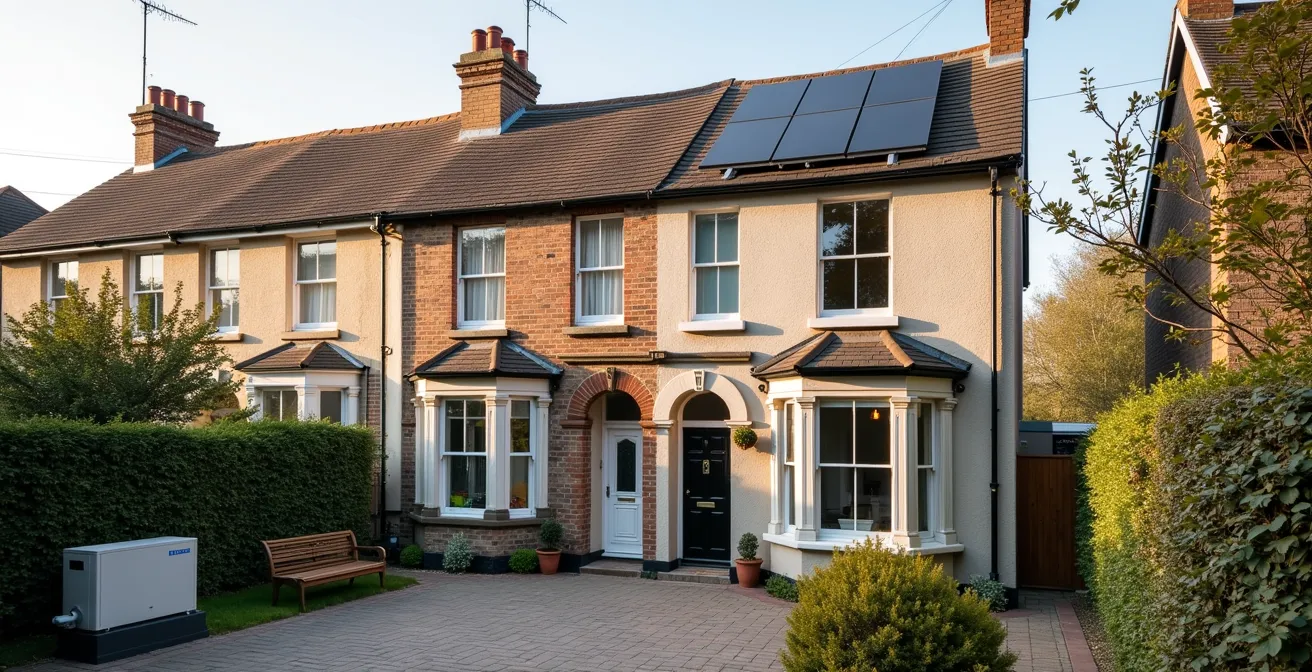
Achieving “true” Net Zero in a high-value UK property is not about ticking boxes for solar panels and heat pumps; it is a forensic accounting of your building’s entire carbon lifecycle.
- The embodied carbon from renovation materials and construction often creates a significant “carbon debt” that operational savings alone cannot repay for decades.
- Genuine carbon neutrality requires investing in high-integrity, UK-based carbon removal credits (like peatland restoration), not just cheap avoidance schemes.
Recommendation: The only credible path forward is to commission a Whole-Life Carbon (WLC) assessment before any design or construction work begins. This is the non-negotiable first step to authenticating your property’s environmental credentials.
The ambition to create a “Net Zero” home has become the ultimate statement of environmental stewardship for discerning property owners in the UK. The market is saturated with advice, typically revolving around a familiar checklist: install a heat pump, add solar panels, and upgrade your insulation. While well-intentioned, this popular narrative is dangerously incomplete. It focuses almost exclusively on operational emissions—the energy you use day-to-day—while conveniently ignoring the far more complex and inconvenient truth of embodied carbon.
This overlooked metric represents the total greenhouse gas emissions generated from manufacturing building materials, transporting them to the site, and the construction process itself. Achieving true, certifiable Net Zero is not a matter of simply installing green technology. It is a rigorous, demanding process of whole-life carbon accounting. It requires confronting the reality that a poorly planned renovation can, paradoxically, emit more carbon than it saves for decades.
This guide moves beyond the platitudes. It is not about finding the cheapest solution; it is about defining the most credible one. We will dissect the critical difference between operational efficiency and genuine carbon neutrality, explore the pitfalls of greenwashing in the carbon offset market, and establish a clear framework for making decisions that stand up to the highest levels of scrutiny. For those seeking not just an efficient home but the unimpeachable status of a true Net Zero property, understanding these distinctions is paramount.
This article provides a strategic overview of the essential, often-overlooked considerations for anyone serious about achieving genuine carbon neutrality in an existing UK home. The following sections break down each critical component, from carbon accounting to market value.
Summary: The Path to Authentic Net Zero for Your UK Property
- Why “Net Zero” Operations Don’t Make Your Renovation Carbon Neutral?
- How to Offset Your Residual Household Emissions Without Greenwashing?
- Gold Standard or Verra: Which Carbon Credits Actually Plant Trees?
- The Rebound Effect: Why Efficiency Often Leads to Higher Consumption?
- Do Net Zero Certified Homes Command a Premium in the UK Market?
- Passivhaus vs Building Regs: Which Guarantee Truly Low Bills?
- How Much Carbon Does Hempcrete Lock Away Compared to Brick?
- Should You Demolish and Rebuild or Retrofit to Save the Most Carbon?
Why “Net Zero” Operations Don’t Make Your Renovation Carbon Neutral?
The term “Net Zero” is frequently misconstrued to mean simply having zero energy bills or generating as much renewable energy as you consume. This is a critical, and costly, misunderstanding. This definition only addresses operational carbon. The far larger and more permanent figure is the embodied carbon: the emissions released during the extraction, manufacturing, transportation, and construction of every material used in your renovation. This creates a significant “carbon debt” from day one.
Deploying low-carbon technologies is a perfect example of this paradox. While a heat pump drastically reduces operational emissions over its lifespan, its manufacture and installation create a substantial upfront carbon cost. In fact, analysis of UK properties reveals that low-carbon technologies like heat pumps can increase the embodied carbon of a retrofit by 38% to 117%. This debt can take decades of operational savings to “repay.”
Therefore, a renovation is not carbon neutral simply because the home is efficient to run. True neutrality demands a whole-life carbon assessment, where the upfront embodied carbon emissions are meticulously calculated and then offset. Ignoring this initial debt is the most common failure in projects aspiring to genuine Net Zero status. It is the difference between achieving a marketing claim and achieving a scientifically robust environmental outcome.
Ultimately, every kilogram of material brought onto your property comes with a carbon price tag. Acknowledging and accounting for this is the first non-negotiable step toward credible Net Zero status.
How to Offset Your Residual Household Emissions Without Greenwashing?
Even with the most rigorous design and retrofit, achieving absolute zero emissions in an existing home is a practical impossibility. There will always be a quantum of residual emissions, from the embodied carbon of materials to baseline operational use. The only credible way to neutralise this remaining footprint is through carbon offsetting. However, the voluntary carbon market is fraught with ambiguity and projects of dubious quality, making it a minefield of potential greenwashing.
The critical distinction to make is between carbon avoidance and carbon removal. Avoidance credits fund projects that prevent emissions elsewhere (e.g., funding a wind farm to displace a coal plant). While beneficial, they do not cancel out the carbon you have already emitted. Carbon removal, by contrast, involves actively sequestering CO2 from the atmosphere. For a property to be credibly “Net Zero,” its residual emissions must be balanced by verified carbon removal.
In the UK, this means investing in high-integrity, domestic nature-based solutions. While residential buildings account for 20% of UK greenhouse gas emissions, the nation also possesses powerful natural carbon sinks. Projects focused on restoring UK peatlands or creating new woodlands under government-backed verification schemes offer a tangible and verifiable method of carbon sequestration. These projects provide permanence, transparency, and co-benefits for local biodiversity, making them a superior choice to anonymous international credits.

Choosing a verified UK-based removal project is not just an environmental decision; it is a reputational one. It demonstrates a commitment to tangible, local impact and insulates your project from accusations of greenwashing that often plague low-cost, low-quality international offsets.
This focus on quality and locality is the only way to ensure your investment in offsetting genuinely neutralises your property’s carbon footprint.
Gold Standard or Verra: Which Carbon Credits Actually Plant Trees?
Navigating the world of carbon credits requires understanding the registries that validate them. While international standards like Gold Standard and Verra (Verified Carbon Standard) dominate the global market, they are not all equal, especially concerning the goal of carbon removal through afforestation. Many projects under these standards focus on avoidance, and their permanence can be difficult to verify from the UK.
For a UK property owner seeking the highest level of integrity, the focus must shift to domestic, government-endorsed schemes. The Woodland Carbon Code (WCC) and the Peatland Code are the UK’s premier standards for verifying locally-based carbon removal projects. They offer a level of transparency and long-term assurance that is often absent in the global market. The WCC, for instance, guarantees that projects are managed sustainably for over 100 years, providing a robust claim of permanence.
The following table, based on information from UK government and industry bodies, provides a clear comparison of the standards most relevant to a UK-based offsetting strategy.
| Standard | UK Recognition | Permanence Period | Verification Method |
|---|---|---|---|
| UK Woodland Carbon Code | Government Backed | 100+ years | Independent audit every 5 years |
| UK Peatland Code | Government Backed | 30-50 years | Annual monitoring reports |
| Gold Standard | International | 20-40 years | Third-party verification |
| Verra VCS | International | 20-100 years | Project-specific audits |
While Gold Standard and Verra have their place, they do not offer the same direct, verifiable link to UK-based carbon sequestration. For an owner of a high-value UK property, prioritising WCC or Peatland Code credits is not just best practice; it is the only way to ensure the investment is credible, geographically relevant, and contributes directly to the UK’s national environmental targets.
This choice determines whether your offsetting is a genuine act of carbon removal or merely a financial transaction with questionable environmental impact.
The Rebound Effect: Why Efficiency Often Leads to Higher Consumption?
A core assumption in sustainable renovation is that increased energy efficiency automatically leads to lower energy consumption. This is a dangerously simplistic view that ignores a well-documented behavioural phenomenon known as the Rebound Effect. This effect occurs when the cost savings from efficiency improvements lead to a change in behaviour that partially or fully negates those savings. It is a psychological trap that can undermine the performance of even the most technologically advanced homes.
In the context of a high-value property, this often manifests as “comfort taking.” For instance, after a comprehensive insulation upgrade, homeowners may feel liberated to heat previously unused rooms or maintain higher internal temperatures throughout the winter, believing the efficiency gains can “afford” it. This is not a hypothetical risk; research from Historic England on listed UK homes confirms that retrofit measures often result in these exact unintended consumption increases.

Mitigating the rebound effect requires a strategy that goes beyond engineering. It necessitates high-resolution energy monitoring systems that make consumption visible and intelligible to the homeowner. It also requires a mindset shift, moving from a goal of “saving money” to one of “maintaining a strict carbon budget.” Even with the best technology, human behaviour remains a critical variable, a point underscored by industry experts. As a technical report from Mitsubishi Electric notes:
The operational carbon is still the most significant factor for whole life carbon, regardless of which system we consider
– Mitsubishi Electric Technical Report, Carbon: Embodied, Operational and Whole Life Cycle Analysis
Failing to account for the rebound effect means your home’s predicted performance on paper will not match its real-world carbon footprint. True Net Zero requires designing for technology and planning for human nature.
This psychological dimension is a sophisticated element of sustainability that separates standard projects from those achieving elite environmental performance.
Do Net Zero Certified Homes Command a Premium in the UK Market?
While the moral and environmental imperatives for achieving Net Zero are clear, the financial case is equally compelling, though often misunderstood. The value of a “green” home in the prime UK market is not derived simply from lower energy bills. For the target client, this saving is marginal. The true premium is commanded by a host of qualitative benefits that a rigorously designed Net Zero home delivers.
A property engineered to Passivhaus or equivalent standards offers an unparalleled living experience. This includes superior acoustic performance due to triple-glazing and airtight construction, exceptional indoor air quality from Mechanical Ventilation with Heat Recovery (MVHR) systems, and unwavering thermal comfort with no drafts and stable year-round temperatures. These are tangible, luxury-level benefits that differentiate a property in a crowded market.
Furthermore, these homes offer significant value through future-proofing. With the UK’s Future Homes Standard mandating that new homes from 2025 have 75% lower emissions than their 2013 counterparts, and with the prospect of carbon taxes and stricter Energy Performance Certificate (EPC) regulations looming, a certified Net Zero home is insulated from future regulatory risk and devaluation. It is not just an efficient home; it is a resilient and intelligent asset.
Action Plan: Key Value Drivers for Green Homes in Prime UK Markets
- Acoustic performance: Superior sound insulation from triple glazing and enhanced wall systems
- Indoor air quality: MVHR systems providing filtered, controlled ventilation
- Thermal comfort: Consistent temperatures year-round without drafts
- Resilience to extremes: Protection against heatwaves and cold snaps
- Future-proofing value: Protection against upcoming EPC regulations and carbon taxes
These factors combine to create a powerful value proposition. In prime postcodes, energy-efficient homes not only command a price premium but also tend to sell faster. The “eco-status” is thus translated into concrete market advantages that go far beyond a simple calculation of saved energy costs.
For the discerning buyer, the certification is a proxy for quality, comfort, and intelligent design—the true hallmarks of a luxury property.
Passivhaus vs Building Regs: Which Guarantee Truly Low Bills?
The UK’s Building Regulations set a minimum legal standard for energy performance. However, they are fundamentally flawed by the “performance gap”—the chasm between a home’s designed energy efficiency and its actual, real-world consumption. It is not uncommon for homes built to code to consume 20-50% more energy than predicted by their SAP calculations. For an owner seeking certainty and guaranteed performance, relying on Building Regulations is an unacceptable risk.
The only standard that reliably closes this gap is Passivhaus (and its retrofit equivalent, EnerPHit). Unlike Building Regulations, which are largely a desktop exercise, Passivhaus is a rigorous, physics-based standard with a non-negotiable quality assurance process. It mandates airtightness levels, specifies thermal bridge-free design, and requires on-site testing and verification, including mandatory blower door tests. The result is a variance of less than 5% between predicted and actual energy use.
This difference in methodology and rigour is stark, as evidenced by research from bodies like the London Energy Transformation Initiative (LETI). A home built to the EnerPHit standard is not just marginally better; it operates in a different performance class entirely. The research shows that retrofitting is critical for the UK’s net zero ambitions, as the vast majority of homes that will exist in 2050 have already been built.
| Standard | Energy Use Target | Performance Gap | Quality Assurance |
|---|---|---|---|
| UK Building Regs 2021 | 55-75 kWh/m²/year | 20-50% worse than predicted | SAP calculation only |
| EnerPHit Retrofit | 25 kWh/m²/year | <5% variance | Rigorous testing & certification |
| Passivhaus New Build | 15 kWh/m²/year | <5% variance | Blower door test mandatory |
Choosing Passivhaus or EnerPHit is not an aesthetic choice; it is a commitment to a guaranteed outcome. It is the only way to be certain that the specified performance will be delivered, ensuring genuinely low energy consumption and providing the foundation for a credible Net Zero claim.
For a high-value property, accepting the ambiguity and proven underperformance of standard building codes is an unnecessary compromise.
How Much Carbon Does Hempcrete Lock Away Compared to Brick?
Material selection is a decisive factor in managing the embodied carbon of a renovation. The conventional choice of brick and block, with their energy-intensive manufacturing processes, contributes significantly to a project’s upfront “carbon debt.” In contrast, bio-based materials like hempcrete offer a radically different proposition: they can be “better-than-zero” carbon, actively sequestering CO2 from the atmosphere during the plant’s growth.
Hempcrete is a composite material made from hemp shiv (the woody core of the plant) and a lime-based binder. As the hemp plant grows, it absorbs a significant amount of CO2. When harvested and locked into the fabric of a building, that carbon is effectively sequestered for the life of the structure. While the lime binder has its own carbon footprint, the net effect is a material that is often carbon-negative. This is a stark contrast to a traditional brick, which has an embodied carbon of around 0.25 kg CO2e per brick.

Beyond its carbon credentials, hempcrete offers excellent thermal insulation and is “breathable,” meaning it helps regulate indoor humidity, contributing to a healthier living environment. While not a load-bearing material itself, it is typically used as infill within a timber frame. Studies confirm the benefits; for example, detailed lifecycle assessments show that using natural materials in retrofits can achieve a 7% to 14% reduction in total embodied carbon. This is a substantial saving that directly reduces the project’s carbon debt from the outset.
Opting for bio-based materials is one of the most direct ways to move from simply reducing emissions to actively designing a carbon-storing building.
Key takeaways
- Retrofit over rebuild: Retaining a building’s structure is the single most impactful decision to reduce its whole-life carbon footprint.
- Performance is not a prediction: The Passivhaus standard offers a verifiable guarantee of low-energy use, while Building Regulations are prone to a significant performance gap.
- True Net Zero is a forensic exercise: It demands a full accounting of embodied carbon and offsetting residual emissions with high-integrity, verified carbon removal.
Should You Demolish and Rebuild or Retrofit to Save the Most Carbon?
The most significant carbon decision in any property’s lifecycle is made before a single design is drawn: the choice between retrofitting the existing structure and demolishing it to build anew. A common misconception is that a brand-new, hyper-efficient building is inherently “greener.” From a whole-life carbon perspective, this is unequivocally false. The embodied carbon released during demolition and the construction of a new building is so immense that it can take a lifetime to pay back.
The mantra “the greenest building is the one that already exists” is backed by hard data. The embodied carbon of a new building is, on average, twice that of a retrofit project. This is because retrofitting preserves the most carbon-intensive elements of a building: its foundations, structure, and envelope. Demolishing this “locked-in” carbon and replacing it creates a carbon debt that even the most efficient new-build cannot overcome in a reasonable timeframe.
This principle is so critical that it is becoming enshrined in policy, with London’s planning guidance now often requiring Whole Life Carbon assessments to justify demolition. The imperative to retrofit is also a matter of pragmatic reality. As leading engineers point out, the vast majority of our future building stock is already here. This is a non-negotiable starting point for any serious climate strategy.
80% of the buildings with us today will still be in use in 2050
– Max Fordham Engineers, Net Zero Carbon Guide
For the owner of a high-value property, especially a heritage asset, the decision is clear. A deep retrofit to the EnerPHit standard not only saves a colossal amount of embodied carbon but also preserves the character and inherent value of the property, delivering a superior outcome on both environmental and aesthetic grounds.
The decision to retrofit is the first and most powerful step towards achieving a credible, authentic, and responsible Net Zero home.
Frequently Asked Questions about Net Zero Homes in the UK
What’s the difference between ‘avoidance’ and ‘removal’ credits?
Avoidance credits prevent emissions (like funding wind farms to displace coal), while removal credits actively extract CO2 from the atmosphere (like tree planting). For true net zero, removal credits are essential because they are the only way to verifiably cancel out the emissions your property has already generated.
How can I verify UK-based offset projects?
To ensure credibility, you must confirm that the project is registered with the UK Carbon Registry. Verify that it holds a valid Woodland Carbon Code or Peatland Code certification. Finally, demand transparency by reviewing all public documentation, including monitoring and verification reports, to assess the project’s integrity and performance.
What is the ‘permanence problem’ for UK forestry?
Permanence refers to the longevity of the carbon storage. For UK woodland projects, this is a 50-100 year commitment. However, this storage is vulnerable to risks such as disease, forest fires, or future changes in land use. This uncertainty is why high-quality projects have robust, long-term management and insurance plans to mitigate these risks and guarantee the carbon remains sequestered.