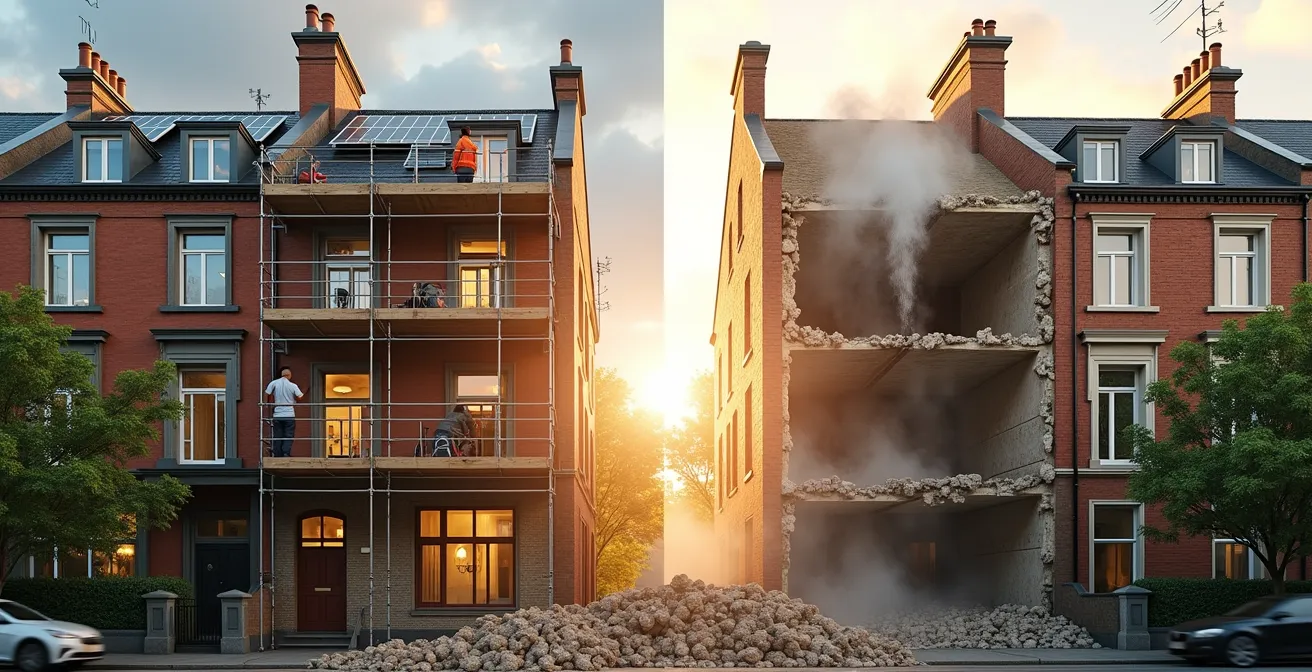
Contrary to popular belief, a brand-new, energy-efficient building is often less green than a well-executed retrofit due to the massive, upfront carbon debt of its construction.
- The embodied carbon from new construction can be equivalent to 20-40 years of a building’s operational emissions, a debt that is released into the atmosphere *today*.
- The critical metric for any property developer is now the “carbon payback period”—the time it takes for operational energy savings to offset the initial carbon cost of the materials used.
Recommendation: Always prioritise a deep retrofit over demolition. Your first step should be a component-level embodied carbon audit to create a quantifiable carbon budget for the project.
For property developers in the UK, the “green” choice has long been framed around operational efficiency. The logic was simple: a new, well-insulated building with a low EPC rating would save more carbon over its lifetime than a draughty old one. This focus on energy bills and operational carbon, however, overlooks a far more immediate and significant factor: the embodied carbon. This is the colossal carbon footprint generated during the manufacturing, transportation, and assembly of every material used in a new build, from concrete foundations to roof tiles.
The conversation is now undergoing a critical shift. As the UK grid decarbonises, the proportional impact of operational emissions is shrinking, throwing the spotlight squarely onto the huge, one-off carbon payment of construction. The ethical and, increasingly, financial question is no longer just “how much carbon will it save over 50 years?” but “how much carbon will it cost us *right now*?”. A new build starts with a significant carbon debt, whereas a retrofit works with the carbon that is already “spent” and locked within the existing structure.
This approach requires moving from vague sustainability goals to a rigorous, analytical mindset. It’s about treating carbon as a budget to be managed. Instead of assuming a new build is superior, the responsible path involves a forensic examination of the existing asset and a calculated plan to upgrade it. This means analysing the carbon cost of every new window, every structural beam, and every layer of insulation.
This guide provides a framework for that analysis. We will dissect the key decisions in a renovation project, offering the tools to calculate the true carbon impact and move beyond the myth that “new” automatically means “green.” We will explore how to read material data, calculate carbon payback, avoid common traps like over-engineering, and leverage regulations that are already making retrofitting the default choice in progressive parts of the UK.
To navigate this complex decision, this article breaks down the core components of a carbon-conscious renovation strategy. The following sections provide a clear roadmap for calculating and minimising the embodied carbon in your next project.
Summary: A Developer’s Guide to Embodied Carbon in Renovations
- How to Read an EPD to Choose the Lowest Carbon Insulation?
- How Many Years of Energy Savings Will It Take to Pay Back the Carbon of New Windows?
- Steel Beams vs Glulam: What Is the Carbon Difference for Your Extension?
- The Over-Engineering Trap: Why Using Too Much Concrete Ruins Your Green Credentials?
- How to Salvage and Reuse Bricks to Slash Embodied Carbon?
- Why “Net Zero” Operations Don’t Make Your Renovation Carbon Neutral?
- How Much Carbon Does Hempcrete Lock Away Compared to Brick?
- Is Achieving “True” Net Zero Carbon Possible for an Existing UK Home?
How to Read an EPD to Choose the Lowest Carbon Insulation?
The first step in managing a carbon budget is understanding the cost of your materials. An Environmental Product Declaration (EPD) is the primary tool for this, functioning like a nutritional label for a product’s environmental impact. For insulation, a critical component in any retrofit, the EPD reveals the ‘Global Warming Potential’ (GWP), typically measured in kg CO2e (carbon dioxide equivalent) per functional unit (e.g., per square metre). This figure represents the embodied carbon.
When comparing insulation options, look for the ‘A1-A3’ GWP value, which covers the carbon emitted from raw material extraction to factory production. A standard mineral wool might have a positive carbon footprint, while a natural material like wood fibre or hemp can be carbon negative. This means it has sequestered more carbon during its growth than was emitted during its production. For example, some natural insulation panels can actively lock away significant amounts of CO2. A 1960s property in England that underwent a deep retrofit to the AECB Carbonlite Silver Standard provides a compelling case. By using external wall insulation made from wood fibre, alongside other measures, the project achieved an 87% reduction in heating energy demand, demonstrating the dual benefit of operational savings and low embodied carbon.
To apply this, request EPDs from your suppliers. Compare the GWP values for different insulation types (e.g., PIR board, mineral wool, cork, wood fibre). Choosing the material with the lowest—or even negative—GWP is a direct and quantifiable way to reduce your project’s upfront carbon debt. This isn’t just a green gesture; it’s a calculated decision that forms the foundation of a low-carbon retrofit.
How Many Years of Energy Savings Will It Take to Pay Back the Carbon of New Windows?
The concept of “carbon payback” is the most critical calculation in the retrofit-versus-rebuild debate. It answers the question: how long will it take for the operational carbon savings from a new component (like triple-glazed windows) to compensate for the embodied carbon released during its manufacture? If the payback period is longer than the component’s lifespan, or even a significant portion of it, the investment is a net loss for the climate.

Consider the high-profile case of the M&S Marble Arch building in London. The proposal to demolish and rebuild was challenged on carbon grounds. Analysis showed it would take years for the new, energy-efficient building to ‘pay back’ the massive carbon emissions of its construction. In fact, in that specific case, an 11-year carbon payback period was calculated for the replacement, a significant time during which the project would be in carbon debt. This principle applies at all scales. Replacing functional double-glazing with triple-glazing might seem like an easy win, but the carbon cost of manufacturing the new units can take decades to pay back through marginal energy savings.
Conversely, retrofitting existing timber sash windows with slim-profile vacuum glazing can offer substantial performance gains for a fraction of the embodied carbon. The key is to analyse the trade-off. A full window replacement must be justified by a short and realistic payback period. The following table, based on data from specialist consultants, illustrates how dramatically this can vary.
| Scenario | Carbon Payback Period | Key Assumption |
|---|---|---|
| New Passivhaus vs Victorian house | 60 years (within building lifetime) | Gas heating for both buildings |
| New Passivhaus vs Building Regs house | 186 years | Both heated with heat pumps |
| External insulation retrofit | Less than 1 year | Applied to existing building |
As this data from a comparative analysis by Greengauge shows, the payback for some new-build scenarios extends far beyond a reasonable timeframe, whereas a targeted retrofit measure can pay back its carbon cost in under a year. This makes calculating the payback period an essential due diligence step for any developer.
Steel Beams vs Glulam: What Is the Carbon Difference for Your Extension?
When extending a property, the choice of structural materials has a disproportionately large impact on your embodied carbon budget. The default option for creating open-plan spaces often involves steel beams (RSJs), which are strong, reliable, and well-understood by builders. However, steel production is an incredibly energy-intensive process, making it one of the most carbon-heavy materials in construction.
The alternative is engineered timber, such as glulam (glued laminated timber) or LVL (laminated veneer lumber). These products offer comparable structural strength to steel for many applications but come with a dramatically lower carbon footprint. Timber is a biogenic material, meaning it stores carbon absorbed from the atmosphere during the tree’s growth. When sourced from sustainably managed forests, a glulam beam can be carbon-neutral or even carbon-negative, effectively locking carbon within the building for its entire lifespan.
Currently, embodied carbon makes up 20% of the UK built environment’s emissions. It is unregulated and is being reduced at a much slower rate compared to operational carbon.
– UK Green Building Council, What is embodied carbon? Everything but operating the building
This choice exemplifies the core principle of a carbon-conscious retrofit. The decision is not just about function but about carbon cost. The Entopia Building, a deep retrofit project in Cambridge, demonstrated that retaining and upgrading an existing structure can result in a 60% embodied carbon saving compared to a new build. A key part of such savings comes from carefully selecting materials for any new elements. By substituting carbon-intensive steel with engineered timber for structural work, you are not just making a sustainable choice; you are actively turning parts of your building into a long-term carbon store.
The Over-Engineering Trap: Why Using Too Much Concrete Ruins Your Green Credentials?
Beyond material selection, a significant and often-overlooked source of embodied carbon is over-engineering—using more material than is structurally necessary. Concrete is the most common culprit. As the source of around 8% of global CO2 emissions, every cubic metre of concrete carries a hefty carbon price tag. Designs often default to conservative specifications, leading to oversized foundations, thicker-than-needed slabs, and unnecessary mass concrete infills.
Challenging these defaults is a crucial part of managing your carbon budget. It requires a dialogue between the developer, the architect, and the structural engineer focused on structural efficiency. The goal is to use the absolute minimum amount of material required to meet safety and performance standards. This means questioning every assumption. Does the foundation design truly reflect the specific ground conditions, or is it a generic, one-size-fits-all solution? Could the structural grid be rationalised to reduce the number of foundation points needed?
Exploring alternatives to traditional concrete foundations can also yield huge carbon savings. For extensions or smaller structures, screw piles or pad foundations can often provide the necessary support with a fraction of the embodied carbon. For floor structures, concrete-free cassettes made from engineered timber are a viable, low-carbon alternative. Furthermore, when concrete is unavoidable, specifying low-carbon mixes that substitute a portion of the cement with alternatives like GGBS (Ground Granulated Blast-furnace Slag) can significantly reduce its carbon footprint. Escaping the over-engineering trap is about precision, optimisation, and a refusal to accept “business as usual” specifications.
Your Action Plan: Key Questions to Reduce Concrete Over-Specification
- Structural Grid: Can we rationalise the structural grid to reduce foundation points?
- Flooring Alternatives: Have we explored concrete-free floor cassettes as viable alternatives?
- Foundation Optimisation: Is the foundation design optimised for the actual, tested soil conditions on site?
- Cement Alternatives: Can we specify the use of GGBS or PFA cement alternatives for a lower carbon mix?
- Alternative Foundations: Have we considered screw piles or other innovative systems instead of traditional concrete foundations?
How to Salvage and Reuse Bricks to Slash Embodied Carbon?
One of the most potent strategies for reducing embodied carbon is embracing the circular economy through material salvage and reuse. An existing building is not a liability to be demolished; it is a repository of high-value, high-carbon materials. A typical Victorian terrace house in the UK contains about 80 tonnes of embodied carbon, primarily locked within its brickwork. Demolishing that structure and sending the bricks to landfill not only wastes this valuable resource but also necessitates manufacturing new bricks, a process that is both energy and carbon-intensive.
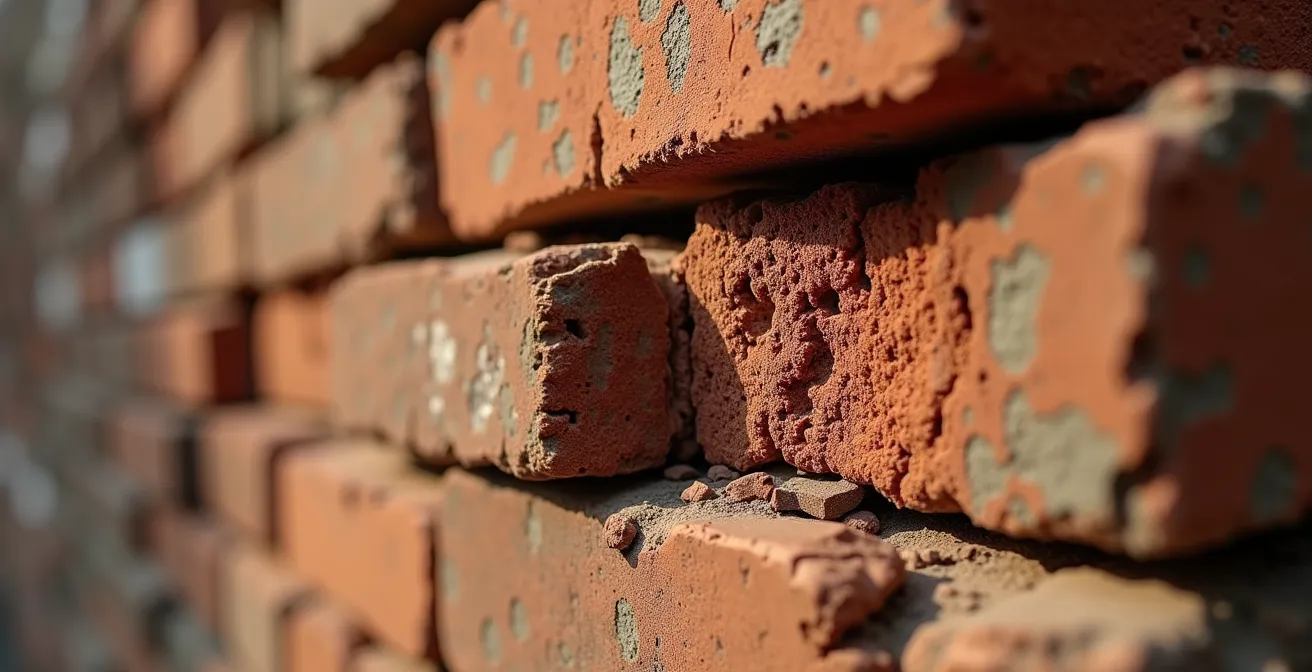
A successful retrofit prioritises the careful deconstruction and reuse of these materials. Before any work begins, a pre-demolition audit should be conducted to identify all salvageable elements. Bricks, roof tiles, timber joists, and slates can often be cleaned and reused directly on-site, eliminating the carbon costs of both manufacturing new materials and transporting waste. A recent pre-demolition audit conducted by Eight Versa for a 1,000 m² dwelling found that 40% of the demolition-derived materials could be successfully repurposed for the new project. This was achieved by crushing old concrete for use as sub-base fill and carefully salvaging bricks, roof tiles, and timber for reuse on site.
Even if bricks cannot be reused structurally, they can be crushed and used as aggregate. The key is to shift your mindset from “demolition” to “deconstruction.” This requires more care and planning, including using lime mortar in new construction where possible, as it is softer than cement and allows bricks to be reclaimed more easily in the future. By treating the existing building as a material bank, you can dramatically slash the embodied carbon of your project and create a building with a rich, authentic character that new materials cannot replicate.
Why “Net Zero” Operations Don’t Make Your Renovation Carbon Neutral?
A common and dangerous misconception in property development is that achieving “net zero” in operation makes a building carbon neutral. A developer might argue that while their new-build project has a high embodied carbon footprint, its excellent energy efficiency and on-site renewables (like solar panels) will quickly balance the books. This argument is fundamentally flawed because it ignores the time value of carbon.
The carbon emissions from construction are released into the atmosphere *today*, contributing to near-term climate tipping points. The operational savings, on the other hand, accrue slowly over many decades. A new building starts its life with a huge carbon debt. As one specialist guide points out, the embodied carbon of a typical new building can be equivalent to 20 to 40 years of its operational carbon emissions, even for an efficient design. Waiting half a century to “break even” on carbon is not a climate solution; it’s an accounting trick that ignores the immediate damage.
The ethical imperative is to minimise upfront emissions, which a deep retrofit does far more effectively than a new build. A retrofit works with the vast majority of embodied carbon that is already locked in the existing structure, focusing new carbon expenditure only on targeted, high-impact improvements.
If there is nothing structurally wrong with a building the last thing we should be doing is demolishing buildings. The previous calculations can be misinterpreted to believing ‘breaking even’ within the lifetime of a building is a good thing. It is not. A huge amount of carbon has still been released into the atmosphere and there are alternative options which release a fraction of the carbon of a new build.
– Greengauge, To Demolish A Building Or Not To Demolish
This perspective forces a more responsible approach. The goal is not to build a structure that might become carbon neutral in a distant future, but to deliver a project with the lowest possible carbon footprint from day one. True carbon neutrality must account for the entire lifecycle, and that begins with acknowledging and minimising the immense upfront cost of construction.
How Much Carbon Does Hempcrete Lock Away Compared to Brick?
Beyond simply choosing low-carbon materials, an advanced strategy involves using biogenic materials that actively sequester carbon. Hempcrete is a prime example. It’s a composite material made from hemp shiv (the woody core of the hemp plant) mixed with a lime-based binder. As the hemp plant grows, it absorbs a significant amount of CO2 from the atmosphere through photosynthesis. When this hemp is harvested and locked into a building as hempcrete, that carbon is effectively stored for the life of the building.
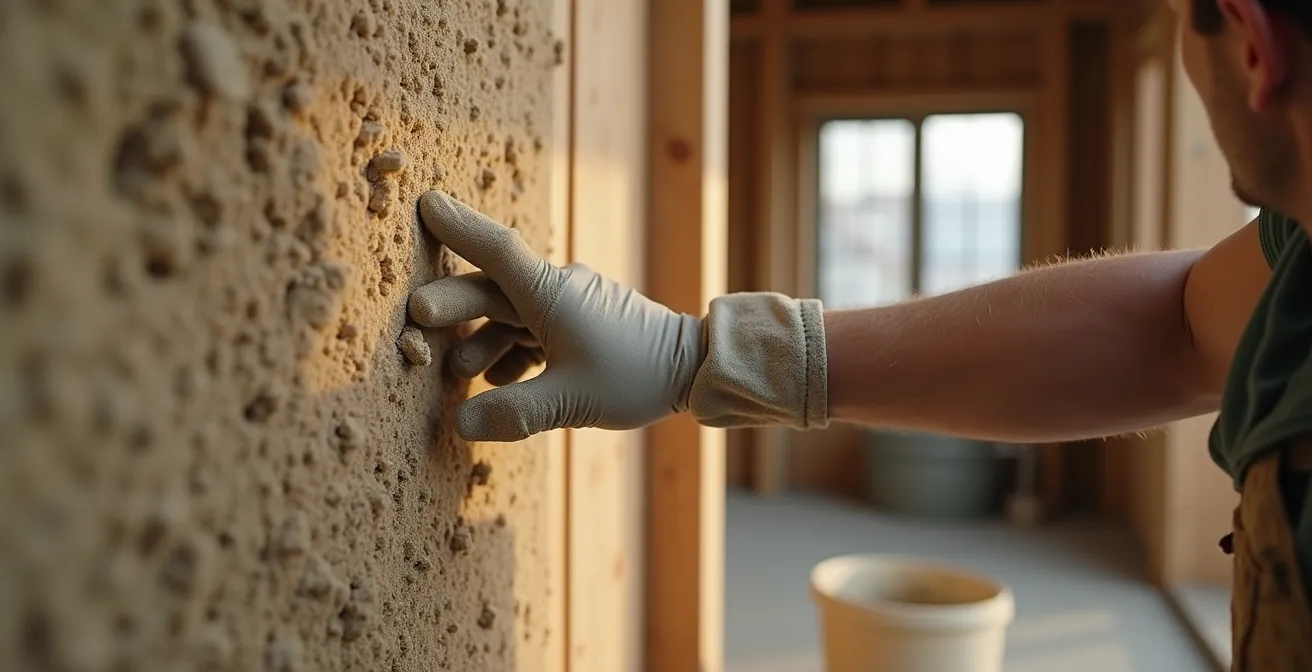
This contrasts sharply with traditional materials like fired clay bricks or concrete blocks, which have a high positive carbon footprint due to the intense energy required for their production. While a brick wall releases carbon, a hempcrete wall acts as a carbon sink. This process of carbon sequestration fundamentally changes the carbon calculation for a project, turning parts of the building from a climate liability into a climate asset. The same principle applies to other biogenic materials like timber, cork, and strawbale.
The scale of this issue was highlighted in the controversial M&S Oxford Street case, where the proposed demolition and rebuild was estimated to release just under 40,000 tonnes of CO2e into the atmosphere. This is the equivalent of driving a typical car 99 million miles. Opting for a deep retrofit that incorporates carbon-sequestering materials for insulation and internal partitions can drastically reduce or even negate the embodied carbon of the new elements required. For a developer committed to a genuinely low-carbon project, specifying biogenic materials is no longer a niche choice but a powerful and necessary tool in the fight against climate change.
Key Takeaways
- The primary focus for green development must shift from long-term operational savings to minimising immediate, upfront embodied carbon.
- The “carbon payback period” is the essential metric for evaluating any new component or build, revealing the true time-cost of a carbon-intensive choice.
- A deep retrofit, which reuses the existing structure and prioritises low-carbon or carbon-sequestering materials, is almost always the superior choice over demolition and rebuild from a climate perspective.
Is Achieving “True” Net Zero Carbon Possible for an Existing UK Home?
Achieving “true” net zero carbon—where the total embodied and operational emissions over a building’s entire lifecycle are zero or negative—is an incredibly challenging goal. However, for the UK, the path towards this goal is unequivocally through retrofitting our existing building stock. The fact is, 80% of the buildings that will be in use in 2050 already exist today. Demolishing and replacing even a fraction of them would trigger a catastrophic release of embodied carbon that would make meeting national climate targets impossible.
Therefore, the only viable strategy is a nationwide program of deep retrofits. For an individual developer, this means committing to a “retrofit first” policy. The pursuit of true net zero on a project involves combining all the strategies discussed: meticulously calculating carbon payback periods, using EPDs to select low-carbon and biogenic materials, avoiding over-engineering, and maximising the reuse of salvaged materials. It requires a holistic view that treats the building as a single, integrated carbon system.
This approach is no longer just an ethical ideal; it is rapidly becoming a regulatory and commercial necessity in the UK. Local authorities are leading the charge, embedding this logic into planning policy. As highlighted by Urbanist Architecture, this shift is already a reality in the capital.
The London Plan Guidance now requires developers to conduct ‘whole-life carbon assessments’, effectively asking them to justify any decision to demolish rather than retrofit. Westminster this year, as the council announced plans that require developers to first explore retrofitting before demolition and rebuild. The price if they don’t? Developers will have to fork out carbon off-setting payments that are up to nine times as they were previously.
– Urbanist Architecture, Retrofit and Upgrade vs Demolition and Rebuild
This trend is set to continue. The ability to proficiently audit, manage, and minimise embodied carbon is transitioning from a niche specialism to a core competency for any successful UK property developer. The question is no longer whether to prioritise retrofit, but how to do it in the most carbon-efficient way possible.
The evidence is clear: the most significant carbon saving you can make is to work with the building you already have. By adopting a rigorous, analytical approach to embodied carbon, you can turn your next renovation project from a potential climate liability into a genuine asset for a sustainable future. Evaluate your project today through the lens of a carbon budget.