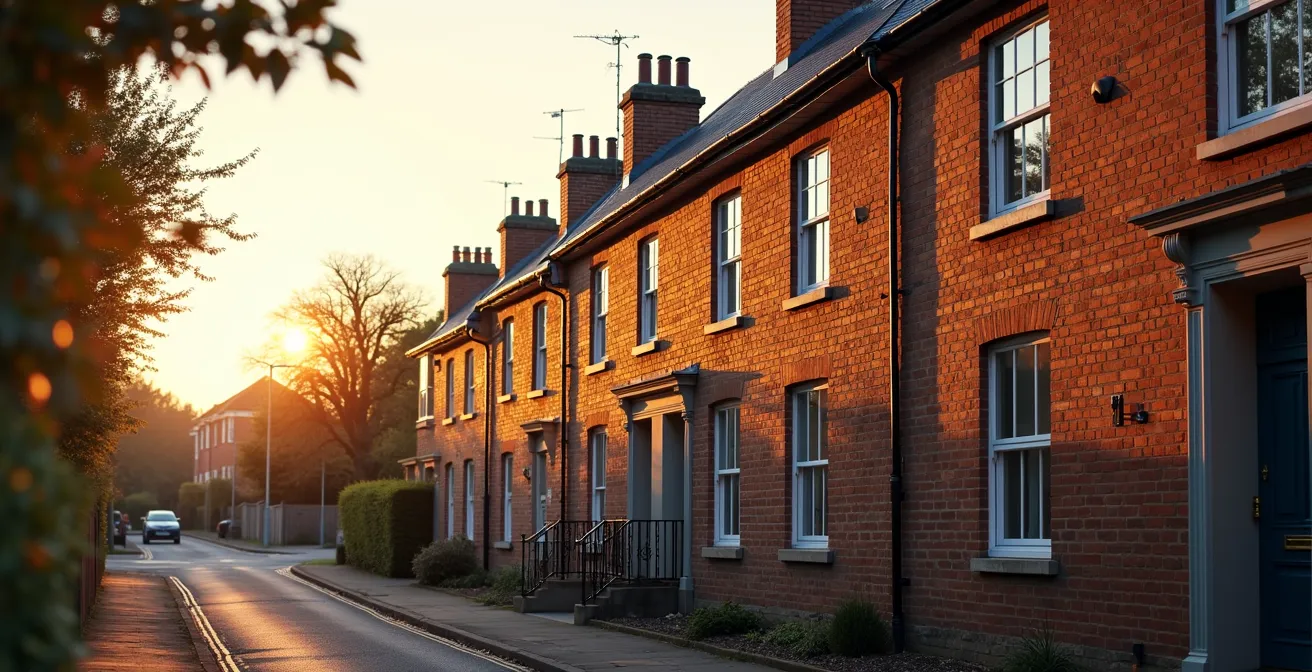
For owners of solid brick properties, the choice between internal and external insulation is not a simple trade-off between cost and space; it is a critical building physics decision that determines the long-term health of your home.
- External Wall Insulation (EWI) is generally superior for thermal performance and moisture management but involves significant cost, aesthetic changes, and regulatory hurdles.
- Internal Wall Insulation (IWI) is less disruptive externally but carries a high risk of interstitial condensation, mould, and damage to the brick structure if incorrect materials are used.
Recommendation: Prioritise breathable, vapour-permeable systems (like wood fibre or lime-based plasters) and focus on meticulous detailing at junctions like windows and eaves to prevent creating new problems.
If you own a pre-1930s property in England, you are likely familiar with the persistent chill of solid brick walls. With no cavity to fill, improving their thermal performance becomes one of the most expensive and disruptive retrofit measures you can undertake. The default advice often presents a simple choice: lose indoor space with internal insulation (IWI) or change your home’s exterior with external insulation (EWI). This oversimplification is dangerous. In the UK, where solid walls make up a significant portion of the housing stock, countless retrofit projects fail not because of the product, but because of a fundamental misunderstanding of how these old buildings function.
The common debate about cost versus disruption misses the most crucial point. Solid brick walls are designed to manage moisture by allowing it to move through them and evaporate—a property known as being ‘breathable’ or vapour-permeable. Wrapping them in modern, impermeable materials, whether inside or out, can trap moisture, leading to damp, mould, and irreversible damage to the very fabric of the building. In fact, official research shows that some insulation approaches can make moisture problems worse.
This guide moves beyond the surface-level pros and cons. From a structural engineer’s perspective, we will dissect the critical building physics, regulatory hurdles, and material science that should govern your decision. This is not about choosing a product; it is about designing a compatible system. We will analyse the real-world implications of space loss, the complexities of planning permission in conservation areas, and why the wrong material can destroy Victorian brickwork. The goal is to equip you with the technical understanding to avoid a £15,000+ mistake and ensure the longevity and health of your property.
For those who prefer a visual format, the following video provides a great introduction to the principles of high-performance insulation, setting the stage for the specific challenges of retrofitting older buildings that we will discuss.
To navigate this complex decision, this article breaks down the key technical challenges and considerations. The following sections will guide you through the critical questions you must answer before committing to an insulation strategy for your solid wall property.
Contents: A Technical Guide to Solid Wall Insulation
- Why You Might Lose 4 Square Meters of Living Space with Internal Insulation
- How to Get Planning Approval for External Insulation in Conservation Areas?
- Polystyrene vs Wood Fibre: Which Insulation Lets Your Walls Breathe?
- The Window Reveal Mistake That Causes Mould After Insulation
- How to Extend Roof Eaves to Cover New Thick External Insulation?
- How to Apply Hemp-Lime Plaster to Improve U-Values Without Losing Space?
- Why Do Modern Cements Damage Victorian Bricks Within 5 Years?
- Why Is Lime Plaster Essential for the Longevity of Pre-1919 Homes?
Why You Might Lose 4 Square Meters of Living Space with Internal Insulation
The most immediate and tangible drawback of Internal Wall Insulation (IWI) is the loss of floor space. While it may seem trivial on paper, the cumulative effect can significantly impact the usability of rooms. For a typical Victorian terraced house, insulating the external walls of a 4m x 4m living room can result in the loss of nearly a square meter of valuable space. Across an entire 80-square-meter ground floor, this can easily add up to 3-4 square meters of lost area—the equivalent of a small home office or a large storage cupboard.
The exact thickness required depends on the insulation material’s thermal conductivity (lambda value, λ) and the target U-value (a measure of heat loss). To comply with building regulations, you need a substantial thickness. For example:
- Rigid PIR boards (λ ≈ 0.022 W/mK): Generally require 70-100mm of insulation.
- Breathable wood fibre boards (λ ≈ 0.040 W/mK): Need 120-140mm for equivalent performance.
To this, you must add the thickness of the plasterboard finish (typically 12.5mm) and any service cavity. The total reduction in room dimension is therefore often between 100mm and 150mm per wall. This not only reduces the floor area but also requires costly adjustments to flooring, skirting boards, electrical sockets, and window sills, adding complexity and hidden costs to the project. While IWI avoids the external aesthetic changes of EWI, this loss of internal space is a permanent compromise that homeowners must be prepared to accept.
How to Get Planning Approval for External Insulation in Conservation Areas?
Applying External Wall Insulation (EWI) to a property in a conservation area, or to a listed building, is not a straightforward process. The primary concern of planning authorities is the preservation of the building’s historic character and appearance. EWI, by its nature, fundamentally alters the exterior, covering original brickwork and changing the depth of window and door reveals. Therefore, it almost always requires planning permission in these sensitive contexts.
Historic England, the public body that looks after England’s historic environment, provides clear guidance on this matter. As they state in their technical advice on insulating solid walls:
For listed buildings any form of wall insulation is likely to require consent. For many buildings, including those in conservation areas and national parks, external wall insulation will usually require planning permission.
– Historic England, Energy Efficiency and Historic Buildings: Insulating solid walls
Successfully navigating this process requires a proactive and well-documented strategy. Simply submitting a standard application is likely to result in refusal. You must demonstrate that your proposal respects the building’s heritage while achieving necessary thermal upgrades. This involves choosing appropriate materials (such as lime-based renders that mimic traditional finishes) and presenting a robust case to the conservation officer.

The key to gaining approval is early engagement and thorough preparation. You must prove that the long-term benefit of protecting the building fabric from thermal stress outweighs the change in its appearance. A detailed pre-application process is essential.
Your 5-Step Plan for Conservation Area Consent
- Review Local Guidance: Start by studying your local council’s specific Planning Advice Notes (PANs) on energy efficiency in historic buildings.
- Consult National Standards: Familiarise yourself with Historic England’s overarching principles, particularly their guidance on adapting historic buildings to climate change.
- Engage Early: Use the pre-application advice service to discuss your project with the conservation officer. Bring material samples and be prepared to listen to their concerns.
- Document Material Choices: Prepare a detailed report showing how your chosen materials, especially the final render, will mimic traditional textures and appearances. Prioritise breathable, lime-based systems.
- Prepare a Heritage Statement: Your formal application must include a Design, Access, and Heritage Statement that explicitly argues how the EWI will ensure the building’s long-term viability and preservation.
Polystyrene vs Wood Fibre: Which Insulation Lets Your Walls Breathe?
The choice of insulation material is the most critical aspect of a solid wall retrofit. Using a non-breathable material can trap moisture within the wall structure, leading to damp, mould on the inside, and frost damage (spalling) to the brickwork on the outside. The key property to understand is vapour permeability, or ‘breathability’. Traditional buildings are designed to allow moisture vapour to pass through them. Modern insulation materials vary dramatically in this regard.
The two most common EWI material types are Expanded Polystyrene (EPS) and Wood Fibre boards. From a building physics perspective, they behave in fundamentally different ways. EPS is a plastic-based foam that acts as a vapour barrier. It is highly effective at stopping heat transfer but is almost completely impermeable to moisture. Wood fibre, by contrast, is a natural material that is both insulating and highly vapour-permeable. It allows moisture to pass through it, maintaining the wall’s ability to ‘breathe’. A documented project on a semi-detached property in Bristol, for example, showed how a breathable wood fibre system successfully managed moisture while achieving significant energy savings of nearly £400 per year.
This difference is crucial for the long-term health of a solid brick wall. Trapping moisture behind an impermeable layer like EPS can lead to interstitial condensation—where moisture turns back into water inside the wall structure, saturating the brick and mortar. The following table, based on data from leading manufacturers, compares the key properties.
| Property | EPS/Polystyrene | Wood Fibre |
|---|---|---|
| Vapour Permeability | High Sd value (non-breathable) | Low Sd value (breathable) |
| Moisture Management | Acts as vapour barrier | Allows moisture transfer |
| Interstitial Condensation Risk | High in solid walls | Low – manages moisture naturally |
| Thermal Mass | Low | High – reduces overheating |
| BBA Certification | Available | Multiple certified systems |
While EPS systems are often cheaper and have been widely used, the risk they pose to solid-walled properties is significant. For the longevity of the building fabric, a breathable system like wood fibre is almost always the more appropriate, albeit more expensive, choice as highlighted by a comprehensive guide to external wall insulation. It works with the building’s natural moisture management system, rather than against it.
The Window Reveal Mistake That Causes Mould After Insulation
One of the most common and damaging failures in wall insulation projects is the improper treatment of “thermal bridges.” A thermal bridge is an area of the building envelope where heat can bypass the insulation layer more easily, creating a cold spot on the internal surface. The most notorious thermal bridges are around windows and doors, specifically at the window reveals (the internal sides of the window opening).
When applying internal insulation, it is often difficult and disruptive to continue the insulation layer around the reveals and up to the window frame. Many contractors will simply stop the main insulation board at the corner of the wall. This creates a direct, uninsulated path for heat to escape, making the internal reveal surface significantly colder than the surrounding insulated wall. When warm, moist air from inside the room comes into contact with this cold surface, it cools rapidly, and the moisture condenses into water droplets. This persistent dampness is the perfect breeding ground for black mould.
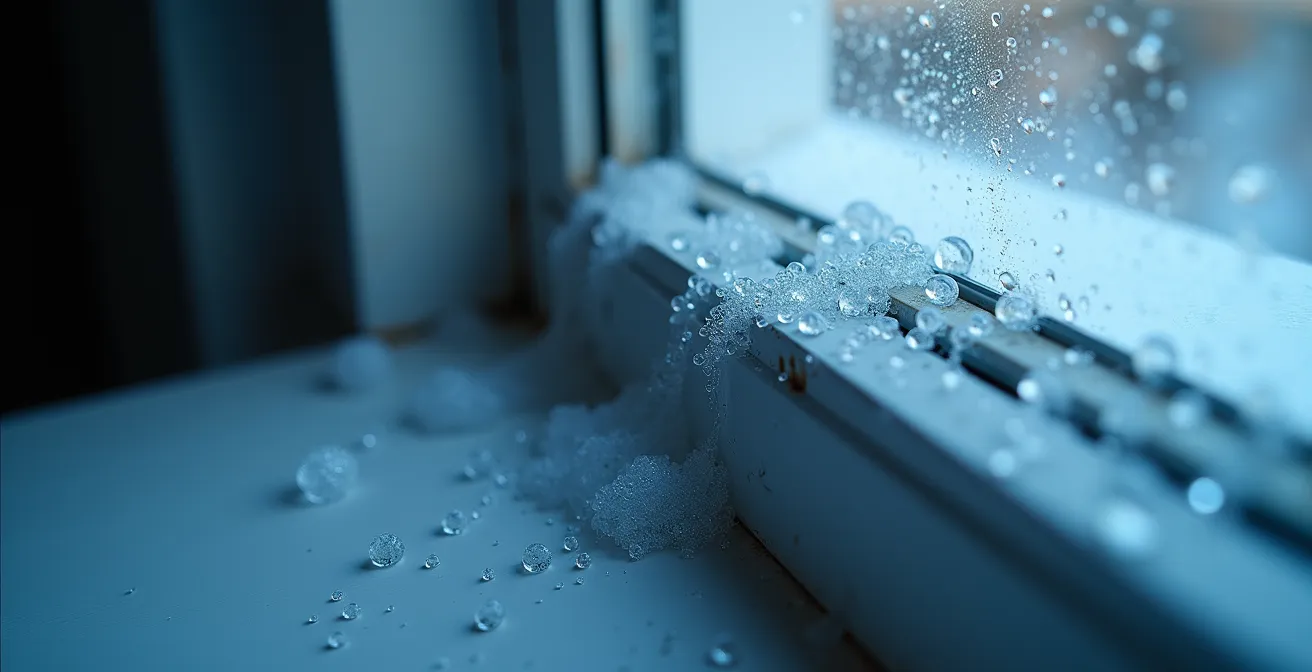
This isn’t just a theoretical risk; it’s a well-documented failure mode. Research from the Department for Energy Security and Net Zero (DESNZ) on retrofit projects has shown that applying IWI without addressing these junctions is a recipe for disaster. According to their findings, installing IWI always led to an increased moisture risk in the buildings they studied, precisely because of these unaddressed thermal bridges. The “solution” to a cold wall ends up creating a concentrated damp and mould problem in a new location.
To prevent this, it is absolutely essential to ensure the insulation is continuous. This means using thinner insulation boards (e.g., 20-30mm high-performance boards) to wrap around the reveals and meet the window frame. While this adds complexity and cost, failing to do so negates much of the benefit of the insulation and introduces a serious health and building-fabric risk. This single detail is often what separates a successful project from a catastrophic failure.
How to Extend Roof Eaves to Cover New Thick External Insulation?
A significant technical challenge of applying External Wall Insulation (EWI) is dealing with the existing roofline. EWI adds between 100mm and 200mm to the thickness of your walls. This means the existing roof eaves and guttering will no longer overhang the new, thicker wall, leaving the top of the insulation exposed to rain. This is a critical failure point that can allow water to get behind the insulation system, leading to widespread damage.
To protect the new wall finish, the roof eaves must be extended. This is a complex job that requires a specialist roofer and adds significant cost and disruption to the project, often requiring full scaffolding. Homeowners must budget for this work from the outset. With the average cost for a three-bedroom semi-detached house being £18,000 for EWI according to Energy Saving Trust estimates, the additional roofing work can add another £1,500-£3,000 depending on the chosen method.
There are three primary technical options for extending the eaves:
- Option 1: Timber Packers. This involves fixing treated timber extensions onto the ends of the existing roof rafters. New fascia and soffit boards are then fixed to these packers. This is a common method but requires careful work to ensure a robust connection.
- Option 2: Proprietary Extension Profiles. Several manufacturers produce specialist aluminium or uPVC profiles that are designed to clip or screw onto the existing fascia, extending the roofline outwards. These can be a quicker solution but may be limited in the extension depth they can achieve.
- Option 3: New Over-Fascia. In some cases, a new fascia and soffit system can be installed directly over the existing one, creating the required overhang. This is often combined with timber packers for additional support.
The choice of method depends on the condition of the existing roof, the thickness of the EWI, and the budget. In all cases, it’s crucial to ensure the new guttering is correctly positioned to catch runoff from the roof and prevent water from running down the face of the new render. Neglecting the roofline detail is a guarantee of future problems.
How to Apply Hemp-Lime Plaster to Improve U-Values Without Losing Space?
For homeowners wary of the risks of impermeable internal insulation and the significant space loss of thick breathable boards, there is an alternative: insulating lime plaster. Specifically, hemp-lime plaster (or ‘hempcrete’ plaster) offers a way to improve thermal performance without creating a vapour barrier or consuming excessive floor space. It’s a modern application of traditional, breathable materials.
Hemp-lime plaster combines hemp shiv (the woody core of the hemp plant) with a hydraulic lime binder. The hemp provides thermal resistance, while the lime provides the breathable, flexible matrix that is compatible with old brickwork. It is typically applied internally in a layer of around 50mm. While this doesn’t achieve the very low U-values of 100mm+ of rigid board insulation, it significantly improves thermal comfort by cutting out drafts, increasing the surface temperature of the wall to reduce radiant heat loss, and providing excellent humidity regulation.
A retrofit project on a Victorian terrace in Bristol provides a compelling example. Homeowners applied a 50mm layer of hemp-lime plaster to a 4m x 4m living room. While losing only 5cm of space on each wall, they reported the complete elimination of the ‘cold wall’ feeling and much more stable indoor humidity. The process for applying it involves building up layers:
- Preparation: The existing non-breathable plaster must be hacked off back to the brick, and the brickwork cleaned and dampened.
- First Coat: A 20-25mm base coat of hemp-lime is applied directly onto the brick and left to cure for 5-7 days.
- Second Coat: A further 20-25mm coat is applied to build up to the desired 50mm thickness and ruled flat.
- Finish Coat: After another week of drying, a final 5-10mm top coat of fine lime plaster is applied, ready for decoration with breathable paint.
This approach represents a ‘middle ground’ solution. It delivers a noticeable improvement in comfort and a modest improvement in U-value, all while maintaining the vital breathability of the solid wall and minimising the loss of internal space. It is particularly well-suited for historic buildings where preserving both the building fabric and internal dimensions is a priority.
Key Takeaways
- The decision is not just Internal vs. External, but a system choice: breathable and well-detailed vs. impermeable and risky.
- Critical details at junctions (window reveals, eaves) are more important than the headline U-value of the insulation product itself.
- For solid brick walls, vapour-permeable (breathable) materials like wood fibre and lime are essential to prevent moisture-related damage.
Why Do Modern Cements Damage Victorian Bricks Within 5 Years?
Underpinning the entire debate about insulating solid walls is a fundamental conflict between modern and traditional materials. Many of the failures seen in retrofits stem from applying hard, impermeable modern materials like Portland cement onto soft, porous historic brickwork. This is a chemical and physical mismatch that can cause irreversible damage in as little as five to ten years.
Victorian bricks and their original lime mortar were designed as a breathable system. Lime mortar is relatively soft and porous. It allows any moisture that enters the wall (either from driving rain or from inside the house) to evaporate away easily. Crucially, the lime mortar is ‘sacrificial’—it is softer than the brick, so over decades, it will weather and decay, protecting the more expensive and harder-to-replace bricks. It can then be easily raked out and ‘re-pointed’ without damaging the brick.
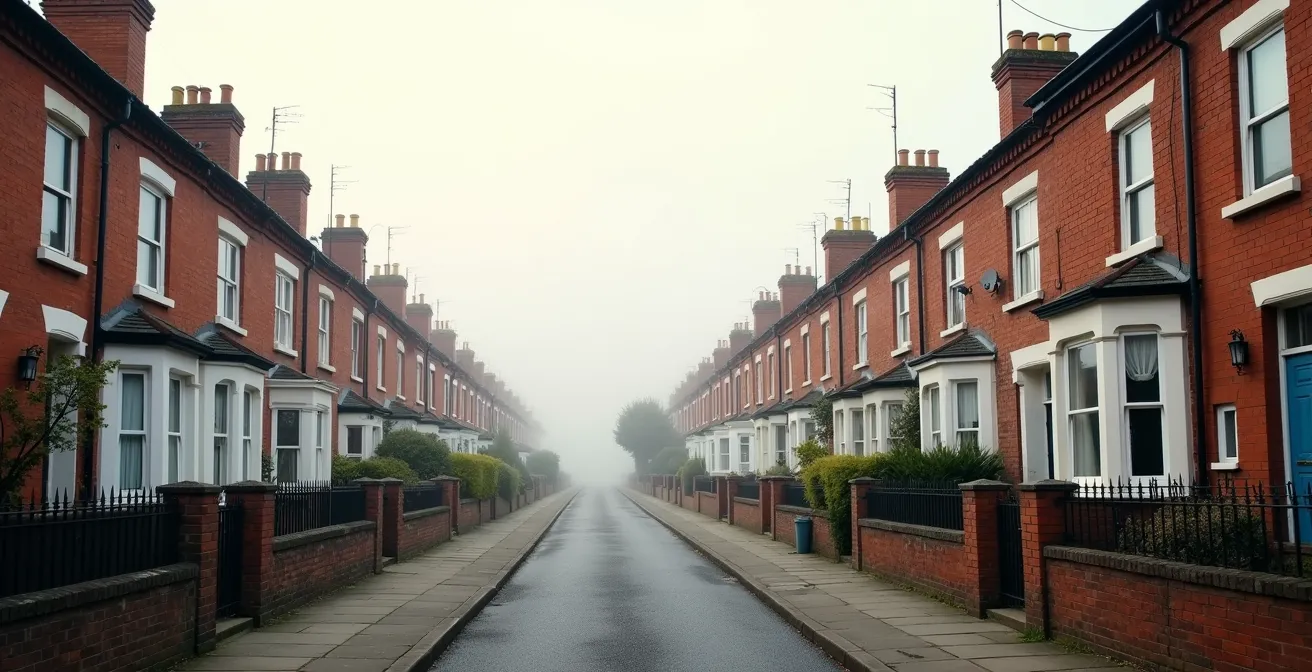
Modern cement render or mortar, by contrast, is extremely hard, dense, and impermeable. When applied over soft Victorian bricks, it traps moisture inside the wall. This trapped water can freeze in winter, expand, and physically blow the face off the bricks—a process called spalling. Because the cement is much harder than the brick, the brick fails first. This damage is permanent. The following table, based on guidance from Historic England’s advice on building maintenance, summarises the destructive differences.
| Property | Modern Cement | Traditional Lime |
|---|---|---|
| Permeability | Impermeable – traps moisture | Breathable – allows moisture movement |
| Flexibility | Hard and brittle | Soft and flexible |
| Freeze-thaw response | Forces brick spalling | Absorbs expansion |
| Repair compatibility | Damages surrounding brick | Sacrificial – fails before brick |
| Victorian brick lifespan | 5-10 years to damage | 100+ years proven |
This principle is vital. Using impermeable insulation systems or finishing EWI with a modern cement-based render repeats this fundamental mistake. It compromises the building’s ability to manage moisture, trading a short-term thermal gain for long-term structural decay. Respecting the original material properties of the building is not nostalgia; it is essential building physics.
Why Is Lime Plaster Essential for the Longevity of Pre-1919 Homes?
Given the destructive nature of modern cements, the role of traditional lime plaster becomes clear. It is not simply a historic finish; it is an essential component of the building’s moisture management system. For the UK’s vast stock of pre-1919 solid wall homes—of which an astonishingly low proportion have been insulated—reverting to or preserving lime plaster is key to their longevity, especially when undertaking thermal upgrades.
The primary function of lime plaster is its hygroscopic nature. This means it can absorb excess moisture from the air when humidity is high (for example, from cooking or showering) and then release it slowly when the air becomes drier. This acts as a natural, passive humidity buffer, dramatically reducing the risk of surface condensation and the associated mould growth. Unlike modern gypsum plaster, which is largely non-breathable and can trap moisture, lime works in harmony with the solid brick wall behind it, allowing the entire structure to breathe as a single, integrated system.
This ability to manage moisture is what makes it so resilient. Original Victorian lime plasterwork can be found in excellent condition in buildings over 150 years old. Its inherent flexibility allows it to accommodate the minor structural movements that old buildings undergo without the large, sharp cracks that are characteristic of brittle cement and gypsum. When it does fail, it does so softly and is easily repaired.
When considering insulation, lime is the perfect partner for breathable insulation materials like wood fibre, cork, or hemp. A system comprising wood fibre boards on the outside, finished with a lime render, or hemp-lime plaster on the inside, finished with a lime skim, creates a fully breathable envelope. This ‘belt and braces’ approach ensures that no moisture can be trapped within the wall structure, protecting the bricks from frost damage and the indoor environment from mould. In the context of retrofitting for energy efficiency, choosing lime is not a stylistic choice; it is a fundamental technical requirement for a successful, durable, and healthy outcome.
Ultimately, the decision to insulate a solid wall property should be driven by a ‘fabric first’ approach that respects the original construction. Choosing a compatible, breathable, and well-detailed system is the only way to improve thermal comfort without compromising the health and longevity of your home. To move forward, the next logical step is to commission a professional building survey from an expert who understands traditional building methods.
Frequently Asked Questions About Lime Plaster in Historic Homes
Can lime plaster prevent mould growth?
Yes, lime plaster’s hygroscopic properties actively regulate indoor humidity levels, reducing condensation and preventing the conditions that allow mould to develop.
How long does lime plaster last on Victorian properties?
When properly applied and maintained, lime plaster can last 100+ years on pre-1919 buildings, as evidenced by surviving original Victorian plasterwork.