
Your long-term job security depends less on finding a niche “green job” and more on strategically repositioning your existing skills within a decarbonising UK economy.
- High-impact actions like your career choice and local civic engagement have a far greater effect on accelerating net zero than small consumer habits.
- A massive “green skills crisis” in the UK creates significant career opportunities, particularly in trades related to building retrofits and energy systems.
Recommendation: Shift your focus from personal consumption to professional and civic leverage. Start by auditing how your current role can support your employer’s decarbonisation and identify one high-demand skill to acquire.
The phrase “Net Zero by 2050” often feels like a distant, abstract target discussed by governments and corporations. For employees and students across the UK, however, it raises a more immediate and personal question: will my job, my skills, and my career path become obsolete? The common response is to point towards a list of emerging “green jobs”—wind turbine technician, solar installer, recycling manager. While accurate, this view is dangerously narrow and misses the fundamental shift underway.
The transition to a net-zero economy isn’t just about creating a new, separate green sector; it’s about a wholesale transformation of every existing industry, from construction and transport to finance and marketing. The anxiety about being left behind is real, but the true risk isn’t a lack of “green jobs.” The risk is failing to see how your current skills can be repositioned and where the real leverage for change—and career security—lies.
This article challenges the conventional wisdom. We will argue that your greatest power to influence the transition and secure your career doesn’t lie in perfecting your recycling habits, but in understanding the systemic levers you can pull. We will move beyond corporate jargon to explore how your professional life, your community engagement, and your strategic skill development are the most potent tools you have. We’ll analyse why a company’s “net zero operations” are only half the story, which trades are facing a critical demand crisis, and how you can translate national targets into tangible, personal career opportunities right here in the UK.
This guide provides a strategic roadmap for navigating the evolving job market. Below, we dissect the key areas where individual action translates into systemic change, offering a clear path from career anxiety to career security in the new economy.
Summary: A Career Strategist’s Guide to the UK’s Net Zero Job Market
- What Are Your Personal “Scope 3” Emissions and Can You Control Them?
- How to Set Up a Community Solar Co-op on Your Local School Roof?
- Recycling vs Voting: Which Action Accelerates Net Zero Faster?
- The Green Skills Crisis: Which Trades Will Be in Highest Demand?
- How to Lobby Your Local Council for Better Cycling Infrastructure?
- Why “Net Zero” Operations Don’t Make Your Renovation Carbon Neutral?
- Why Doing “Imperfect Sustainability” Is Better Than Quitting?
- Is Achieving “True” Net Zero Carbon Possible for an Existing UK Home?
What Are Your Personal “Scope 3” Emissions and Can You Control Them?
In the corporate world, “Scope 3” emissions are the indirect emissions that occur in a company’s value chain—from the raw materials they buy to the customer’s use of their products. It’s the hardest category to measure and control. But what if we applied this concept to our own lives? Your “personal Scope 3” isn’t just the carbon footprint of the food you buy; it’s the impact of the systems you participate in. The most significant of these is your employer.
Your choice of workplace is a powerful act of systemic leverage. Working for a company actively decarbonising its operations and supply chain amplifies your personal impact far beyond individual lifestyle changes. This reframes job security: it’s not just about what you do, but who you do it for. The data shows this is a growing concern for UK businesses. According to an analysis by FTSE Russell, just 45% of FTSE All-World UK constituents report Scope 3 emissions, indicating a massive corporate blind spot and an opportunity for employees to drive change from within.
Controlling your personal Scope 3 means asking critical questions during job interviews: What are the company’s science-based targets? How is sustainability integrated into corporate strategy, not just marketing? Choosing an employer with a robust net-zero plan—or helping your current one develop one—is a direct investment in a more stable climate and a more secure career. You become part of the solution at a scale individuals can rarely achieve alone, repositioning your career as a high-impact climate action.
How to Set Up a Community Solar Co-op on Your Local School Roof?
Moving from the corporate to the community level, systemic leverage takes on a tangible, local form. The idea of installing solar panels on a local school or community centre roof is more than just a feel-good project; it’s a powerful engine for local economic development and a direct pathway into the green economy for you and your neighbours. These initiatives create a virtuous circle: they reduce energy costs for public buildings, generate clean power, and, most importantly, create skilled local jobs.
This isn’t just a theoretical possibility. Across the UK, local authorities are proving it can be done. By creating a cooperative, community members can pool resources, secure grants, and collectively own a renewable energy asset. The process involves engaging the school or building owner, conducting a feasibility study, forming a legal entity (like a Community Benefit Society), and raising funds through community shares or grants.
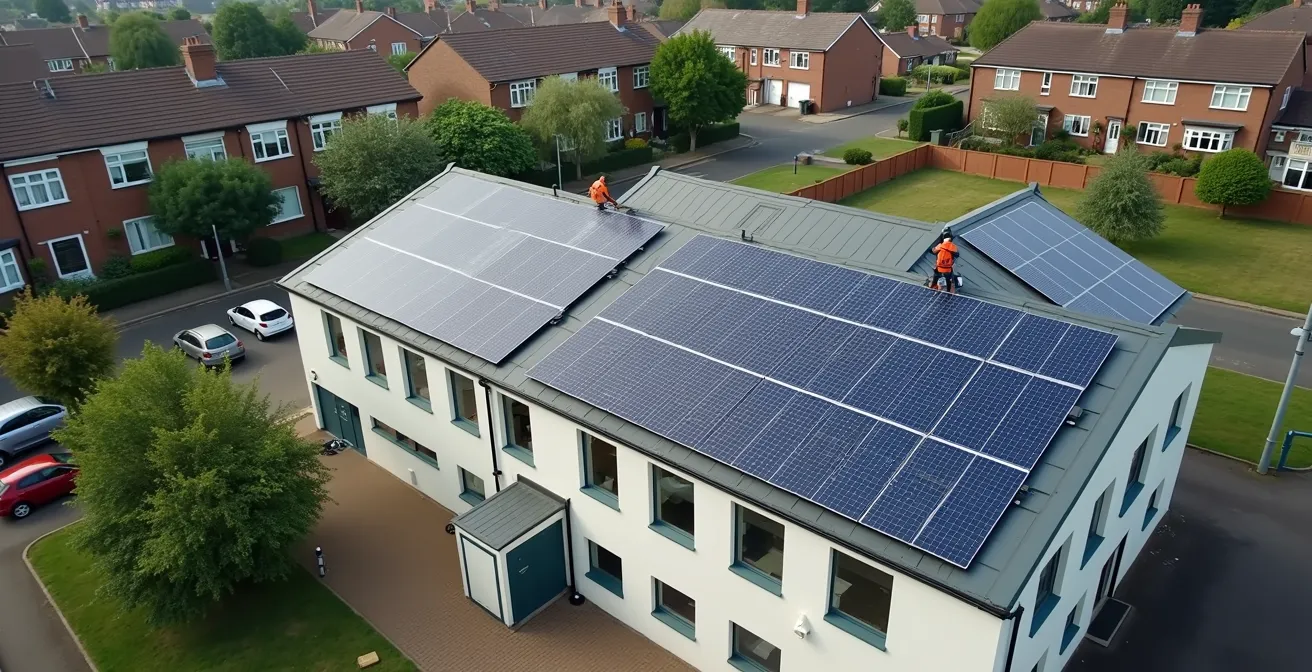
As the illustration above depicts, such projects are becoming a feature of the British landscape. They transform passive consumers of energy into active producers and stakeholders in the energy transition. This hands-on engagement demystifies renewable technology and creates direct demand for local installers, project managers, and maintenance technicians, building a resilient local workforce.
Case Study: Bristol’s Community Energy Investment
Bristol City Council’s partnership model exemplifies this approach. The council has mapped out a £500 million investment in renewable infrastructure over five years, a plan projected to create 1,000 jobs paying above the real minimum wage. By using its procurement power to favour social value, the council provides certainty for micro-businesses and SMEs, demonstrating how local authorities can leverage community energy projects for both decarbonisation and stable, local job creation.
Recycling vs Voting: Which Action Accelerates Net Zero Faster?
For decades, environmental messaging has focused on individual consumer actions: recycle more, drive less, reduce waste. While these are positive habits, they can create a sense of “action fatigue” and, crucially, misdirect our energy towards low-impact activities. When it comes to accelerating the net-zero transition and securing your place in the new economy, the evidence is clear: systemic actions have an exponentially greater impact.
The choice is not between doing nothing and recycling a plastic bottle; it’s between low-leverage and high-leverage actions. Your vote, your voice in local council meetings, your choice of employer, and your influence as a shareholder or pension holder are far more powerful levers for change. These actions shape the rules, incentives, and capital flows that govern the entire economy. As the Climate Change Committee highlights, this systemic shift is the primary driver of new employment, stating that “Between 135,000 and 725,000 net new jobs could be created by 2030 in low-carbon sectors”.
The following comparison, based on data and models from bodies like the UK’s Climate Change Committee, puts the scale of impact into sharp perspective:
| Action Type | Potential CO2e Impact by 2030 | Implementation Difficulty | Career Security Impact |
|---|---|---|---|
| Individual Recycling (10% UK increase) | 0.5 Mt CO2e reduction annually | Low | Minimal |
| Parish Council Influence (EV/Green Space) | 2-5 Mt CO2e locally | Medium | Moderate |
| Career Choice (B-Corp/SBTi employer) | Direct funding of 50-100 Mt CO2e reduction | High | High (positive) |
| Shareholder Activism | Potential 200+ Mt CO2e via corporate strategy shifts | Medium | Variable |
This data makes it clear that while personal responsibility is important, focusing your efforts on where you work and how you engage with civic and corporate structures is the most effective strategy for both climate action and career relevance. It shifts your role from a passive consumer to an active agent of economic change.
The Green Skills Crisis: Which Trades Will Be in Highest Demand?
The UK’s net-zero ambition has created an unavoidable reality: a massive and growing “green skills crisis.” We simply do not have enough trained professionals to build, install, and maintain the infrastructure required for a decarbonised economy. This gap between demand and supply is precisely where the greatest opportunity for job security lies. For those willing to train, the demand is not just high; it’s critical.
The scale of this transformation is immense. The UK government’s Clean Energy Jobs Plan projects nearly 860,000 jobs in clean energy sectors by 2030, almost doubling the 2023 workforce. This isn’t just about wind farms; a huge portion of these roles are in retrofitting the UK’s 29 million homes. This includes trades like heat pump engineers, insulation specialists, retrofit assessors, and battery storage technicians. This is the frontline of the net-zero transition, offering stable, well-paid, and geographically distributed careers that are impossible to offshore.

For students choosing a career or employees considering a pivot, this skills gap represents a strategic opportunity for skills arbitrage. By identifying the most acute shortages and pursuing accredited training, you can position yourself in a high-demand, low-supply market. The key is to look for recognised certifications like MCS (Microgeneration Certification Scheme) for installers or PAS 2035 for retrofit coordinators, which are fast becoming the gold standard in the UK industry.
Your Green Skills Action Plan: Identifying High-Demand Pathways
- Heat Pump Engineers: Especially in rural areas like Norfolk, access MCS accreditation through specialised courses (e.g., Heat Geek) and regional training centres to meet the demand for replacing gas boilers.
- Battery Storage Specialists: Focus on the Coventry/Sunderland “Gigafactory corridor.” Pursue T-Levels in Engineering or seek apprenticeships directly with battery manufacturers and automotive firms.
- PAS 2035 Retrofit Assessors: With hubs in cities like Manchester and London, complete the necessary certification via National Careers Service adult learning courses to qualify for assessing whole-house retrofit projects.
- Solar PV Installers: A consistent need across all UK regions. Obtain MCS certification through a wide range of approved training providers to ensure you meet industry standards.
- Deconstruction Experts: An emerging circular economy role. Train through new apprenticeship standards that focus on material salvage, reuse, and waste reduction from building sites.
How to Lobby Your Local Council for Better Cycling Infrastructure?
Engaging in local politics is one of the most effective, yet often overlooked, forms of systemic leverage. Lobbying your local council for better cycling and walking infrastructure is a prime example. It’s a direct action that reduces transport emissions, improves public health, and creates local construction and maintenance jobs—a clear net-zero win. With over 300 UK councils having declared a climate emergency, the political will often exists, but it needs to be activated by organised community demand.
Effective lobbying is not about angry letters; it’s about building a compelling, data-driven case. Your first step is to understand the council’s current plans and budget cycles. Identify key documents like the Local Transport Plan. The goal is to present your proposal not as a “nice-to-have” but as a solution to existing problems, such as traffic congestion on a specific road, poor air quality near a school, or a lack of safe routes to a new housing development.
Building a broad coalition is crucial for success. Partnering with local GP surgeries can frame cycling as a “social prescribing” health benefit. Collaborating with local businesses can highlight the evidence that improved footfall and cycling access boosts retail sales. Engaging parent groups advocating for “school streets” adds a powerful voice for child safety. This multi-faceted approach demonstrates widespread support and makes it harder for councillors to ignore.
Case Study: Tapping into UK Funding for Active Travel
Successful campaigns across the UK have leveraged specific funding streams and standards. By aligning proposals with the government’s LTN 1/20 design standards for cycle infrastructure, groups ensure their plans are credible and eligible for funding. They proactively identify pots of money like Section 106 developer contributions (funds paid by developers to mitigate their impact) and allocations from the UK Shared Prosperity Fund. This strategic approach, successfully used by numerous councils, transforms a resident’s request into a shovel-ready project that delivers on the council’s own climate and economic objectives.
Why “Net Zero” Operations Don’t Make Your Renovation Carbon Neutral?
Many companies now proudly advertise “net-zero operations,” meaning they have offset the emissions from their energy use (Scope 1 and 2). However, this creates a dangerous illusion of climate action, especially in the construction and renovation sectors. The electricity used to power a building site is a fraction of a project’s total climate impact. The real issue is the embodied carbon—the emissions generated from manufacturing, transporting, and installing every single material, from concrete and steel to plasterboard and insulation.
A renovation project using standard materials can have a massive carbon footprint before it’s even completed, a debt that “net-zero operations” completely ignores. This is the next frontier of decarbonisation and a critical area for future job skills. Achieving a truly carbon-neutral renovation requires a fundamental shift in thinking, moving from operational efficiency to a whole-life carbon approach. This means prioritising material reuse, specifying low-carbon alternatives (like timber structures or natural insulation), and designing for deconstruction from the outset.
Four out of five jobs will be supporting the transition to net zero by 2050
– UK100, Green Jobs Research Report
This shift creates a huge demand for new roles and skill sets. We will need deconstruction experts who can salvage materials, architects and engineers who can design with low-carbon materials, and builders who understand airtightness and thermal bridge-free construction. This isn’t a niche; it’s the future of the entire construction industry. As the UK100 report suggests, the vast majority of jobs, including those in construction, will be redefined by the net-zero transition. Your career security may depend on understanding this hidden “embodied carbon liability” and gaining the skills to address it.
Why Doing “Imperfect Sustainability” Is Better Than Quitting?
The scale of the climate challenge can be paralysing. The pressure to be a “perfect” environmentalist—eating a flawless diet, producing zero waste, and having a zero-carbon footprint—often leads to burnout and a feeling that individual efforts are futile. This “sustainability paralysis” is counterproductive. The reality is that consistent, imperfect progress is far more effective than sporadic, perfect efforts. This principle applies as much to your career as it does to your personal life.
Within any organisation, an employee can become a powerful agent for incremental change. Instead of being overwhelmed by what your company *isn’t* doing, focus on what it *can* do. Championing the formation of an internal “Green Team” can be a starting point. These teams can identify and implement measurable, high-return initiatives that often face little internal resistance. The cumulative impact of these small wins can be significant, both for the company’s footprint and for employee morale.
Case Study: The Power of SME ‘Green Teams’
Research from National Grid shows that 57% of UK workers are interested in working for organisations contributing to net-zero. SMEs that tap into this desire by implementing ‘Green Teams’ have achieved significant, measurable wins. Simple changes like switching to a green energy supplier can lead to 20-30% cost savings, while installing LED lighting can cut energy use by 60%. These actions not only reduce emissions and operational costs but also demonstrably improve staff morale and retention by showing a genuine commitment to environmental goals.
These small, imperfect steps contribute to a much larger economic trend. The UK’s low-carbon and renewable energy economy is a rapidly expanding sector. Data shows that these incremental green improvements contribute to a sector worth over £46.7bn to the UK economy in 2018, growing steadily. By pushing for imperfect progress within your organisation, you are not just making a small difference; you are building skills and experience in a high-growth part of the economy, directly boosting your long-term career security.
Key Takeaways
- Your career security is directly linked to your ability to leverage systemic change, not just personal habits.
- The UK faces a critical green skills gap, particularly in home retrofitting, creating a secure and high-demand career path for trained tradespeople.
- Engaging with local councils and influencing your employer’s strategy are among the most powerful climate actions you can take.
Is Achieving “True” Net Zero Carbon Possible for an Existing UK Home?
For most people in the UK, the net-zero transition hits closest to home—literally. The UK’s housing stock is among the oldest and least energy-efficient in Europe, making residential retrofitting a monumental challenge and a cornerstone of the national strategy. Achieving “true” net-zero carbon for an existing home is incredibly difficult, but getting close is possible and, in doing so, we unlock one of the largest job creation engines of the next decade.
A deep retrofit involves a whole-house approach: high levels of insulation (walls, floor, and roof), triple-glazed windows, complete airtightness, and a mechanical ventilation with heat recovery (MVHR) system. This is then combined with the removal of the gas boiler in favour of a renewable heating source, typically an electric heat pump. Each of these steps requires a skilled professional, and the UK currently has a fraction of the workforce needed. A National Grid report highlights this gap, identifying that 120,000 jobs are needed in the UK’s low-carbon energy sector by 2030 just to keep pace.
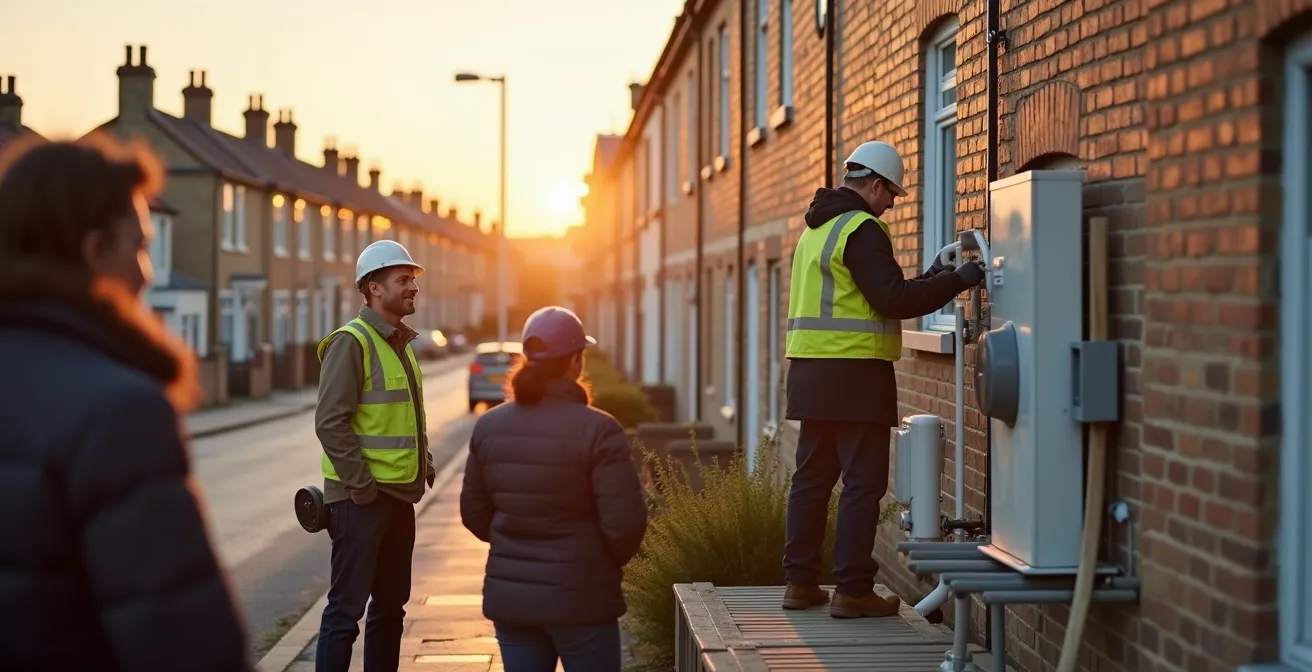
This skills shortage is your opportunity. The table below outlines the key career paths in the UK’s domestic retrofit market, showing the chasm between the current workforce and the 2030 demand. These are not low-skilled jobs; they are technical, rewarding careers that are central to the nation’s future.
| Career Path | Current UK Workforce | 2030 Demand | Training Required | Average Salary Range |
|---|---|---|---|---|
| Passivhaus Tradespeople | ~500 certified | 10,000+ | Passivhaus tradesperson course (5 days) | £35-50k |
| PAS 2035 Retrofit Coordinators | ~2,000 | 20,000+ | Level 5 Diploma (6-12 months) | £40-60k |
| Heat Pump Installers | ~3,000 | 50,000+ | MCS certification (2-5 days) | £30-45k |
| MHVR System Designers | ~1,500 | 15,000+ | Building services engineering qualification | £35-55k |
Your career strategy for the net-zero transition is now clear. It requires a mental shift from being a passive consumer to an active economic and civic participant. By assessing the systemic impact of your employer, engaging with your local community, and strategically acquiring high-demand skills, you move from a position of anxiety to one of agency, securing not only your own future but also contributing meaningfully to a decarbonised UK.
Frequently Asked Questions About Green Jobs and Net Zero
How can I access my council’s traffic and air quality data?
File a Freedom of Information (FOI) request specifically asking for collision data, air quality measurements, and traffic counts for your target area over the past 3 years.
What funding sources should I reference in my proposal?
Identify Section 106 developer contributions, UK Shared Prosperity Fund allocations, and Active Travel England grants available in your council’s current budget cycle.
Which coalition partners strengthen cycling infrastructure proposals?
Partner with GP surgeries (for social prescribing benefits), local businesses (for increased footfall data), and parent groups advocating for ‘school streets’ to build broad support.