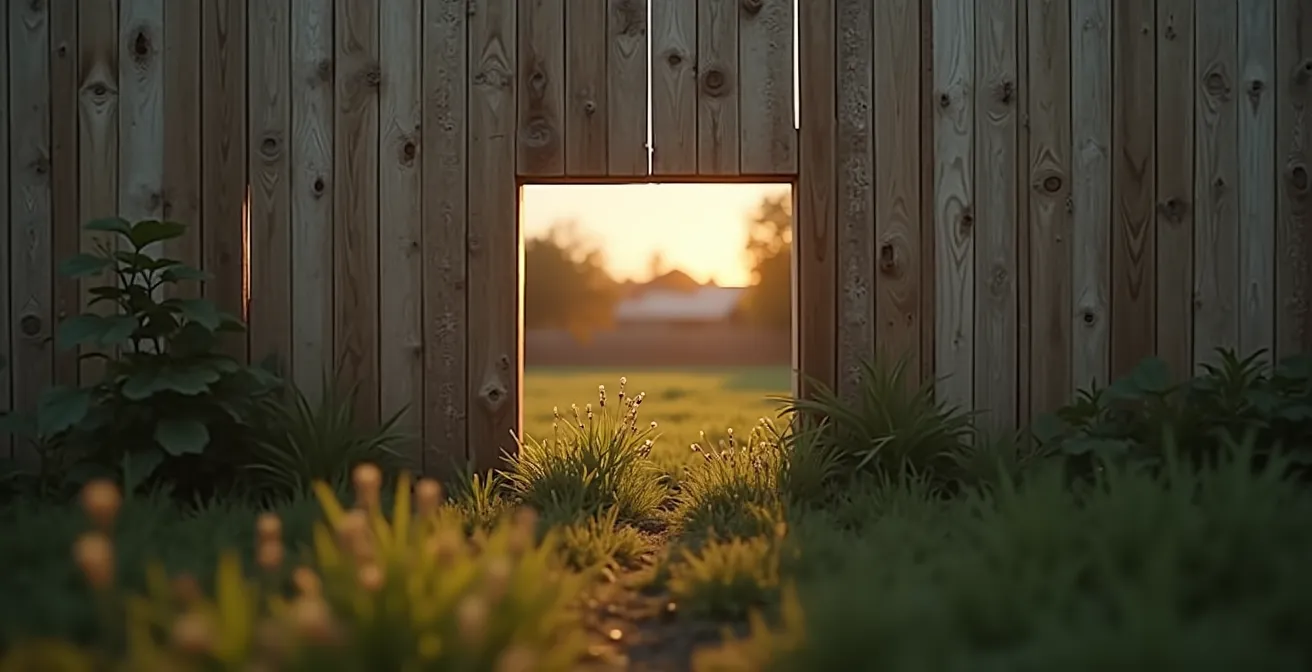
Transforming your street into a wildlife haven is less about individual fences and more about starting a neighbourhood-wide conversation.
- Hedgehogs are just the start; connected gardens create vital corridors for birds, bats, and other wildlife.
- You have legal backing, like the NERC Act, to engage your local council on rewilding public verges.
Recommendation: Start by reframing the “hedgehog hole” as the first, simple step in a shared community project to boost your street’s local biodiversity.
Seeing a hedgehog snuffling through your garden at dusk is a quintessential British delight. For many, the first instinct is to help, often by following the well-known advice to cut a small hole in the garden fence. This is a vital first step, but it’s only a single piece of a much larger puzzle. The real challenge, and the greatest opportunity, lies not in our own back gardens but in the fences and walls that separate us from our neighbours.
The conversation around wildlife-friendly gardening often stops at our own property line. We might put up bird feeders, plant pollinators, and leave a wild patch, but these efforts remain isolated islands in a sea of pristine lawns and impenetrable fences. This fragmentation is one of the biggest threats to urban wildlife, turning our neighbourhoods into an impassable maze.
But what if the key wasn’t just asking a neighbour for a favour, but inviting them to join a collective project? This guide reframes the “hedgehog highway” from a simple hole into the foundation of a community ecology project. We will explore how to move beyond a single garden, connect your entire street, and create a resilient, interconnected neighbourhood ecosystem that benefits not just hedgehogs, but a whole host of native wildlife, and fosters a powerful sense of community pride in the process.
This article will provide you with the diplomatic tools, ecological knowledge, and practical steps needed to become a catalyst for change on your street. We’ll cover everything from the science of wildlife corridors to the practicalities of cutting holes and the legal leverage you have to transform shared green spaces.
Summary: How to Create a Hedgehog Highway Neighbourhood
- Why Do Hedgehogs Need Access to 10 Different Gardens to Survive?
- How to Cut a Hedgehog Hole in a Concrete Gravel Board?
- Trees or Hedges: Which Corridors Are Vital for Bats and Birds?
- The Infill Housing Mistake That Blocks Ancient Wildlife Routes
- How to Legally Rewild Your Council Verge to Connect Habitats?
- Why Do UK Songbirds Abandon Gardens With Wooden Fences?
- Why Are Hedgehog Highways Crucial for Local Populations?
- Why Should Every UK Garden Dedicate 20% of Space to a Rewilding Zone?
Why Do Hedgehogs Need Access to 10 Different Gardens to Survive?
To understand why a street-wide effort is necessary, we must first appreciate the scale of a hedgehog’s world. A single garden, no matter how wildlife-friendly, is simply not enough. It’s a larder with only one or two items, a home with no exit. The reality is that hedgehogs are wanderers, driven by an instinct to find food, mates, and safe nesting sites across a surprisingly large territory. This need is more critical than ever, as rural hedgehog populations have suffered a staggering 30%-75% decline in some areas since 2000.
Research shows a single hedgehog can travel up to 2 kilometres in a single night, visiting as many as 13 different gardens. They require a diverse landscape, a concept ecologists call a ‘habitat mosaic’. One garden might offer a beetle-rich log pile, another a safe space under a shed for a nest, and a third a pond for a drink. When fences block their path, they are cut off from these essential resources. This forces them into dangerous situations, like crossing roads, and severely limits the gene pool, making local populations vulnerable to disease and decline.
Creating a highway is about transforming a street of isolated plots into a single, large, interconnected territory. It allows hedgehogs to roam freely and safely, creating a more resilient and genetically diverse local population. The goal is to build a network where every garden contributes something unique to the collective whole.
Community in Action: The Kirtlington Hedgehog Highway
The village of Kirtlington in Oxfordshire provides a powerful example of this principle in action. What started as a small effort has grown into a network of 60 connected houses. Residents have created a variety of gaps, holes, and even custom-built ramps to ensure their prickly neighbours have free rein of the village, demonstrating the immense impact of coordinated community action.
Therefore, when you approach your neighbour, you’re not just asking for a hole; you’re inviting them to link their patch of land into a life-saving super-territory for local wildlife.
How to Cut a Hedgehog Hole in a Concrete Gravel Board?
The idea of a neighbourhood-wide network is inspiring, but it often comes down to a very practical question: how do we physically create the opening? While wooden fences are straightforward, the solid barrier of a concrete gravel board can seem like an insurmountable obstacle. However, with the right tools and safety precautions, it is entirely possible to breach these ‘concrete curtains’ and connect your gardens.
The standard size for a hedgehog hole is 13cm by 13cm. This is large enough for any hedgehog to pass through but small enough to deter most pets. For concrete, the most effective tool is an angle grinder fitted with a diamond blade. This is a powerful tool, and it is absolutely essential to use proper safety equipment: heavy-duty gloves, full-face protection or safety goggles, and a dust mask are non-negotiable. Mark the 13x13cm square on the gravel board and make slow, careful cuts along the lines. It’s a noisy, dusty job, so it’s a good idea to inform your neighbours beforehand – a perfect opportunity to explain the project!

For less daunting barriers, the solutions are simpler. A coping saw or jigsaw is perfect for wooden fence panels. For brick walls, it may be possible to carefully remove a single brick at the base. In some cases, you may not need to cut at all; simply digging a shallow channel under a fence or gate can provide the necessary access. The key is to assess each boundary and find the most practical and least destructive solution to link the chain.
Each new hole is a doorway to a larger, safer world, and tackling even the toughest barriers like concrete sends a powerful message that your community is serious about helping wildlife.
Trees or Hedges: Which Corridors Are Vital for Bats and Birds?
A truly connected neighbourhood thinks in three dimensions. While hedgehog highways solve the problem at ground level, the space above is just as important. The ‘green corridors’ formed by trees and, crucially, hedgerows, are the motorways for a huge variety of other wildlife, including bats and songbirds. Sadly, Great Britain has lost an estimated 50% of its hedgerows since World War II, replacing these living arteries with sterile wooden fences.
For bats, hedgerows and tree lines are not just ‘scenery’; they are essential navigational aids and feeding grounds. Many UK bat species use a form of echolocation that relies on linear features like hedges to ‘see’ their way across the landscape in the dark. These corridors guide them from their roosts to foraging areas, which are often rich with the insects that live in the hedge itself. A street with an unbroken line of hedges is a brightly lit, well-signposted route for a bat; a street with tall fences is a dark, confusing void.
Songbirds depend on these corridors for food, shelter, and nesting sites. A dense hawthorn hedge offers protection from predators and the elements, while its berries and the insects it hosts provide a year-round food supply. Planting a native hedge is one of the most significant actions you can take to reverse the trend of silent gardens. When talking to neighbours, proposing a shared hedge instead of a new fence can be a transformative, long-term project for your street’s ecological connectivity.
UK Native Hedge Starter Pack
- Hawthorn (Crataegus monogyna): Provides a dense structure for nesting birds and a bounty of red berries in autumn.
- Blackthorn (Prunus spinosa): Its early spring flowers are a vital resource for pollinators, and its sloes feed birds in winter.
- Hazel (Corylus avellana): Offers nuts for small mammals like wood mice and its catkins provide early pollen for bees.
- Dog Rose (Rosa canina): The flowers are a boon for insects, and the vitamin C-rich hips are a favourite of birds like thrushes.
By encouraging the planting of native hedges, you are not just erecting a boundary; you are building a multi-storey, living supermarket and motorway for the wildlife on your street.
The Infill Housing Mistake That Blocks Ancient Wildlife Routes
Our modern suburban landscape is a patchwork of historical development. Gardens that seem new may sit on ancient wildlife routes that have been used for centuries. The trend of infill housing—building new homes on plots of land like large gardens or small fields—often ignores this invisible history. When a new development goes up, it frequently comes with high, impenetrable fences that suddenly sever these ancient pathways, with devastating consequences.
This habitat fragmentation is a primary driver of hedgehog decline. When their traditional routes are blocked, hedgehogs are forced into the most dangerous part of our landscape: the roads. It is estimated that up to 335,000 hedgehogs die on British roads annually. Many of these deaths are not random accidents but occur at specific ‘hotspots’ where a new fence or wall forces a hedgehog to detour onto a busy road. Your street could be one of these critical pinch points without anyone even realising it.
This is where the community-led hedgehog highway becomes a powerful act of ecological repair. It retroactively corrects the mistakes of developers by reopening these lost corridors at a grassroots level. Each 13cm hole acts as a small but vital bypass, guiding wildlife away from deadly roads and back onto safer, more traditional routes through gardens.
The scale of this community power is no longer theoretical. A 2021 study estimated that the actions of volunteers had already created over 120,000 hedgehog highways, connecting around 240,000 gardens across the UK. This represents about one percent of all residential gardens, a testament to how small, coordinated actions can begin to heal a fragmented landscape and create a national network of safe passage for our wildlife.
By connecting your street, you are not just being kind to animals; you are actively restoring the ecological integrity of your local area, one garden at a time.
How to Legally Rewild Your Council Verge to Connect Habitats?
The final frontier in connecting your neighbourhood’s habitat mosaic often lies just beyond your front gate: the council-owned grass verge. These green strips, typically mown to within an inch of their life, represent a huge missed opportunity. By transforming them from sterile green deserts into wildflower meadows, you can create the final, crucial link connecting your street’s gardens to local parks and other green spaces. But how do you approach the council without being dismissed?
Your greatest tool is a piece of UK legislation. As a community organiser, you can approach your local authority with confidence by referencing their legal obligations. In a letter to your council’s Parks or Biodiversity Officer, you can highlight this duty.
The NERC Act 2006 places a Biodiversity Duty on all public authorities in England and Wales to conserve biodiversity.
– UK Legislation, Natural Environment and Rural Communities Act 2006
This duty has been strengthened by the Environment Act 2021, which now requires authorities to go beyond just conserving and actively ‘enhance’ biodiversity. This gives your proposal real legal weight. Rather than demanding they rewild the whole area, propose a ‘Community Verge Partnership’. Start small by asking for permission to manage a symbolic patch on your street as a trial. This reduces the perceived risk and workload for the council.

Document the results of your trial. Take photos of the wildflowers that emerge and the bees, butterflies, and other insects that arrive. Use this positive evidence to then propose expanding the project to connect key habitats, creating a continuous wildlife corridor that flows from garden to garden, down the verge, and into the wider landscape. This is the pinnacle of the community ecology project, turning public land into a shared asset for both people and wildlife.
This strategic approach transforms a simple request into a collaborative partnership, making the council an ally in your mission to rewild your street.
Why Do UK Songbirds Abandon Gardens With Wooden Fences?
The shift from living, breathing hedges to solid wooden fences has had a quiet but devastating impact on many of our beloved garden birds. While a fence provides privacy for us, for a small bird, it creates a dangerous and desolate environment. A garden enclosed by solid fencing is an ecological trap, and birds are smart enough to abandon it for safer, more resource-rich territories. There are approximately 520 thousand hectares of residential garden space in urban Great Britain, so the collective choice of boundary has a colossal impact on wildlife.
The core problem is twofold: a lack of escape routes and a complete absence of food. A dense hedge offers a three-dimensional network of branches that a small bird like a dunnock or robin can dart into to escape a predator like a sparrowhawk or a local cat. A flat, solid fence offers zero cover. A bird at a feeder in a fenced garden is completely exposed; if a predator strikes, it has nowhere to go. This constant stress and vulnerability make the garden an unsuitable place to feed or nest.
Furthermore, a wooden fence is a sterile, dead surface. A living hedge, by contrast, is a vibrant ecosystem. It hosts hundreds of species of insects and caterpillars—the primary food source for nestlings—and provides berries and seeds later in the year. By replacing a hedge with a fence, we are effectively bulldozing the local supermarket and replacing it with a food desert.
The following table, inspired by advice from wildlife charities, clearly illustrates the stark contrast between these two choices.
| Feature | Solid Wooden Fence | Living Hedge/Fence with Climbers |
|---|---|---|
| Wildlife Access | Blocks all ground-level movement | Multiple entry points at all levels |
| Food Sources | None | Berries, insects, caterpillars |
| Nesting Sites | None | Dense cover for multiple species |
| Escape Routes | Creates predator traps | 3D network of escape paths |
| Maintenance | Regular treatment needed | Annual trim outside nesting season |
When we choose or advocate for living boundaries, we are giving our local songbirds a fighting chance to thrive in our shared urban landscape.
Why Are Hedgehog Highways Crucial for Local Populations?
The most compelling argument you can make to a sceptical neighbour is simple: these actions work. This isn’t just a hopeful theory; it’s a conservation strategy with proven results. The creation of hedgehog highways is directly linked to the stabilisation and even recovery of hedgehog populations in the very places they were disappearing from. This provides the crucial proof needed to turn a ‘nice idea’ into an urgent, effective community mission.
The data is encouraging. While hedgehogs are still in steep decline in many rural areas, recent reports show a more optimistic picture in our towns and cities. The key finding from organisations like Hedgehog Street is that in urban areas where hedgehogs are still found, their numbers appear to be stabilising or even increasing where gardens are well-connected. This is a direct testament to the power of thousands of individual actions adding up to a landscape-level effect. Your small hole in the fence is part of a national success story.
This success is driven by a remarkable national movement. The ‘Hedgehog Street’ campaign, a partnership between the People’s Trust for Endangered Species and the British Hedgehog Preservation Society, has galvanised the public. As of early 2025, over 130,000 volunteers have signed up as ‘Hedgehog Champions’, committing to making their gardens hedgehog-friendly and, crucially, linking them to their neighbours. This transforms individual enthusiasm into a powerful, data-driven conservation force, allowing researchers to map the growing network of highways across the country.
When you talk to your neighbours, you are not asking them to join an unsupported experiment. You are inviting them to become part of a huge, proven, and ever-growing movement that is making a measurable difference to the survival of one of Britain’s most beloved animals. You are giving them a chance to be a part of the solution.
This isn’t just about feeling good; it’s about doing good, with the data to back it up.
Key Takeaways
- A single hedgehog needs to roam across 10-13 gardens per night to find enough food and mates.
- Creating a 13x13cm hole is the first step, but the bigger goal is creating ‘green corridors’ with hedges for birds and bats.
- Your community has legal backing (NERC Act 2006) to engage councils in rewilding public verges to connect habitats.
Why Should Every UK Garden Dedicate 20% of Space to a Rewilding Zone?
The final piece of the neighbourhood ecosystem puzzle is about what happens within each garden. Creating corridors between them is vital, but if they all lead to sterile, manicured lawns, the benefit is limited. The ultimate goal is to create a rich ‘habitat mosaic’, and the simplest way to achieve this is for every garden to dedicate a small portion of its space to nature. The ‘20% rewilding’ rule is a powerful concept that, if adopted street-wide, could have a revolutionary impact.
There are over 22.7 million private gardens in the UK. The collective power they hold is immense. It has been calculated that if just 20% of each of these gardens were allowed to go wild, the resulting habitat would create a new nature reserve larger than all of the UK’s existing National Nature Reserves combined. This is the scale of the opportunity. By persuading your neighbours to join you in this simple pledge, your street becomes a microcosm of this national ecological recovery project.
Dedicating 20% of a garden to rewilding doesn’t mean letting the whole space become an overgrown jungle. It’s a manageable, targeted action. It’s about choosing a corner, perhaps at the back of the garden where it connects to a neighbour’s, and simply stopping intensive management. It means letting the grass grow long, leaving fallen leaves on the ground to provide mulch and shelter, and creating a small log pile from pruned branches. This small patch quickly becomes a haven for insects, which in turn provides food for hedgehogs, birds, and bats. It becomes the ‘service station’ on the wildlife highway you’ve created.
Your 5-Step Garden Rewilding Audit
- Identify the Zone: Choose a 20% corner of your garden, ideally one that connects to a boundary or your new hedgehog hole.
- Cease Mowing: Simply stop mowing this selected area. Let native grasses and ‘weeds’ like dandelions and clover grow to provide food for pollinators.
- Build a Habitat Pile: Create a small log pile using any pruned branches or fallen wood. This becomes a 5-star hotel for insects and a potential nesting site.
- Leave the Leaves: In autumn, instead of raking up fallen leaves, let them be. They provide a vital winter blanket for hibernating creatures and food for worms.
- Add Water: If possible, add a shallow dish of water with pebbles in it. This provides a safe drinking source for birds, insects, and hedgehogs.
Now that you are armed with the knowledge and the strategy, the next step is to start the first, friendly conversation. Begin with the neighbour you know best, share your passion, and invite them to join you in creating a street you can all be proud of—a true neighbourhood for nature.
Frequently Asked Questions About a Hedgehog Highway Neighbourhood
Will a hedgehog hole let rats in?
A 13cm by 13cm square is sufficient for any hedgehog to pass through, but this will be too small for nearly all pets. Rats can, and likely already do, access gardens through numerous other routes, so a hedgehog hole is unlikely to make a difference to their presence.
Do I need my landlord’s permission?
Yes, for rental properties, it is always best to request permission from your landlord. You can frame it as a minor, easily reversible alteration made to help protected British wildlife, an action that is supported and encouraged by national charities like the RSPB and The Wildlife Trusts.
What if I have pets?
The 13cm hole is generally too small for most cats and dogs to fit through. For peace of mind, you can strategically position the hole behind a planter or other object on your side of the fence, or fashion a simple slide-down cover that can be used to temporarily block the hole when your pet is unsupervised in the garden.