The key to upgrading a listed building isn’t the materials you choose, but mastering the legal distinction between ‘repair’ and ‘alteration’ and prioritising full reversibility.
- Most enforcement action stems from unauthorised works that are legally defined as ‘alterations’, not simple repairs.
- Conservation officers are far more likely to approve interventions that can be removed without damaging the building’s historic fabric.
Recommendation: Shift your focus from finding the ‘best’ insulation to developing a strategy of ‘performance without presence’ that a conservation officer can confidently approve.
Owning a Grade II listed property in England is a privilege that comes with a weighty legal responsibility. The desire for modern thermal comfort often clashes with the stringent regulations designed to protect the nation’s architectural heritage. Many owners find themselves paralysed, caught between rising energy bills and the genuine fear of committing a criminal offence. Unauthorized alteration to a listed building is not a minor infraction; it can lead to unlimited fines, a prison sentence, and a legal order to reverse all changes at your own expense. This fear is what stops most well-intentioned projects in their tracks.
The common advice often revolves around a simplistic list of “approved” materials or the default recommendation of secondary glazing. While not incorrect, this approach fails to address the fundamental strategic issue. It overlooks the nuanced legal landscape and the core philosophy of conservation. The central question is not “what can I use?” but “what can I justify?” This requires a shift in mindset, moving away from a purely technical perspective to a strategic and quasi-legal one.
The truth is that a successful outcome hinges on understanding the conservation officer’s perspective. Their mandate is to preserve the historic fabric and special character of the building. Therefore, the most successful strategies are not those that hide modern materials best, but those that are founded on the principle of reversibility. If an intervention can be removed in the future without a trace, it presents a minimal risk to the building’s long-term integrity and is far more likely to gain consent.
This article provides a strategic framework for navigating this complex process. We will deconstruct the legal boundaries, explore reversible techniques, analyse cutting-edge materials that meet heritage standards, and highlight the critical mistakes that trap moisture and trigger enforcement. It is a guide to thinking like a conservation consultant, empowering you to create a comfortable home while respecting its invaluable history.
To navigate these critical considerations effectively, this guide is structured to address the most pressing questions owners of listed properties face. The following sections provide a clear roadmap for your project.
Summary: A Strategic Framework for Listed Building Insulation
- Repair or Alteration: When Do You Actually Need Listed Building Consent?
- How to Improve Thermal Comfort Using Fully Reversible Techniques?
- Vacuum Glazing: Is It Thin Enough to Satisfy Council Heritage Teams?
- The Cement Render Mistake That Traps Moisture in Historic Stone
- How to Restore Original Shutters to Act as Effective Thermal Barriers?
- How to Get Planning Approval for External Insulation in Conservation Areas?
- Timber or Plastic Parting Beads: Which Lasts Longer in UK Weather?
- Why Is Lime Plaster Essential for the Longevity of Pre-1919 Homes?
Repair or Alteration: When Do You Actually Need Listed Building Consent?
The single most critical concept to master before touching a single brick of your listed home is the legal distinction between ‘repair’ and ‘alteration’. Section 7 of the Planning (Listed Buildings and Conservation Areas) Act 1990 makes no reference to Listed Building Consent (LBC) being required for repairs. Consequently, a genuine like-for-like repair using identical materials and methods often falls outside the scope of LBC. However, the moment a repair crosses the threshold into an ‘alteration’—an act that changes the character of the building—consent becomes a legal necessity. This is the grey area where most homeowners unwittingly fall foul of the law.
An ‘alteration’ is not defined by the scale of the work, but by its impact on the building’s historic fabric and special interest. Replacing a single rotten timber in a window frame with an identical piece of seasoned oak is likely a repair. Replacing the entire window with a new unit, even one that looks similar, is almost certainly an alteration. The distinction is subtle but profound. The conservation officer’s primary concern is the loss of historic fabric. Any proposal that involves removing original material, introducing new and different materials, or changing the building’s layout will be scrutinised as an alteration.
Your communication with the local authority is therefore a strategic exercise. The language used in your initial enquiries and formal applications can inadvertently frame your project as an alteration, triggering a higher level of scrutiny. Adopting a precise, conservation-aware vocabulary is not about deception; it is about accurately describing your intent within the established legal framework.
Action Plan: ‘Red Flag’ Words to Avoid in LBC Discussions
- Avoid using ‘replace’ unless discussing like-for-like replacement with identical materials. ‘Repair’ or ‘reinstate’ are often more appropriate.
- Be cautious with ‘remove’. Any removal of historic fabric typically requires consent, so this word immediately signals an alteration.
- Never use ‘introduce’ when describing new materials or elements. This explicitly states you are adding something new, which is the definition of an alteration.
- Substitute ‘reconfigure’ with ‘restore to original configuration’ where possible, as the former implies a new design.
- Replace ‘upgrade’ with ‘repair using traditional methods’ in your documentation. ‘Upgrade’ suggests a modern intervention, not a conservation-led repair.
Ultimately, if there is any doubt, the safest and most prudent course of action is to seek a formal opinion from the local authority’s conservation officer. Presenting your proposed works as a schedule of careful, like-for-like repairs is the most effective strategy to stay on the right side of the law.
How to Improve Thermal Comfort Using Fully Reversible Techniques?
The principle of reversibility is the cornerstone of modern building conservation and your most powerful tool in gaining consent. A reversible intervention is one that can be removed in the future without causing damage to the building’s original fabric. This approach is highly favoured by conservation officers because it respects the building’s integrity and does not prejudice the decisions of future generations. Instead of making permanent, irreversible changes, you are adding layers that can be taken away.
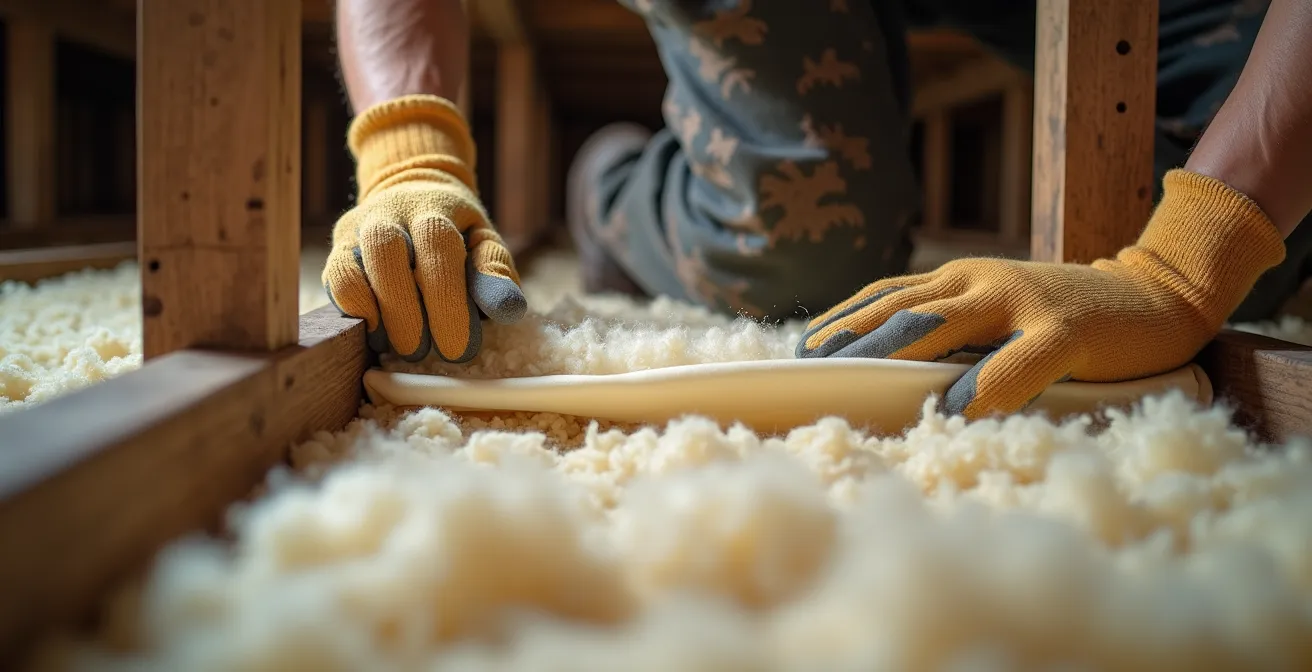
This strategy fundamentally shifts the conversation from “what can I get away with?” to “how can I provide comfort without harm?”. A classic example is the insulation of suspended timber floors. A common but ill-advised approach might be to spray modern closed-cell foam insulation between the joists. This is highly effective thermally but is irreversible; removing it would inevitably damage the historic timbers. It also traps moisture, potentially leading to rot.
A reversible, conservation-led alternative involves carefully fitting natural, breathable insulation like sheep’s wool or wood fibre batts, often held in place with a breathable membrane or a simple timber lathe system. This entire assembly can be removed years later, leaving the original floor structure completely untouched and able to breathe as it was designed to. According to Historic England research, even simple measures like well-fitted shutters can reduce heat loss by 60%, a fully reversible technique.
As this demonstrates, the focus is on working *with* the building’s existing systems. Other reversible techniques include heavy, thermally-lined curtains, bespoke secondary glazing units that fit within window reveals without altering the original frame, and the careful draught-proofing of doors and windows using traditional methods. Each of these measures improves thermal comfort significantly while leaving the precious historic fabric untouched.
When you present a plan to a conservation officer based on reversibility, you are demonstrating that you are a careful custodian of the property, not just a homeowner seeking to impose modern standards. This collaborative posture is far more likely to result in a positive and productive outcome.
Vacuum Glazing: Is It Thin Enough to Satisfy Council Heritage Teams?
Windows are often described as the ‘eyes’ of a building and are a key element of its special architectural character. For this reason, proposals to replace original single-glazed sash or casement windows with modern, bulky double-glazing units are almost universally rejected by conservation officers. The thickness of standard units (20-28mm) requires a much heavier frame, altering the delicate proportions and sight-lines of historic joinery. Furthermore, the tell-tale ‘double reflection’ is seen as a significant intrusion on the building’s character.
For decades, the only acceptable solution has been secondary glazing—installing a second, discreet window pane on the inside of the original. While thermally effective, it can be visually cumbersome and inconvenient to operate. However, recent technological advancements have provided a compelling alternative: vacuum insulated glazing (VIG). This technology uses a micro-thin vacuum gap (around 0.3mm) between two panes of glass, achieving exceptional thermal performance in a unit that is barely thicker than the original single pane.
With a total thickness of just 6.7mm to 7.7mm, heritage vacuum glazing can often be retrofitted into the original timber frames of listed buildings, preserving the slender, elegant profiles that are so integral to their character. This concept of ‘performance without presence’ is exactly what conservation officers are looking for. The thermal performance can be extraordinary, with some VIG units achieving a U-value of 0.4 W/m²K, which is significantly better than standard triple glazing, yet in a profile that is visually almost indistinguishable from original glass.
The following table, based on data from leading manufacturers, illustrates why vacuum glazing presents such a strong case for listed buildings, as confirmed by precedent and analysis from heritage bodies.
| Glazing Type | Thickness | U-Value (W/m²K) | Conservation Approval Likelihood |
|---|---|---|---|
| Single Glazing (Original) | 3-4mm | 5.8 | N/A – Existing |
| Standard Double Glazing | 20-28mm | 2.8 | Very Low |
| Vacuum Glazing | 6.7-7.7mm | 0.4-0.7 | High with Precedent |
| Secondary Glazing | N/A (Internal) | 2.0-2.5 | Very High |
The key to gaining approval is a well-argued application, often supported by a heritage statement and examples of successful precedents. Demonstrating that the original frames will be carefully repaired and retained, with the new glazing being the only change, is a powerful and often successful strategy.
The Cement Render Mistake That Traps Moisture in Historic Stone
One of the most common and damaging mistakes made in the maintenance of pre-1919 buildings is the application of modern, impermeable materials over traditional, breathable structures. Historic buildings with solid walls were designed as a complete ‘vapour permeability system’. They are intended to absorb moisture from the environment (such as driving rain) and then release it naturally through evaporation. This process relies on all components—the stone or brick, the mortar, and the internal plaster—being vapour-permeable, or ‘breathable’.
The introduction of modern cement-based render or gypsum plaster breaks this system. These materials are effectively a plastic bag wrapped around the wall. They prevent moisture that enters the wall (either from outside or from condensation within) from escaping. The trapped moisture builds up within the wall fabric, leading to a host of problems: persistent damp patches, peeling paint, salt efflorescence, and, most seriously, the accelerated decay of the historic masonry and timber elements embedded within the wall. As Historic England’s guidance states, this is a fundamental error.
Using modern gypsum plaster breaks this system, trapping damp and potentially leading to structural decay.
– Historic England, Energy Efficiency and Historic Buildings guidance
The visual signs of a cement-rendered historic building are often a precursor to significant structural issues. While it might seem like a quick fix to cover up poor-quality stonework, it is a ticking time bomb. The long-term solution is always to remove the offending cement render and replace it with a traditional, breathable lime render. This is a specialist job and can be costly; rectifying the damage done by inappropriate materials is always more expensive than using the correct materials in the first place. In some cases, professional remediation costs can reach significant sums, running into thousands of pounds for even a moderately sized wall area.
Before undertaking any insulation project, it is therefore imperative to first assess the existing condition of the walls. If impermeable materials are present, their removal and replacement with appropriate lime-based products should be the absolute first priority, even before considering adding insulation.
How to Restore Original Shutters to Act as Effective Thermal Barriers?
Before considering the addition of new layers or technologies, the first principle of conservation is always to repair and reuse what already exists. Many Georgian and Victorian properties were originally equipped with internal timber window shutters. Far from being merely decorative, these were a key part of the building’s original thermal strategy. When closed, they create a pocket of still air between the shutter and the single-glazed window, dramatically reducing both radiant heat loss and cold draughts. A well-maintained and properly draught-proofed set of original shutters can be surprisingly effective.
Over the years, many shutters have been painted shut, have warped, or have been damaged. Bringing them back into full working order is a highly cost-effective and conservation-friendly way to boost thermal performance. This work is almost always classed as ‘repair’ and is therefore unlikely to require Listed Building Consent, provided it is done on a like-for-like basis. The process involves more than just a new coat of paint; it is a careful exercise in traditional joinery and alignment to ensure a snug, draught-free fit.
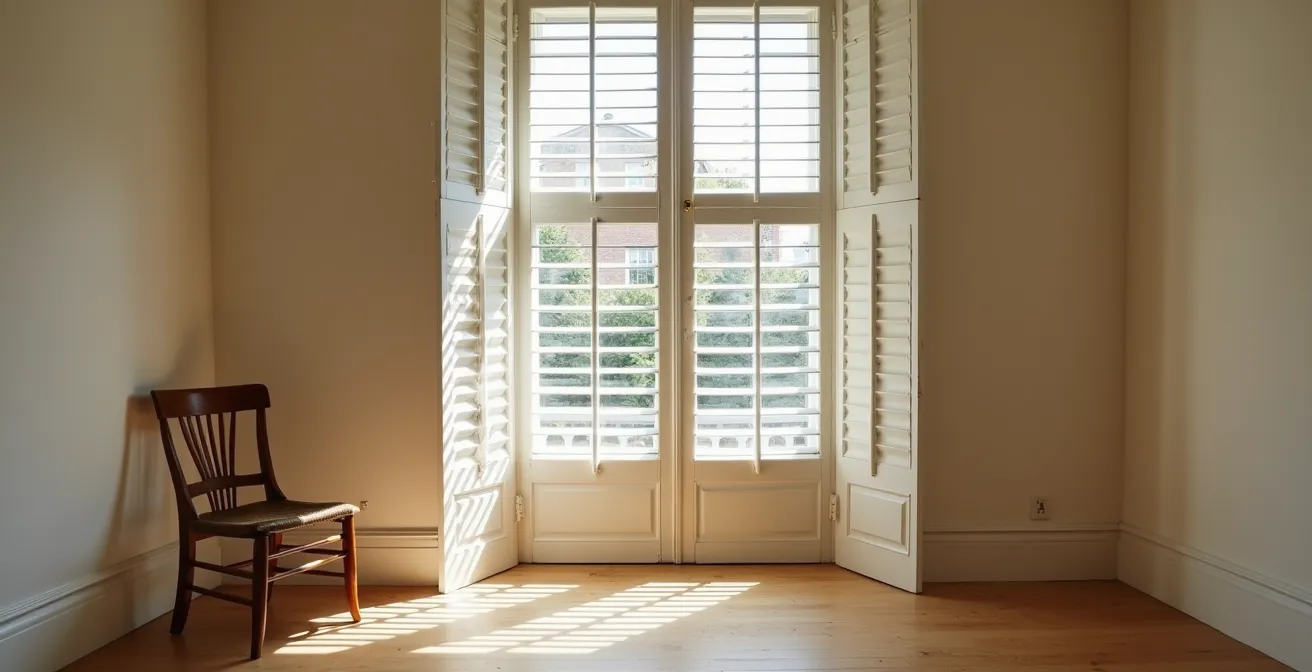
The restoration process focuses on returning the shutters to their original function, often with subtle, non-visible enhancements to improve their performance further. The goal is to make these original features work as hard as possible, just as their makers intended.
- Check and re-align all hinges, using traditional slotted brass screws rather than modern cross-heads to maintain authenticity.
- Repair damaged panels or frames using matching timber (e.g., old pine) and traditional joinery methods like mortise and tenon joints.
- Install concealed draught-strips within the rebates of the shutter box or on the edges of the shutters themselves. This must not alter the visible surfaces.
- For a significant thermal boost, consider adding a thin (3mm max) cork sheet backing to the inner face of the shutter panels. This is reversible and adds insulation without affecting the external appearance.
- Apply a traditional linseed oil paint finish. Unlike modern plastic paints, this allows the timber to breathe and protects it for decades.
This approach delivers a triple benefit: it improves your home’s comfort, preserves and celebrates its historic character, and is viewed extremely favourably by any conservation officer, as it embodies the very essence of sustainable heritage management.
How to Get Planning Approval for External Insulation in Conservation Areas?
External Wall Insulation (EWI) presents one of the greatest challenges in the context of listed buildings and conservation areas. The practice involves fixing a layer of insulation to the outside of the building and covering it with a new render. While highly effective thermally, it fundamentally and visibly alters the building’s external appearance, which is often the primary reason for its listing. As such, the default position of most planning authorities is to refuse such applications.
Historic England’s guidance is explicit on this matter. They are the statutory body for the historic environment in England, and their view carries immense weight with local councils. Their position underscores the difficulty of getting such proposals approved.
The external appearance of listed buildings is a key concern and for this reason external wall insulation is unlikely to be acceptable due to harmful impacts.
– Historic England, Adapting Historic Buildings for Energy and Carbon Efficiency
Does this mean approval is impossible? Not necessarily, but it is exceptionally difficult and rare. Success hinges on a strategy of justifiable detailing and, in most cases, applying the insulation to less significant elevations. An application for EWI on the principal, street-facing elevation of a Georgian townhouse is almost certain to fail. However, an application for a visually discreet EWI system on a poorly-built, non-original rear extension might have a chance if a compelling case is made.
The argument must be overwhelmingly strong. It would need to demonstrate that the wall in question has little or no historic or aesthetic value, that the proposed insulation system will not harm the underlying fabric (i.e., it must be vapour-permeable), and that the final finish will be of exceptionally high quality, respecting the character of the building. Success stories, though few, often involve meticulous architectural detailing to replicate original features like plinths, string courses, and eaves details over the new insulation layer. It is a complex and expensive route that should only be considered for the least historically sensitive parts of a property.
For the vast majority of Grade II listed properties, the strategic focus should remain firmly on internal insulation, roof insulation, and window improvements, as these interventions carry a much lower risk of planning refusal and heritage-related conflict.
Key Takeaways
- The legal line between ‘repair’ (often no consent needed) and ‘alteration’ (consent mandatory) is your primary strategic consideration.
- Prioritise fully reversible interventions that do not damage or remove original historic fabric.
- Modern materials like vacuum glazing can be acceptable if they offer ‘performance without presence’, preserving historic character.
Timber or Plastic Parting Beads: Which Lasts Longer in UK Weather?
When overhauling traditional timber sash windows, the small details matter immensely. Parting beads and staff beads are the timber strips that hold the sashes in place and allow them to slide. When these are replaced, the choice of material has significant implications for both longevity and the likelihood of gaining consent. In recent years, many companies offer uPVC or plastic replacements, often integrated with draught-stripping brushes, promising a maintenance-free solution.
From a conservation perspective, this is a non-starter. The use of plastic components on a listed building, however small, is anathema to conservation principles. It introduces an incongruous, modern material that behaves very differently to timber. Conservation officers will not approve it. As research from the Country Land and Business Association highlights, applications involving uPVC window elements face an almost 100% refusal rate for listed buildings in England. The focus must therefore be on the correct specification of timber.
The choice is not simply ‘wood’, but which wood. Standard softwood is the cheapest option but requires regular painting to prevent rot and may only last 15-20 years in an exposed location. Traditional hardwoods like oak are excellent but can be expensive. A superior modern alternative, highly favoured in conservation work, is Accoya. This is a brand of modified timber where softwood is put through a non-toxic acetylation process that changes its cell structure, making it as stable and durable as the best tropical hardwoods. It is guaranteed for 50 years and is sustainably sourced, making it an ideal choice that satisfies both durability and conservation criteria.
This comparative table clarifies the strategic choice when replacing these essential window components.
| Material | Durability (Years) | Conservation Approval | Maintenance Required |
|---|---|---|---|
| uPVC/Plastic | 20-25 | Never Approved | None |
| Standard Softwood | 15-20 | Usually Approved | Regular painting |
| Accoya Modified Timber | 50+ | Highly Favoured | Minimal |
| Traditional Hardwood | 30-40 | Always Approved | Periodic treatment |
Opting for a high-quality, durable timber like Accoya for details such as parting beads demonstrates a commitment to long-term, quality repair that a conservation officer will recognise and appreciate, smoothing the path for your project’s approval.
Why Is Lime Plaster Essential for the Longevity of Pre-1919 Homes?
To truly understand how to care for a historic home, one must appreciate that it functions as a complete, integrated system, not a collection of separate parts. The key to this system in a solid-walled building is its ability to manage moisture, and the indispensable material that facilitates this is lime plaster. Unlike modern gypsum or cement-based plasters which are hard, brittle, and impermeable, lime plaster is soft, flexible, and critically, vapour-permeable.
This ‘breathability’ is not just a buzzword; it is a physical property that allows moisture vapour to pass through it. A wall plastered with lime can absorb moisture from the internal air (e.g., from cooking or bathing) or from the wall itself, and then slowly release it, helping to regulate internal humidity and keeping the underlying wall structure dry. This constant, gentle movement of moisture is the building’s way of breathing. It is a self-regulating system that has proven effective for centuries.
Using lime plaster is essential for maintaining this equilibrium and provides a range of benefits critical to the health of a historic building:
- It allows walls to ‘breathe’ by maintaining high vapour permeability, preventing moisture from becoming trapped.
- It helps to naturally regulate indoor humidity, reducing the risk of surface condensation and mould growth.
- The high alkalinity of lime creates an inhospitable environment for mould and harmful decay organisms.
- Its soft, flexible nature allows it to accommodate the natural small movements of a historic building without cracking.
- It contains zero Volatile Organic Compounds (VOCs), contributing to better indoor air quality.
Applying a modern gypsum plaster internally is akin to applying cement render externally: it seals the wall, traps moisture, and inevitably leads to damp and decay. Research has repeatedly confirmed that replacing breathable materials with impermeable ones creates a significant risk of interstitial condensation—moisture forming *within* the wall structure—which can be catastrophic for embedded timbers like floor joists or roof trusses.
Therefore, any internal insulation strategy for solid walls must be paired with a breathable internal finish. Systems using wood fibre or cork insulation boards finished with a lime plaster are the gold standard, as they add thermal performance without compromising the building’s essential ability to breathe.