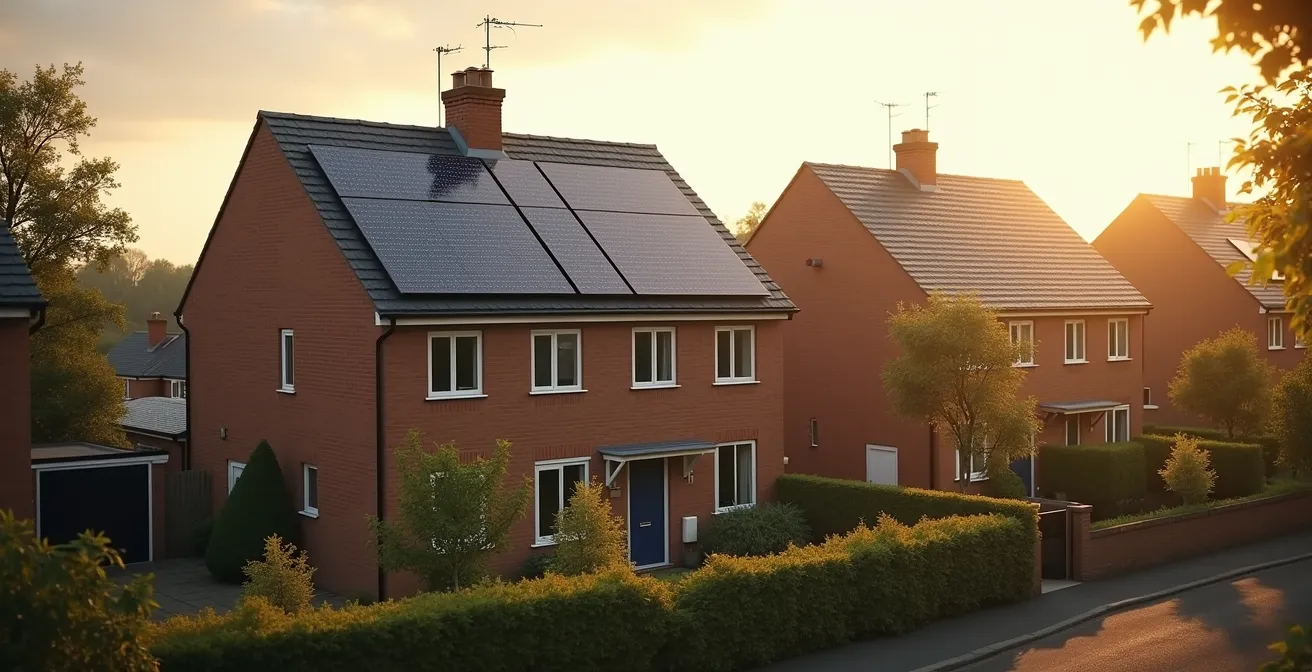
For UK homeowners with savings, a solar panel system is no longer just an eco-friendly purchase; it’s a high-performing financial asset that can outperform a standard savings account when managed correctly.
- The return on investment (ROI) is driven by multiple revenue streams: bill savings, Smart Export Guarantee (SEG) payments, and active grid arbitrage.
- Technology choices (like optimisers) and forward-planning (like bird proofing) have a direct and calculable impact on long-term financial returns.
Recommendation: Shift your mindset from “saving on bills” to “active asset management.” The first step is to audit your home’s unique energy consumption profile to model a precise, personalised ROI.
The demise of the Feed-in Tariff (FiT) led many UK homeowners to a simple conclusion: the golden age of solar is over. The narrative shifted, and putting £8,000 into a savings account or an ISA seemed like a more sensible financial decision than covering your roof in photovoltaic cells. This perspective, however, overlooks a fundamental transformation in the energy market. The question is no longer “Are solar panels worth it?” but rather “How do I calculate and maximise their ROI as a financial asset?” While the old model of passive income from FiT is gone, a new, more active model of value generation has emerged, built on self-consumption, smart export strategies, and grid services.
Today, a properly specified solar installation isn’t just about reducing your electricity bill. It’s an investment vehicle with multiple, stackable revenue streams. The value comes from a calculated blend of offsetting peak-rate electricity, earning through the Smart Export Guarantee (SEG), and, crucially, using battery storage for grid arbitrage. When you compare the potential 5-10% annualised return of a well-managed solar system against the 4-5% offered by top savings accounts, the financial case becomes compelling. This analysis requires moving beyond generic online calculators and adopting the mindset of an asset manager, focusing on variables like panel orientation, inverter technology, and even future-proofing against pests. Understanding these factors is the key to unlocking a return that a passive savings account simply cannot match, and it even has the potential to increase your property’s value.
This guide provides a detailed financial breakdown of the key variables that determine your solar ROI. We will dissect the technical choices and strategic decisions that transform a solar installation from a simple home improvement into a robust financial investment for UK homeowners.
Summary: Are Solar Panels Still Worth It in the UK Without the Feed-in Tariff?
- Why Do East-West Facing Panels Sometimes Beat South Facing Systems?
- How Long Does a Standard 4kW Solar Installation Take to Install?
- Micro-inverters or Optimizers: Which Choice Handles UK Shade Better?
- The Bird Proofing Error That Costs £500 to Fix Later
- How Many Panels Do You Need to Charge an EV and Run a Heat Pump?
- Fixed 15p or Variable Agile Outgoing: Which Export Tariff Pays More?
- How to Set Up a Community Solar Co-op on Your Local School Roof?
- Why Is a Battery Storage System Essential Even Without Solar Panels?
Why Do East-West Facing Panels Sometimes Beat South Facing Systems?
The long-standing advice for UK solar installations has been “south-facing is optimal.” From a pure peak generation perspective, this is true; a south-facing array produces the most energy at solar noon. However, from a financial ROI perspective, this advice is outdated. The crucial metric isn’t peak generation, but consumption matching—using the solar power you generate directly to avoid importing expensive grid electricity. An east-west facing system often provides a superior financial return for typical UK households for this very reason.
The logic is rooted in daily energy use patterns. An east-facing array begins generating significant power in the morning, offsetting energy spikes from kettles, showers, and getting the house ready. The west-facing array takes over in the afternoon and early evening, covering the demand from cooking, entertainment, and lighting. This spread-out generation curve aligns far better with when a home actually uses power. In contrast, a south-facing system’s massive midday peak often generates a surplus that, while exportable, is sold at a lower SEG rate than the cost of importing electricity in the morning and evening. Therefore, research shows that east-west systems generate a smoother, more usable power curve throughout the day, maximising self-consumption and minimising reliance on the grid during expensive peak hours.
This approach effectively flattens your import curve, leading to a greater reduction in your total electricity bill. For homeowners without a large battery, an east-west orientation can deliver a faster payback period than a “perfect” south-facing roof, simply because more of the generated energy has a higher value—the value of electricity you didn’t have to buy.
How Long Does a Standard 4kW Solar Installation Take to Install?
From a financial standpoint, the installation timeline is critical because it dictates when your asset starts generating a return. The period between signing a contract and earning your first penny from the Smart Export Guarantee (SEG) is not just “a couple of days.” A realistic timeline for a standard 4kW system in the UK involves several administrative and logistical stages that investors must factor into their cash flow projections. While the physical installation is surprisingly quick, the surrounding bureaucracy is what defines the schedule.
A typical project breaks down into four key phases. First is the pre-installation administration, primarily the G98 application to your Distribution Network Operator (DNO), which can take 2-4 weeks. This is a notification that you are connecting a small-scale generation system. Second, the logistics phase involves erecting scaffolding, which usually happens 4-5 days before the installers arrive. The third phase is the actual on-site installation of panels, inverter, and wiring, which a proficient team can complete in just 1-2 days. This is the part most people think of, but it’s the shortest step.
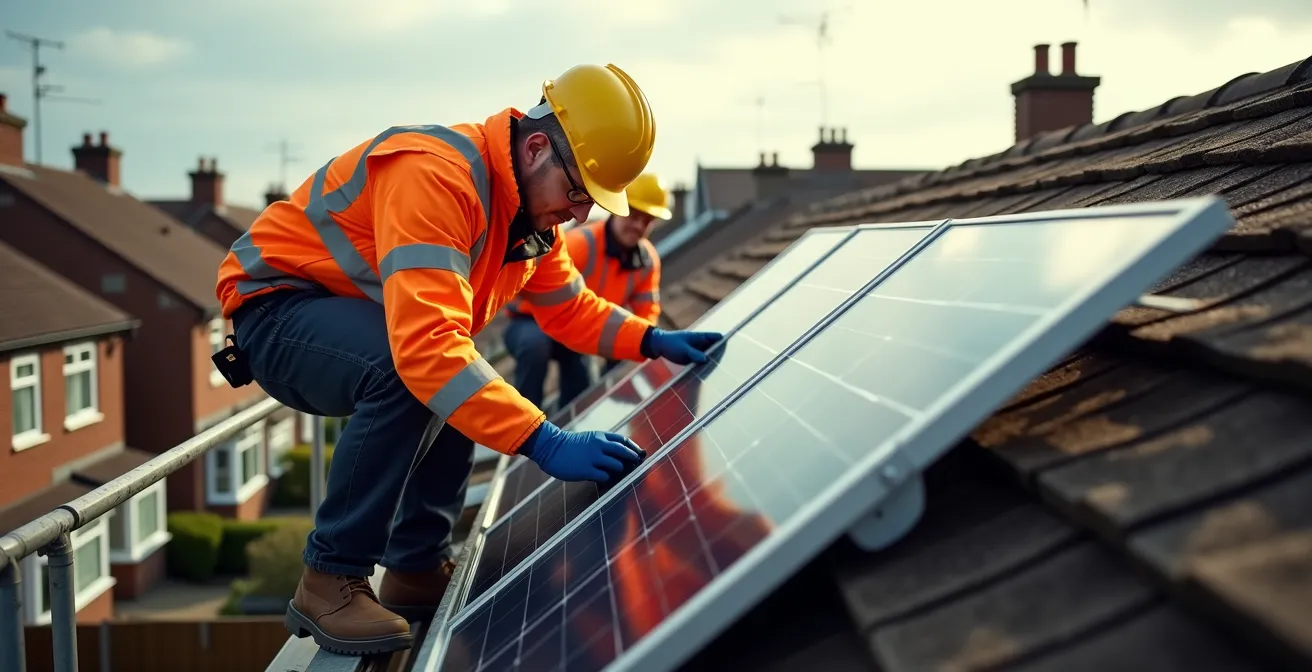
Finally, the post-installation process begins. This includes issuing the MCS (Microgeneration Certification Scheme) certificate, which takes 1-2 weeks, and then using that certificate to register with an energy supplier for your SEG tariff. The creation of an export MPAN (Meter Point Administration Number) can take another 1-4 weeks. Based on this breakdown, the total timeline from contract signature to a fully operational, income-generating asset is typically between 6 and 10 weeks. This waiting period is a crucial factor in calculating the first year’s ROI.
Micro-inverters or Optimizers: Which Choice Handles UK Shade Better?
In the UK’s dense residential landscape, chimneys, neighbouring houses, and trees create partial shading that can cripple the output of a standard solar array. For an investor, choosing the right inverter technology isn’t a technicality—it’s a direct decision about yield protection and ROI maximization. A traditional “string inverter” is the most basic option, but it has a significant financial flaw: if one panel is shaded, the performance of the entire string of panels drops to that low level. This is where Module Level Power Electronics (MLPEs), such as micro-inverters and power optimisers, become a critical investment.
Micro-inverters and power optimisers both work by isolating the performance of each individual panel. If one panel is shaded, the others continue to operate at their maximum potential. This is particularly crucial for complex UK roofs. The key difference lies in their architecture and cost.
The following table, based on a recent comparative analysis, breaks down the financial and performance differences for a UK homeowner.
| Feature | Micro-inverters | Power Optimizers | String Inverters |
|---|---|---|---|
| Shade tolerance | Excellent – each panel independent | Very good – panel-level optimization | Poor – entire string affected |
| UK typical cost premium | £100-150 per panel | £50-80 per panel | Baseline cost |
| Monitoring capability | Individual panel data | Individual panel data | String-level only |
| Warranty period | 20-25 years | 20-25 years | 10-12 years |
| Best for UK scenario | Complex roofs, heavy shading | Partial shading, chimneys | Unshaded south-facing |
From an ROI perspective, the decision is a mathematical one. The upfront premium for optimisers or micro-inverters must be weighed against the projected annual yield loss from shading with a string inverter. For most typical UK properties with any form of partial shading, the additional yield and longer warranty of MLPEs provide a clear and positive impact on the lifetime return of the system.
The Bird Proofing Error That Costs £500 to Fix Later
One of the most overlooked and financially damaging mistakes a new solar panel investor can make in the UK is viewing bird proofing as an optional extra. Pigeons and other birds are notorious for nesting under the warm, sheltered space created by solar panels. This leads to a build-up of corrosive droppings, nesting materials that create fire hazards, and potential damage to the wiring and back of the panels. Fixing this problem retroactively is significantly more expensive than addressing it during the initial installation.
The mathematics are simple and compelling. Adding professional-grade steel mesh around the perimeter of the array during the initial installation is a marginal cost. The scaffolding is already in place, and the installers are on-site. However, if you wait until a pigeon infestation becomes a problem, the cost escalates dramatically. You will need to pay for scaffolding to be erected again, for a pest control or specialist company to clean the area, and then for the proofing to be installed. This turns a minor upfront cost into a significant, unplanned maintenance expense.

The financial impact is clear: according to UK solar maintenance data, adding bird proofing during the initial build costs between £350 and £500. A retrofit installation, by contrast, starts at over £700 and can easily exceed £1,000 once the costs for new scaffolding and cleaning away established nests are included. This £500+ difference is a direct, avoidable loss that negatively impacts your system’s overall ROI. Many homeowners who skip this step find themselves paying double within a few years to solve a problem that was entirely preventable.
How Many Panels Do You Need to Charge an EV and Run a Heat Pump?
Sizing a solar array is a critical financial decision. Undersizing means leaving potential savings on the table, while oversizing can extend the payback period unnecessarily. For homeowners looking to future-proof their investment by powering an electric vehicle (EV) and a heat pump, the calculation moves beyond simply covering current household usage. It requires a forward-looking assessment of your total future electrical load. A standard 4kWp system, often quoted as the UK average, is typically insufficient for a fully electrified home.
The maths starts with your baseline consumption. An average UK home uses around 3,000 kWh per year, which a 4kWp system (around 10-12 panels) can largely cover. However, adding an EV and a heat pump dramatically increases demand. An EV driven for an average of 7,400 miles a year will consume approximately 2,000 kWh. A typical air source heat pump can add another 3,000-4,000 kWh to your annual consumption. To meet this combined load, your solar array needs to be significantly larger.
Based on these figures, you need to plan for a much larger system. To power an EV and heat pump in addition to your home, calculations based on UK average usage show you would need a baseline 4kWp system plus an additional 8 panels for the EV and another 10 for the heat pump. This brings the total system size to approximately 28-30 panels (around 10-11 kWp), space permitting. While this represents a higher upfront investment, it maximises your energy independence and insulates you from future electricity price rises, locking in a lower cost-per-kWh for your heating and transport for decades to come.
Action Plan: Smart Integration for Solar with EV and Heat Pump
- Install a solar diverter (e.g., Myenergi Eddi) to automatically direct surplus generation to your hot water tank, storing thermal energy for free.
- Set up a smart EV charger (e.g., Myenergi Zappi) with an ‘ECO+’ mode to ensure the vehicle charges using only excess solar power, not grid electricity.
- Program your heat pump to run primarily during peak solar generation hours in the shoulder seasons (spring/autumn) to pre-heat the house.
- Utilise a time-of-use grid tariff for winter, charging a battery overnight on cheap rates to power the heat pump during expensive daytime periods when solar is low.
- Regularly monitor your system via its app to analyse energy flows and adjust the charging and heating schedules to maximise self-consumption.
Fixed 15p or Variable Agile Outgoing: Which Export Tariff Pays More?
Once your system is generating surplus electricity, choosing the right Smart Export Guarantee (SEG) tariff is one of the most important active management decisions you will make. It’s the difference between a predictable, modest income and a potentially much higher, albeit more volatile, revenue stream. The choice boils down to two main models: a fixed-rate tariff, typically offering around 15p/kWh, or a variable (or ‘agile’) tariff, where the price you’re paid changes every 30 minutes based on wholesale market rates.
A fixed 15p/kWh tariff offers simplicity and predictability. For every kWh you export, you receive a guaranteed price. This is a low-risk option, ideal for homeowners who prefer a ‘set and forget’ approach and do not have a battery. However, it often leaves money on the table. Variable tariffs, like Octopus Agile Outgoing, pay you the real-time market price. This means that during periods of high national demand (typically 4-7 pm), when wholesale prices can spike, you could be paid significantly more than 15p/kWh for your exported energy.
The financial outcome depends heavily on your ability to control *when* you export. A real-world analysis of Octopus Agile Outgoing vs a fixed 15p/kWh SEG for a 4kWp system showed that the variable tariff earned 18% more annually. The key to this outperformance was a battery storage system, which allowed the homeowner to store their midday solar energy and export it during the lucrative evening peak. However, the analysis also highlighted the risk of “solar cannibalisation” on sunny days, where oversupply can drive midday export prices very low. Without a battery, a fixed rate can sometimes be more profitable in summer, while the variable rate’s ability to capture price spikes offers a clear advantage in winter.
How to Set Up a Community Solar Co-op on Your Local School Roof?
For individuals who lack a suitable roof or the upfront capital, investing in solar energy is still possible through a community energy model. Setting up a solar co-operative on a large, publicly-owned roof like a local school provides a powerful way to deploy capital, generate a return, and benefit the local community. This approach transforms the investment from a personal asset into a shared one, governed by a structured legal and financial framework specific to the UK.
The process requires careful planning and navigation of UK-specific regulations. As outlined by Community Energy England, the foundational step is to establish a legal entity, typically a Community Benefit Society (BenCom). This structure ensures that the project is run for the benefit of the community. From there, the project involves a clear sequence of financial and legal milestones. A critical step is negotiating a Power Purchase Agreement (PPA) with the school and local authority, which sets the price at which the school will buy the electricity generated, creating a stable revenue stream for the co-op.
Community energy projects require navigating specific UK bureaucratic hurdles including negotiating PPAs with schools and local authorities
– Community Energy England, UK Community Solar Implementation Guide 2024
The capital for the installation is raised through a community share offer, where local people can invest, often from as little as £250, in return for a projected annual dividend. This model democratises solar investment, making it accessible to a wider range of people. The typical process follows these key steps:
- Form a Community Benefit Society (BenCom) with guidance from Community Energy England.
- Conduct a feasibility study on the school roof, including a structural survey and shading analysis.
- Create a detailed financial model outlining installation costs, projected returns, and the share offer structure.
- Negotiate and sign a Power Purchase Agreement (PPA) with the school and local authority.
- Launch the community share offer to raise capital from local investors.
- Obtain necessary planning permission and meet Ofgem regulations for commercial generation.
- Install the system and begin distributing annual returns to investors, which typically target a 4-5% return.
Key Takeaways
- The financial viability of UK solar now hinges on “consumption matching” and active asset management, not just peak generation.
- Technical choices like optimisers and preventative measures like bird proofing are not extras; they are critical investments that directly protect your long-term ROI.
- A battery system unlocks the highest returns through “grid arbitrage” and participation in grid services, making it a profitable asset even without solar panels.
Why Is a Battery Storage System Essential Even Without Solar Panels?
The ultimate expression of solar as a financial asset is realised when you decouple the battery from the panels. In the new energy landscape, a home battery system is a powerful investment in its own right, capable of generating significant returns purely through grid arbitrage. This strategy is perfectly suited to the UK’s growing number of time-of-use tariffs, such as Octopus Agile, which offer cheap off-peak electricity overnight and charge high rates during peak demand periods.
The concept is simple: you use the battery as a financial trading tool. You charge it overnight when electricity is cheap (e.g., 7.5p/kWh) and then use that stored energy to power your home during the expensive evening peak (4-7 pm), avoiding grid import at prices that can exceed 35p/kWh. The profit is the price difference. An analysis of Octopus Agile tariff data shows that charging a 10kWh battery at 7.5p overnight and discharging it to avoid a 35p peak rate generates a daily profit of £2.75. Annualised, this arbitrage alone can generate over £1,000, delivering a payback on the battery in 5-7 years, entirely independent of any solar generation.
Furthermore, this asset can generate an additional revenue stream. National Grid’s Demand Flexibility Service pays homeowners to export power back to the grid during high-stress events. Homeowners enrolled in the service can earn £3-6 per kWh exported. A 10kWh battery participating in the 10-12 typical winter events could generate an additional £150-£300 in annual income. This “revenue stacking”—combining arbitrage savings with grid service payments—transforms the battery from a passive backup device into an active, income-generating financial asset. It solidifies the argument that a solar and battery system is not an expense, but an investment with a multi-faceted and compelling ROI that far outstrips a traditional savings account.
To determine the precise ROI for your specific property and consumption patterns, the next logical step is to conduct a detailed financial analysis. This evaluation will model your potential savings, export income, and arbitrage profits to give you a clear comparison against other investment options.
Frequently Asked Questions about Are Solar Panels Still Worth It in the UK Without the Feed-in Tariff?
Who suits a fixed export tariff best?
Homeowners who prefer predictable income, don’t have battery storage, and want ‘set and forget’ simplicity. Ideal for risk-averse users.
When does Agile Outgoing perform best?
With battery storage to export at peak prices (4-7pm), and users comfortable with price volatility and active energy management.
What is solar cannibalisation risk?
As more UK homes install solar, midday export prices on variable tariffs may decrease due to oversupply, particularly in dense neighbourhoods.